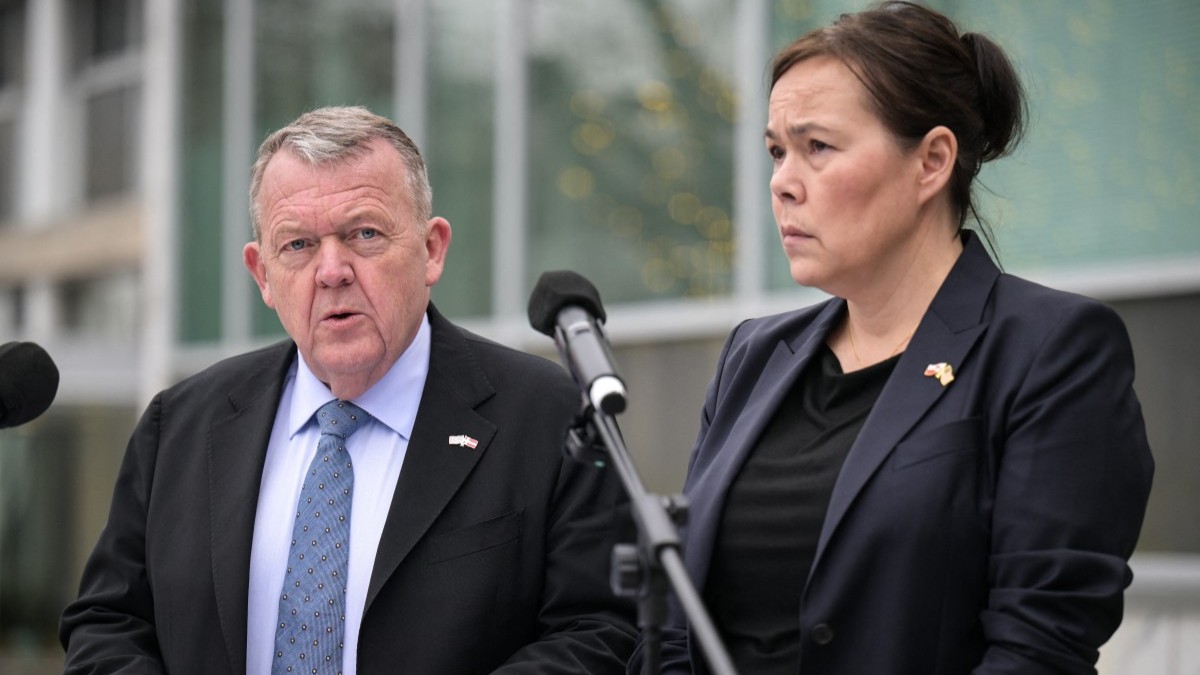
Danish Foreign Minister Lars Løkke Rasmussen and Greenland’s Foreign Minister Vivian Motzfeldt speak during a news conference at the Danish Embassy in Washington, D.C., on January 14, 2026.
Oliver Contreras / AFP
The crisis surrounding Greenland has entered a new phase following the failure of the meeting held this Wednesday, January 14th, in Washington, D.C. between representatives of the United States, Denmark, and Greenland’s autonomous government.
Far from easing tensions, the talks have accelerated a European military response that is beginning to generate internal frictions within NATO, highlighting the growing strategic divergences among allies.
The White House meeting between U.S. Vice President JD Vance, Secretary of State Marco Rubio, and their Danish and Greenlandic counterparts ended without any substantive progress. The parties merely agreed to establish a high-level working group to “explore fundamental disagreements,” a diplomatic euphemism that conceals the current political deadlock.
Washington has left intact the position of President Donald Trump, who has publicly reiterated his intention for Greenland to come under U.S. control, even setting a “starting price” for a hypothetical purchase of the island. For Copenhagen and Nuuk, any scenario that violates Denmark’s territorial integrity or the Greenlandic people’s right to self-determination is simply unacceptable.
The lack of agreement has triggered an immediate reaction in several European capitals. France, Germany, Sweden, and Norway have announced the deployment of troops or officers to Greenland to reinforce the allied presence and coordinate future security missions in the Arctic. Paris has confirmed it will join a European military mission with a small detachment, likely mountain troops, as part of joint exercises with Denmark.
Germany, for its part, has announced a reconnaissance mission between January 15 and 17, formally under NATO auspices, although the political backdrop is unmistakable: Europe is seeking to assert itself in the face of U.S. pressure and to demonstrate its capacity for autonomous action in a strategic region.
Denmark has already mobilized an advanced command to Nuuk and is preparing the deployment of additional personnel, aircraft, and vessels. The intended message is that Greenland is not unprotected. However, this military escalation introduces a destabilizing factor for the Atlantic Alliance, where the main source of tension is no longer Russia or China, but rather the clash of interests among partners.
From Brussels, European Commission President Ursula von der Leyen has reiterated the European Union’s support for Denmark and stressed that Arctic security is a strategic priority.
Some European governments believe that reinforcing the military presence in Greenland could help allay Washington’s security concerns regarding Russia and China. Others fear, however, that this logic merely legitimizes a dangerous precedent: the redefinition of borders and sovereignty within the Western world itself.