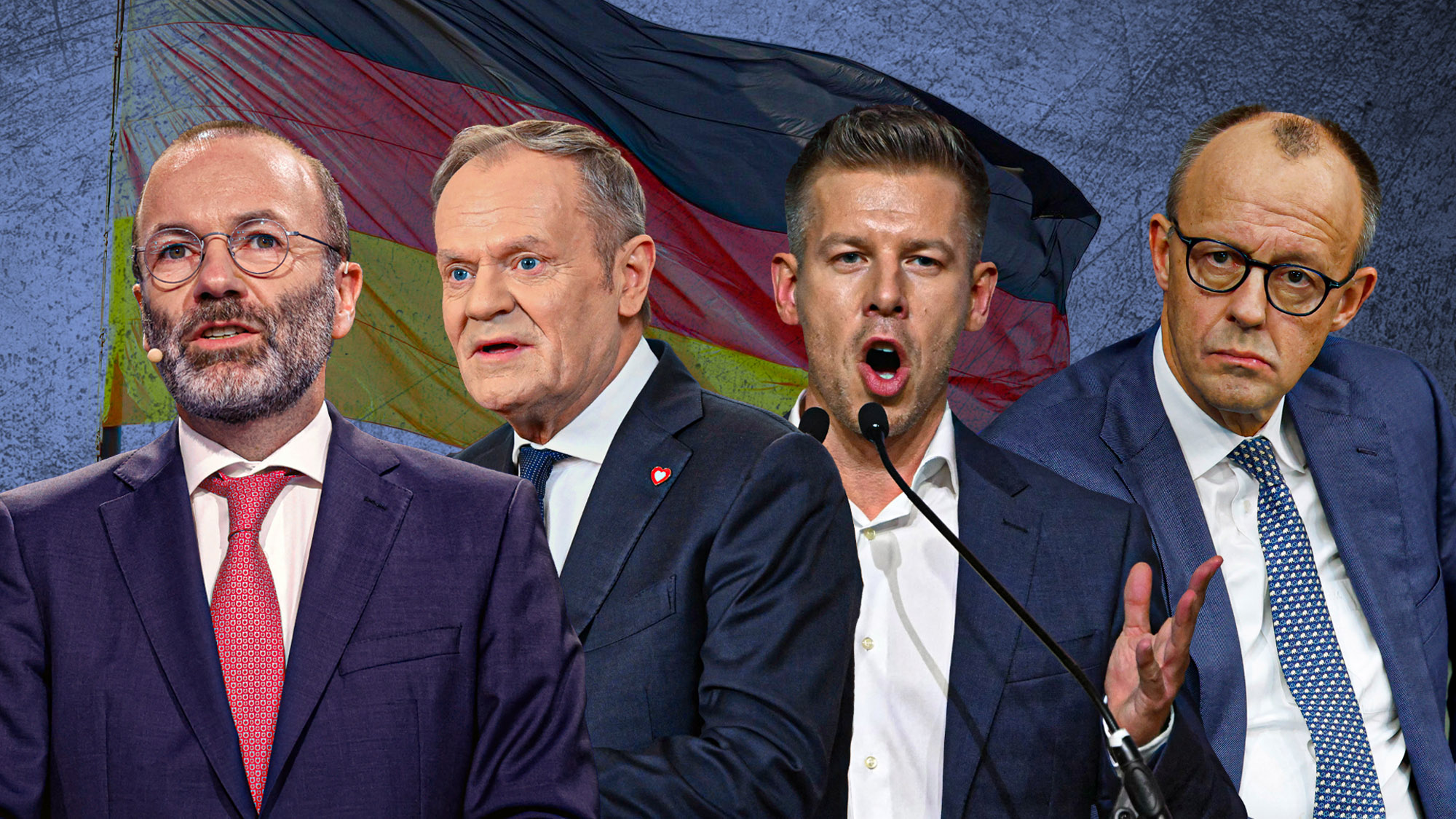
Centre-right and liberal politicians like (from left) EPP leader Manfred Weber, Polish PM Donald Tusk, and (far right) German chancellor Friedrich Merz continue giving Hungarian opposition leader Péter Magyar (second from right) a warm welcome despite his involvement in several scandals.
euconedit
Hungarian opposition leader Péter Magyar is facing a fresh political storm after admitting he was present at a private apartment where what he described as “drug-like substances” were visible, reigniting questions about his personal conduct just weeks before Hungary’s April 12 parliamentary election.
The controversy erupted after a mysterious website, radnaimark.hu, appeared online, displaying a still image of a ransacked bed taken from what appeared to be security camera footage, alongside cryptic captions and a date—August 3, 2024.
Magyar, the leader of the Tisza Party, later confirmed that he had attended a house party at the apartment in the early hours of that morning, following a Tisza Party event, and acknowledged that drugs were present in the flat, though he insisted he did not consume them.
He also admitted that he had consensual sexual relations in the bedroom shown in the image with his former partner, Evelin Vogel, while strongly denying any criminal wrongdoing.
Nevertheless, the admission prompted a criminal complaint for suspected drug possession by public activist István Tényi, filed with the Budapest prosecutor’s office.
Magyar has framed the affair as a politically motivated “kompromat” operation, alleging involvement by government-linked actors and the security services. He claimed the timing was designed to exert psychological pressure on him ahead of his nationwide campaign tour.
The episode has revived memories of earlier scandals that have followed the Tisza Party leader.
In June 2024, he was involved in a late-night altercation at a Budapest nightclub, during which he forcibly took a mobile phone from a man filming him and later threw it into the Danube—an incident that led to a police investigation.
He has also faced repeated allegations of aggressive behaviour towards former partners—Evelin Vogel and his ex-wife, former Justice Minister Judit Varga.
Reacting to the latest developments, Balázs Orbán, political director to Prime Minister Viktor Orbán, launched a sharp attack on social media. He said Magyar, whom he labelled “the Brussels- and Kyiv-backed leader of the Tisza Party,” was now “surrounded by drug-related scandals.”
Private life is private life. However, when someone chooses to place their private life before the entire country in a self-recorded confessional video, citizens are entitled to ask a legitimate question: who is truly capable of representing their interests? The prime minister who stands up for Hungarians even against powerful empires—or someone who visibly struggles with his own demons and a double life? At a time when Brussels and Kyiv are exerting constant pressure on Hungary over war, energy, and sovereignty, the country cannot afford distraction, instability, or weak leadership.
Péter Magyar, the Brussels- and Kyiv-backed leader of the Tisza Party, is now surrounded by drug-related scandals.
— Balázs Orbán (@BalazsOrban_HU) February 13, 2026
This is the left’s candidate for prime minister.
Private life is private life. However, when someone chooses to place their private life before the entire country… pic.twitter.com/PpBvibGm6u
Despite his scandals, Magyar continues to be warmly received by centre-right and liberal political circles. On Friday, February 13th, he is due to meet Polish Prime Minister Donald Tusk in Munich and, on Saturday, hold talks with German Chancellor Friedrich Merz on the sidelines of the Munich Security Conference.
His political allies in Brussels have proven reliable. In October 2025, the European Parliament—dominated by the European People’s Party and its liberal partners—voted to keep Magyar’s parliamentary immunity intact, blocking Hungarian authorities from pursuing multiple legal cases against him.
Critics argue that such protection comes with expectations.
If elected, Magyar could be under intense pressure to align Hungary with Brussels’ policies, particularly on the war in Ukraine. While he has remained vague about his own position, government figures insist the outcome is all but predetermined.
Prime Minister Viktor Orbán has repeatedly argued that Hungary’s national interest lies in staying out of the conflict, rejecting military aid to Kyiv and opposing Ukraine’s fast-tracked EU accession.
According to conservative daily Magyar Nemzet:
Péter Magyar, obedient to all diktats from Brussels, would drag Hungary into the camp of the warmongers.