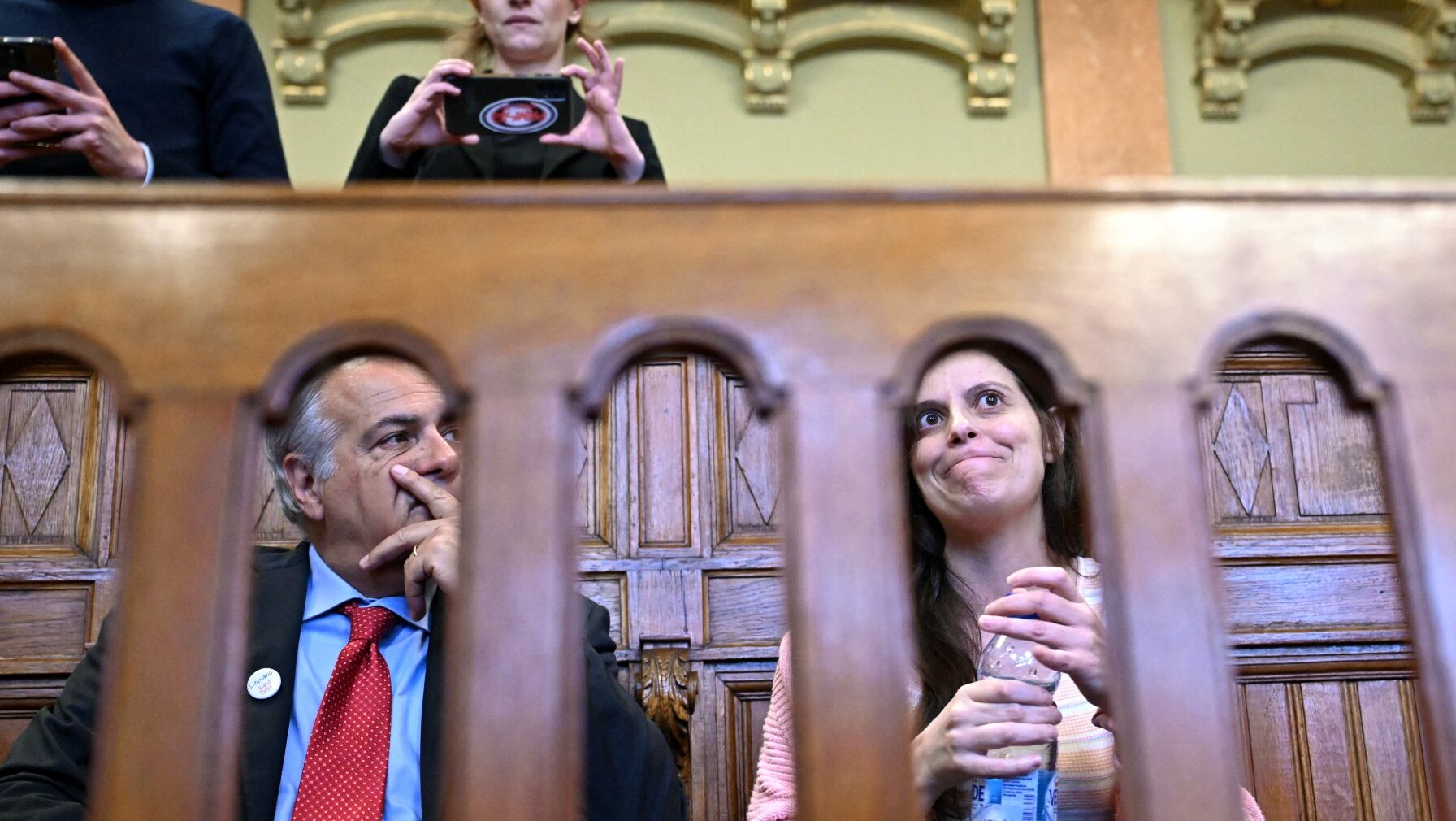
Ilaria Salis sits next to her father Roberto Salis at a court in Budapest on May 24, 2024 prior to her trial for brutal attacks on alleged.
ATTILA KISBENEDEK / AFP
Italian MEP Ilaria Salis has once again found herself at the centre of European controversy after claiming that she and her parliamentary assistant were subjected to a police check at a hotel in Rome just hours before taking part in the “No Kings” demonstration on 28 March. The two were in the same hotel room, and the policemen did not actually enter the room, reports say—this has significance as the Left is now accusing law enforcement of violating Salis’ immunity.
According to various reports published in Italy, the operation stemmed from an alert entered by Germany into the Schengen system regarding the assistant, Ivan Bonnin, and led to questioning about Salis’s movements, the people accompanying her, and her intention to attend the protest.
The episode has once again brought back to the surface a controversy that had partially subsided after her election to the European Parliament. Because Salis is not a conventional MEP. For the past two years, her name has been linked to one of the most controversial political and judicial cases in the European Union, at the intersection of political violence, parliamentary immunity, and the growing clash between conservative governments and radical left-wing movements.
Ilaria Salis, 39, was already known in Italy for her anti-fascist activism long before entering institutional politics. For years, she moved in radical left-wing circles linked to student mobilisations and street protests.
Her international notoriety began in February 2023, when she was arrested in Budapest, accused of taking part in a series of attacks against three people identified by Hungarian prosecutors as far-right sympathisers.
The events took place during an annual gathering in Budapest that brings together radical right-wingdescribed by some as ‘neo-Nazi’—groups from across Europe. According to the prosecution, a small group of masked ‘anti-fascist’ activists followed and attacked several participants in the event. The members of the group surrounded and bludgeoned nine innocent people—who the attackers decided “looked like” neo-Nazis based on their choice of clothing—with telescopic batons and hammers on the streets of Budapest.
Salis was accused of having participated in the organisation and execution of those attacks as part of a violent transnational network linked to radical ‘anti-fascist’ circles. Prosecutors argued that the operation had been planned and could be framed as part of an organised structure; she has always denied it.
The case took on an international dimension months later, when images began to circulate of Salis entering court in handcuffs, shackled at the ankles and connected by a chain to several officers.
The controversy grew even further in 2024, when the Italian Greens and Left Alliance decided to place her on their lists for the European elections. The decision was interpreted in two completely different ways. For the Italian Left, it was about protecting an activist they considered politically persecuted. For many observers, however, the candidacy also had the purpose of using European parliamentary immunity to halt or complicate the judicial proceedings opened against her.
The strategy worked. Salis was elected as an MEP in June 2024 and, a few weeks later, was able to leave Hungary and return to Italy. Since then, she has turned her case into a political banner. In her public interventions, she frequently accuses European conservative governments of fostering an authoritarian drift and has been particularly harsh towards Hungary, Italy, and other right-wing administrations which, in her view, use the language of security or national sovereignty to restrict freedoms.
The Rome episode has once again brought that past back into focus. Information published by the Italian press indicates that the police check affected not only her but also her companion and parliamentary assistant, Ivan Bonnin. Bonnin is not an unknown figure in certain Italian political circles. For years, he was involved in student movements, and in 2015, he was convicted of offences related to clashes and public disorder during university protests in Bologna. This did not prevent Salis from employing him—a person with a criminal record.
Various Italian media outlets suggest that Bonnin may not only be a political collaborator but also her partner, which could raise questions about his hiring as a parliamentary assistant using European public funds. There has so far been no official decision on the matter, but the debate has already reached Italian politics and does not appear likely to disappear any time soon.