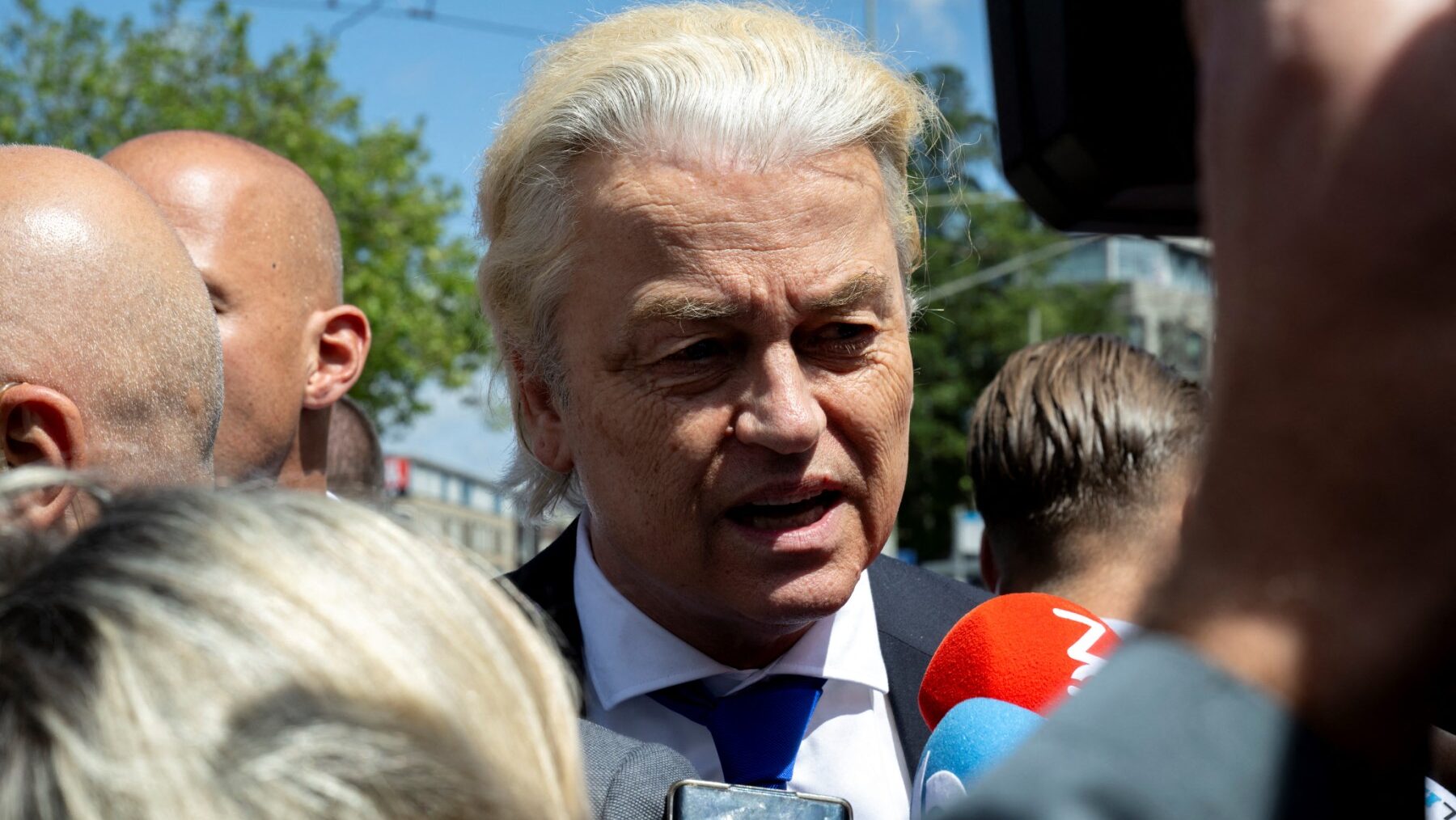
Netherlands’ PVV Freedom Party leader Geert Wilders talks to the press while campaigning at The Hague market near Hobbemaplein on June 5, 2024 ahead of the European Parliament election.
Nick Gammon / AFP
The Netherlands will hold general elections tomorrow that, according to the latest polls, could alter the political balance of the country without changing the underlying trend: the right continues to set the agenda, and Geert Wilders remains the favourite, though still isolated.
According to the Ipsos-I&O poll published by Europe Elects, Wilders’s Party for Freedom (PVV) leads voting intentions with 17% (–2), followed by the left-wing GroenLinks-PvdA alliance at 15% (+1) and the progressive liberals of D66 (14%, +2). They are followed by the CDA (13%, –3), the VVD (10%, +1), and JA21 (8%), which aims to capture the vote of the moderate right disillusioned with the establishment. None of these parties clearly surpasses the threshold for forming a stable majority, foreshadowing an extremely fragmented parliament and a long, complex coalition negotiation.
Netherlands, Ipsos-I&O poll:
— Europe Elects (@EuropeElects) October 25, 2025
PVV-PfE: 17% (-2)
GL/PvdA-G/EFA|S&D: 15% (+1)
D66-RE: 14% (+2)
CDA-EPP: 13% (-3)
VVD-RE: 10% (+1)
JA21~ECR: 8%
FvD-ESN: 4% (+1)
PvdD-LEFT: 3%
SP-LEFT: 3%
BBB-EPP: 3%
SGP-ECR: 3% (+1)
DENK-*: 2%
CU-EPP: 2%
Volt-G/EFA: 2%
50PLUS-RE: 1% (-1)
NSC-EPP: 1%… pic.twitter.com/jqmpeaeW2V
Among voters aged 18 to 34, the same survey shows a significant generational divide: GL/PvdA (18%) and D66 (18%) share the lead, while PVV drops to 14%, followed by CDA (9%) and JA21 (7%). The data confirm that Wilders’s message—focused on immigration and the defence of national identity—retains strength among middle-aged and rural voters but encounters more resistance among the urban and younger electorate.
Netherlands, Ipsos-I&O poll:
— Europe Elects (@EuropeElects) October 27, 2025
Voters aged 18-34 years old
Demographic vote national parliament election
GL/PvdA (Greens/EFA|S&D): 18%
D66 (RE): 18%
PVV (PfE): 14%
CDA (EPP): 9%
JA21 (~ECR): 7%
VVD (RE): 6%
DENK (*): 5%
PvdD (LEFT): 5%
SP (LEFT): 3%
FvD (ESN): 3%
SGP (ECR): 3%… pic.twitter.com/nKoA8nNChZ
Aware of this scenario, the left- and centre-leaning parties have softened their tone in search of transversal alliances. The GroenLinks-PvdA coalition, led by Frans Timmermans, seeks to present itself as a point of balance between the defence of social welfare and fiscal responsibility, adopting a more pragmatic tone than in previous campaigns but maintaining the same green radicalism. Its strategy is to attract centrist voters who reject the cultural radicalism of the postmodern left but also the assertive nationalism of Wilders.
Nevertheless, it is immigration—more than climate or the green economy—that has dominated the final stretch of the campaign. The Dutch asylum system remains overwhelmed, and many municipalities refuse to open new reception centres. Wilders has capitalised on this discontent with his slogan “This Is Your Country!,” summarising his promise to close the borders, suspend the right to asylum, and “give control back” to Dutch citizens. Although he has withdrawn earlier proposals such as banning the Quran or closing mosques, he still maintains that Islam represents a threat to European culture.
Traditional parties are trying to counter that message by appealing to consensus. Timmermans insists that “one cannot govern from resentment,” while the liberals of the VVD seek to recover disenchanted urban voters, and the Christian Democrats of the CDA struggle to stop their steady decline. However, all parties—from left to centre—have reiterated their veto on any coalition with Wilders. The same dynamic can be observed in France, Austria, and Spain.
Beyond the percentages, these elections confirm a change of cycle. The Left is trying to reconnect with the ordinary voter, but it is doing so on the terrain the Right has been defining for years: immigration, security, and national sovereignty. The question is not so much whether Wilders will win—the polls already assume he will—but whether the other parties will be able to continue governing against a growing part of society that no longer feels represented by the liberal-progressive consensus.