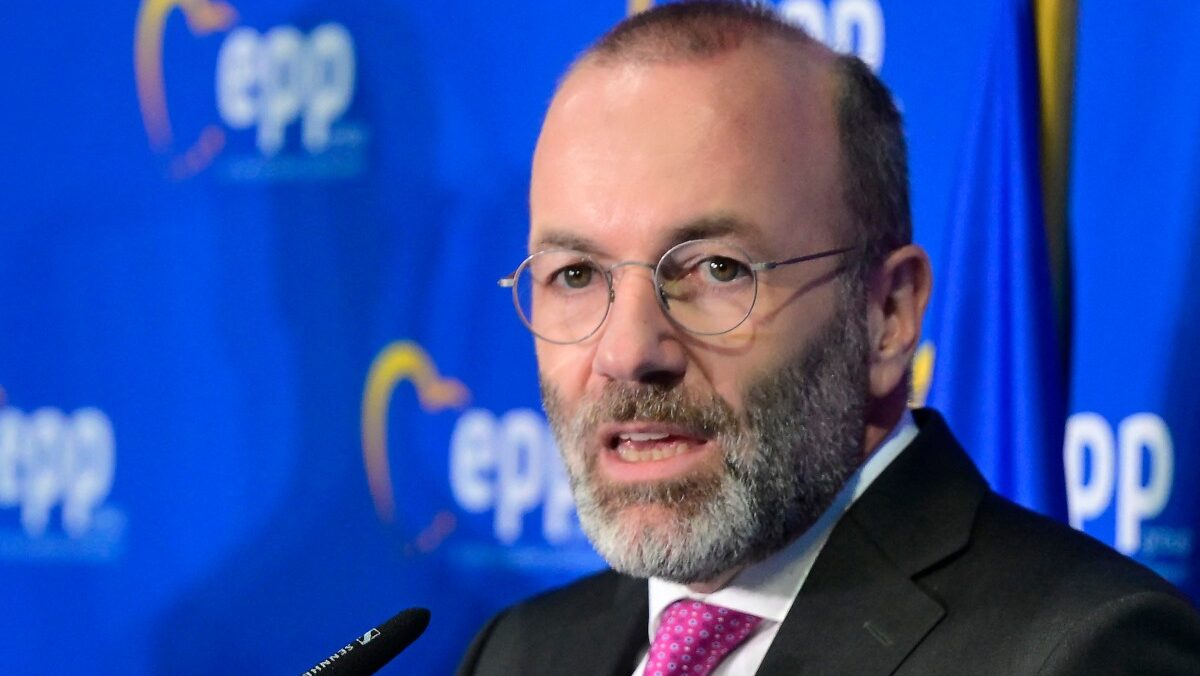
President of the European People’s Party (EPP) Manfred Weber addresses a press conference during the EPP congress in Valencia on April 29, 2025.
José Jordan / AFP
Manfred Weber, president of the European People’s Party and leader of the largest political group in the European Parliament, is once again taking advantage of the international context to promote what he has always defended at its core: a project of the United States of Europe, with Brussels as the single command center. This time, the chosen argument is Europe’s supposed weakness against the United States and, in particular, against President Donald Trump.
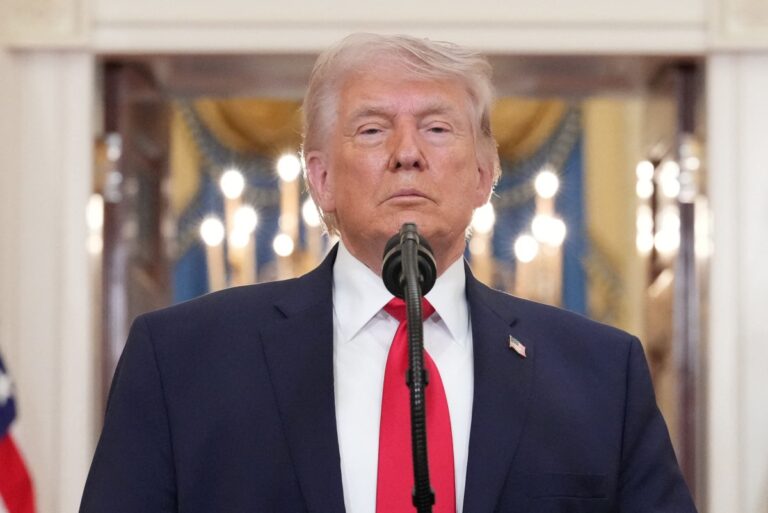
According to Weber, Washington uses its military strength to condition trade exchanges with the European Union. In an interview on German public television, Weber insisted that while the United States has the capacity to pressure Brussels through force, the EU appears unarmed, dependent, and divided. However, behind this rhetoric of alarm lies his usual message: the need for a more centralized Europe, where defense and foreign policy decisions are transferred to the community institutions.
Weber does not hide his vision. He accuses Central and Eastern European countries—Poland, Romania, the Balkans—of living in fear of Russia and relying exclusively on the American military umbrella. He uses this situation to justify the demand for a supranational response. “We are naked in the middle of the storm,” he declared, dramatizing the Union’s inability to defend itself even against drones. With this, he once again puts the idea of a European army on the table, a recurring theme in his rhetoric aligned with the communication strategy of his parliamentary group.
On trade, Weber reproaches the European Commission—run by his own party colleague Ursula von der Leyen—for its weakness during the negotiations with Trump. He criticizes, for example, that Brussels gave up on imposing a digital tax on American tech giants. Simultaneously, he admits this “surrender” was inevitable as long as the EU depends on Washington’s military protection. Again, the solution he suggests is not so much strengthening the sovereignty of the member states but concentrating competencies in Brussels, providing the Union with centralized military and political power.
To reinforce his argument, Weber evoked Kohl and Mitterrand—historical figures of European integration who pushed for the single currency—to reinforce his argument. In his opinion, if leaders with that kind of “visionary courage” existed today, they would already be paving the way for a European army. That is, it is not about cooperation between member states but about replacing national sovereignties with a common command. His direct reference to German Chancellor Friedrich Merz and French President Emmanuel Macron was aimed precisely at demanding such a political leap from them.
That Weber himself is pushing this narrative is no coincidence. As president of the European People’s Party, he needs to uphold the discourse of ‘more Europe’ in order to justify his group’s relevance on the EU political stage.
In the last State of the Union debate, Weber had already made this script clear. Every international crisis—whether commercial, military, or technological—serves as a pretext to insist that the member states are too small to respond on their own and must therefore cede even more power to the EU’s central core. What is sold as collective defense and “historical vision” is, ultimately, a revival of the old dream of the United States of Europe, with a centralized apparatus in Brussels and control increasingly distant from national parliaments.