Ferenc ISZA / AFP
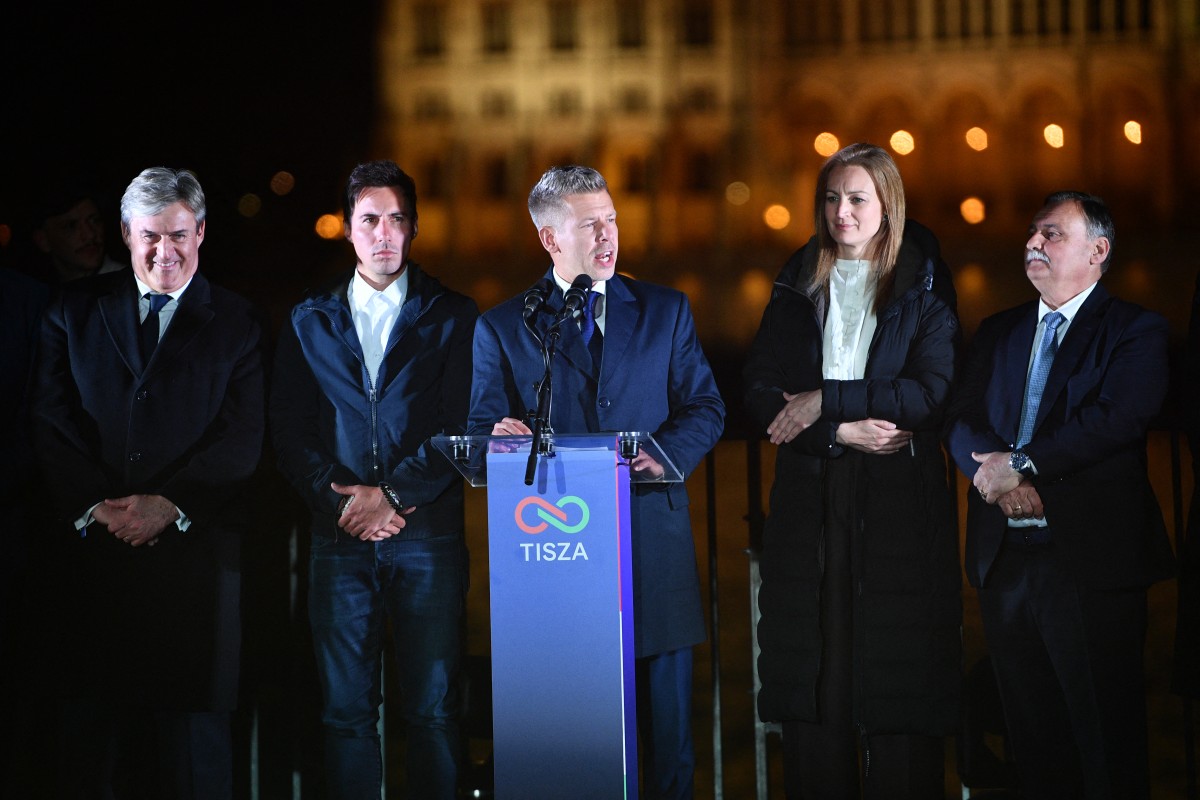
Péter Magyar, the leader of Hungary’s liberal-centrist Tisza Party, has declared a sweeping political overhaul after securing a two-thirds parliamentary majority in Sunday’s election, raising concerns about potential constitutional changes and the risk of a purge of key state institutions.
The result of the Hungarian parliamentary election ends sixteen years of rule by Prime Minister Viktor Orbán and his conservative Fidesz party.
In a triumphant speech on Sunday night, 45-year-old Péter Magyar, a former low-level Fidesz official and the former husband of ex-Justice Minister Judit Varga, hinted at some of the sweeping changes his new government would be making—many of which seem like a reversal of conservative policies and the surrender of national sovereignty.
For instance, Magyar said: “Our homeland has decided and wants to live again. It wants to become a European country again,” adding that Hungary should be a place “where no one is stigmatised for loving someone differently than the majority.”
The remarks can be interpreted as a signal that his government may seek to roll back conservative legislation on banning LGBT propaganda in school education, and potentially revisit constitutional definitions of marriage introduced under Viktor Orbán.
According to the Hungarian constitution,
Hungary shall protect the institution of marriage as the union of one man and one woman established by voluntary decision, and the family as the basis of the survival of the nation. Family ties shall be based on marriage or the relationship between parents and children. The mother shall be a woman, the father shall be a man.
At the same time, Magyar pledged to create a country “where it is possible to calmly have children and start a family,” a strange statement to say the least—the outgoing government has already introduced extensive pro-family policies, including tax relief for mothers and subsidised housing loans.
More controversially, the incoming prime minister called on several senior officeholders—including the president of the republic, the chief prosecutor, the head of the State Audit Office, and the president of the media authority—to step down. He also warned that “from now on, we will not be a country without consequences. Those who have robbed the country must be held accountable,” vowing accountability for past governance.
Such rhetoric risks paving the way for a politically motivated purge of state institutions—developments similar to those in Poland under Donald Tusk, who is threatening, prosecuting, and imprisoning his conservative political rivals.
Magyar also made clear that Hungary would adopt a markedly different foreign policy stance, declaring that “Hungary will once again be a strong ally in the European Union and NATO.” This suggests a shift away from Orbán’s often confrontational approach in Brussels, where Hungary has frequently vetoed joint decisions in defence of national interests.
Outlining his diplomatic priorities, Magyar said his first trips would be to Warsaw and Vienna—to meet his liberal political allies—as well as Brussels, with the aim of restoring relations and unlocking billions of euros in frozen EU funds.
Once again, there is a clear similarity to Poland, where the previous conservative government was denied EU funds under so-called “rule of law violations,” but the money was released without any legal reforms as soon as Europhile Donald Tusk came to power. The simple fact that Magyar will be politically aligned with the EU mainstream will almost certainly guarantee Hungary the EU funds.
While Magyar’s allies in Europe, particularly within the European People’s Party, are expected to welcome the change in Budapest, the concentration of power in a two-thirds majority—combined with calls to remove key institutional figures—raises serious questions about checks and balances in Hungary’s next political chapter.
According to conservative think tank MCC Brussels’ post-election statement:
It is clear, not just from the ecstatic mood among EU elites but also from Magyar’s signature campaign promises—such as the unfreezing of EU funds and the expansion of the European Public Prosecutor’s Office—that Magyar plans to significantly accommodate to the diktats of Brussels. Magyar will have a difficult time protecting Hungary’s sovereignty, borders and culture whilst allowing Brussels to stamp its mark on the country.