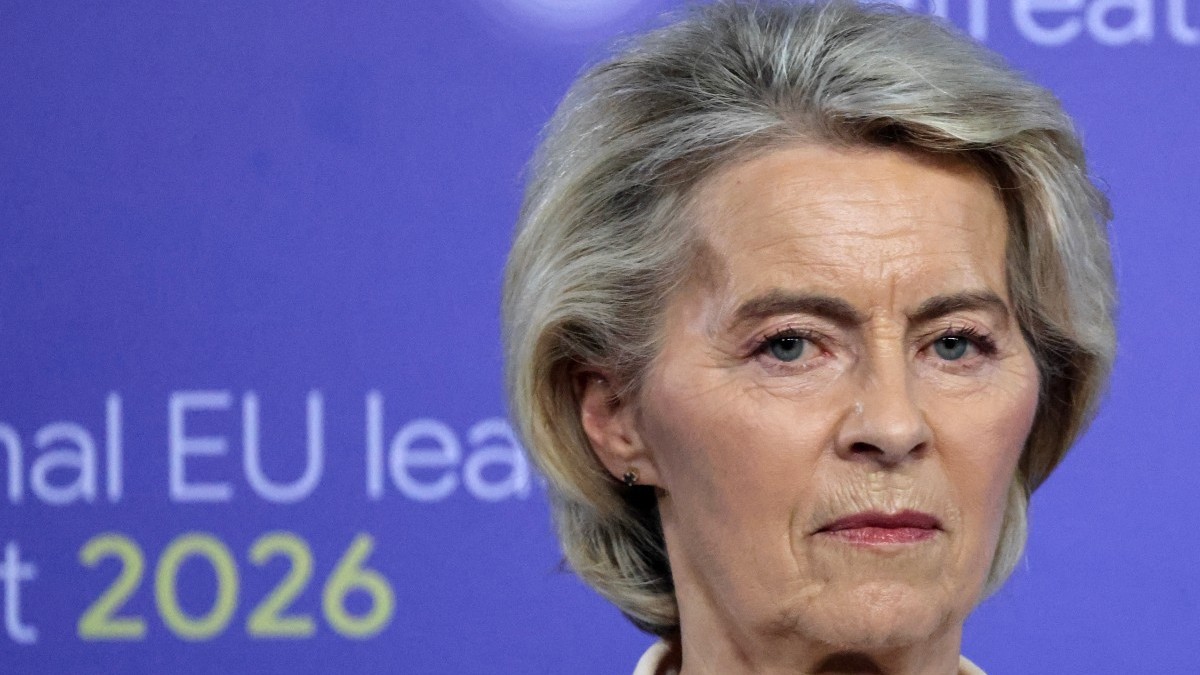
European Commission President Ursula von der Leyen speaks during a press conference at the end of the Informal EU Leaders’ Retreat at the Alden Biesen Castle, in Rijkhoven on February 12, 2026.
LUDOVIC MARIN / AFP
Alden Biesen Castle, in the Belgian town of Bilzen, hosted on February 12th one of those informal European Council retreats that serve, above all, to acknowledge the obvious: Europe has lost momentum and needs to react.
Far from the usual Brussels liturgy, heads of state and government debated for hours how to prevent the Union from continuing to fall behind the United States and China.
The official objective was to “exchange views” without the pressure of adopting formal conclusions. António Costa summed it up in diplomatic language: the meeting sought to strengthen economic growth and prepare decisions for March. Translated into real political terms: buy time, measure positions, and try to build a minimum common denominator before taking on concrete commitments.
The central focus was regulatory simplification. After years of expanding the regulatory perimeter in energy, climate, finance, industry—there is now a growing consensus that the accumulation of rules is weighing down companies and the self-employed.
Commission President Ursula von der Leyen defended an “ambitious simplification agenda” and announced new initiatives to cut red tape.
The very fact that the Commission speaks of reducing bureaucracy is, in itself, an implicit admission: the model has ended up suffocating part of the dynamism it sought to organize. The “One Europe, One Market” roadmap and the so-called “28th regime” aim to facilitate cross-border operations, but they come after years in which economic integration has coexisted with increasing regulatory fragmentation.
Emmanuel Macron urged the adoption of “very concrete” decisions before June, while German Chancellor Friedrich Merz called for a Union that is “faster and more effective.” Both agreed on accelerating the capital markets union. The diagnosis is therefore shared; the question is whether the treatment will be sufficient.
The energy debate was one of the most sensitive points. Leaders acknowledged that high energy prices continue to weaken European industrial competitiveness. However, what was presented as “imbalances” has clear political causes.
The accelerated break with Russian gas, the turn toward liquefied natural gas—largely from the United States—and an energy transition designed with suicidal timelines have created a cost structure that penalizes European industry compared to its competitors. The United States protects its production with cheap energy; China combines subsidies and strategic control. Europe, by contrast, pays more to produce. And, moreover, seems proud of it. The exceptions are Hungary and Slovakia, unwilling to fully decouple from Russian fossil fuels. This much-attacked stance, coupled with significant government subsidies as part of the utility prices reduction program Budapest maintains (also under fire from Brussels), results in Hungary boasting the lowest household gas (and electricity) prices in Europe.

In Alden Biesen there was talk of diversification and efficiency. What was not heard was a critical review of the course adopted in recent years. Reorganize, yes; rectify, no.
In this context, the debate over “Made in Europe” resurfaced: prioritizing European companies in strategic sectors. António Costa spoke of a “broad agreement” to explore this avenue in a specific and proportional manner. France is pushing; Germany and the northern countries fear protectionism that could fracture the single market. Or perhaps their balance sheets.
The discussion reflects how Europe wants to protect its industry without admitting that openness without reciprocity has generated vulnerabilities. Strategic autonomy is no longer a slogan; it is a necessity. Yet its implementation clashes with years of commercial orthodoxy and political interests.
At the same time, the proposal for new eurobonds reappeared. Macron once again defended joint debt to finance strategic investments but Germany and other partners remain cautious.
With growing ease, the idea of moving forward without everyone is being raised. Costa and von der Leyen insisted on prioritizing consensus among the Twenty-Seven but did not rule out enhanced cooperation if unanimity proves impossible. A multi-speed Europe, once considered an anomaly, is beginning to be accepted as a practical tool.
In this new map of alliances, the meeting of a select few ahead of the larger gathering, driven by Merz alongside Giorgia Meloni and Bart de Wever, was no minor detail. Around twenty leaders coordinated positions before the formal retreat, with Pedro Sánchez conspicuously absent.