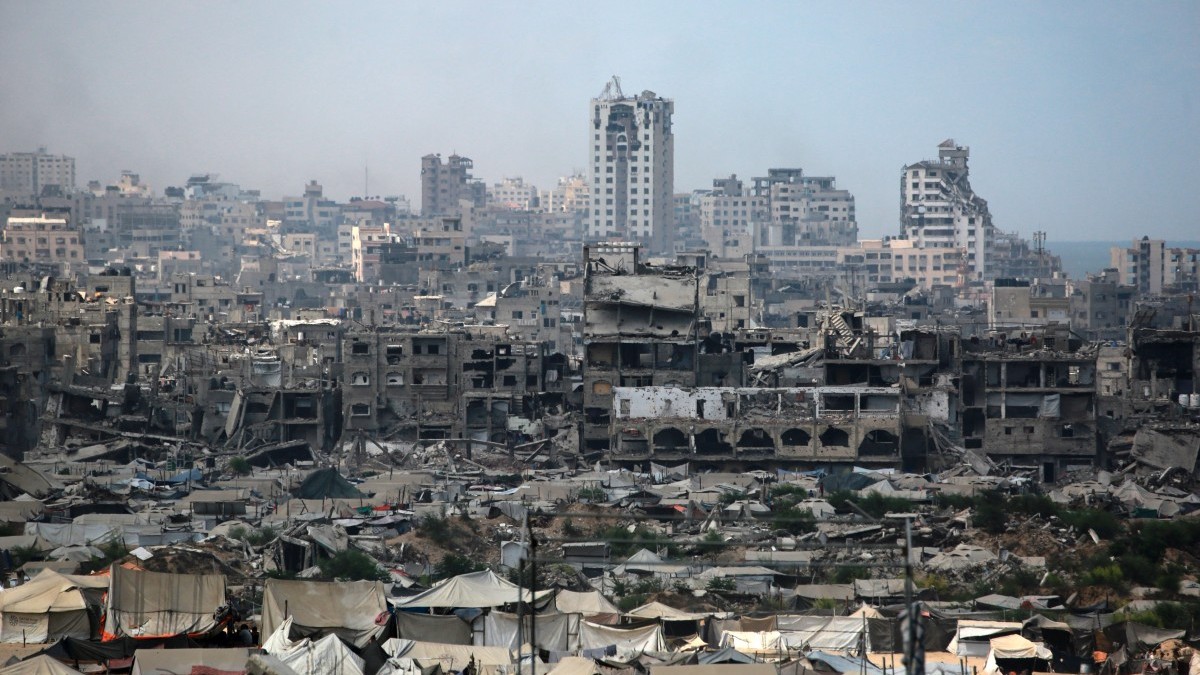
War-damaged buildings in Gaza City on August 8, 2025
Bashar Taleb / AFP
Israel’s security cabinet has approved Prime Minister Benjamin Netanyahu’s plan for the army to take military control of Gaza City, as part of the ongoing offensive against Hamas launched after the October 7, 2023, attack on Israel.
The decision of the security cabinet, announced in the early hours of Friday, comes barely a week after the Knesset endorsed—in a non-binding vote—the annexation of the West Bank (Judea and Samaria), reflecting a hardening of the government’s territorial strategy.
In an interview with U.S. network Fox News, Netanyahu confirmed that Israel “intends” to occupy the coastal enclave, although he insisted that it does not plan to administer it permanently. “We do not want to keep Gaza or govern it. We want to establish a security perimeter and hand over administration to Arab forces that will not threaten us and will provide a decent life for their inhabitants. That is not possible with Hamas,” he stated.
The plan approved by the cabinet sets out five principles for ending the war: the disarmament of Hamas, the release of all hostages—both living and dead—the demilitarisation of the Gaza City, Israeli security control, and the creation of an alternative civilian administration, distinct from both Hamas and the Palestinian Authority. According to the official statement, any proposal that does not include these points “will neither bring about the defeat of Hamas nor the recovery of the hostages.”
Israeli military sources confirmed months ago that one of the vital objectives for Israel’s security is to establish direct relations with each region or city-state, beyond the Palestinian Authority or terrorist groups. In this regard, Jerusalem does not oppose Palestinian administration of certain territories, provided it does not pose a threat.
Currently, the Israel Defense Forces control or conduct ground operations in approximately 75% of the Strip, with airstrikes carried out throughout the territory. According to NBC, recent satellite images show a buildup of troops and equipment on the border, suggesting an imminent large-scale ground offensive on Gaza City. However, analysts point out that it could also be a negotiating pressure tactic.
The decision has triggered internal tensions in Israel. Local media have reported disagreements between the government and Chief of Staff Eyal Zamir, who opposes a full occupation. The families of hostages—of the 251 kidnapped in 2023, 49 remain in Hamas custody, 27 of them presumed dead—fear that an escalation of the war could endanger their loved ones and are demanding an agreement that prioritises their release.
Israel’s decision to move towards a complete occupation has also intensified political tensions in Brussels, where the European response remains deeply divided.
The European Commission has already proposed the partial exclusion of Israel from the Horizon Europe scientific programme, after the EU’s External Action Service concluded that it may be violating Article 2 of the EU-Israel Association Agreement, in force since 2000, which obliges respect for human rights. However, the proposal has not gained the necessary backing: a qualified majority of at least 15 member states representing 65% of the EU’s population is required— a threshold made harder to reach by countries such as Germany, which remain opposed to direct sanctions.