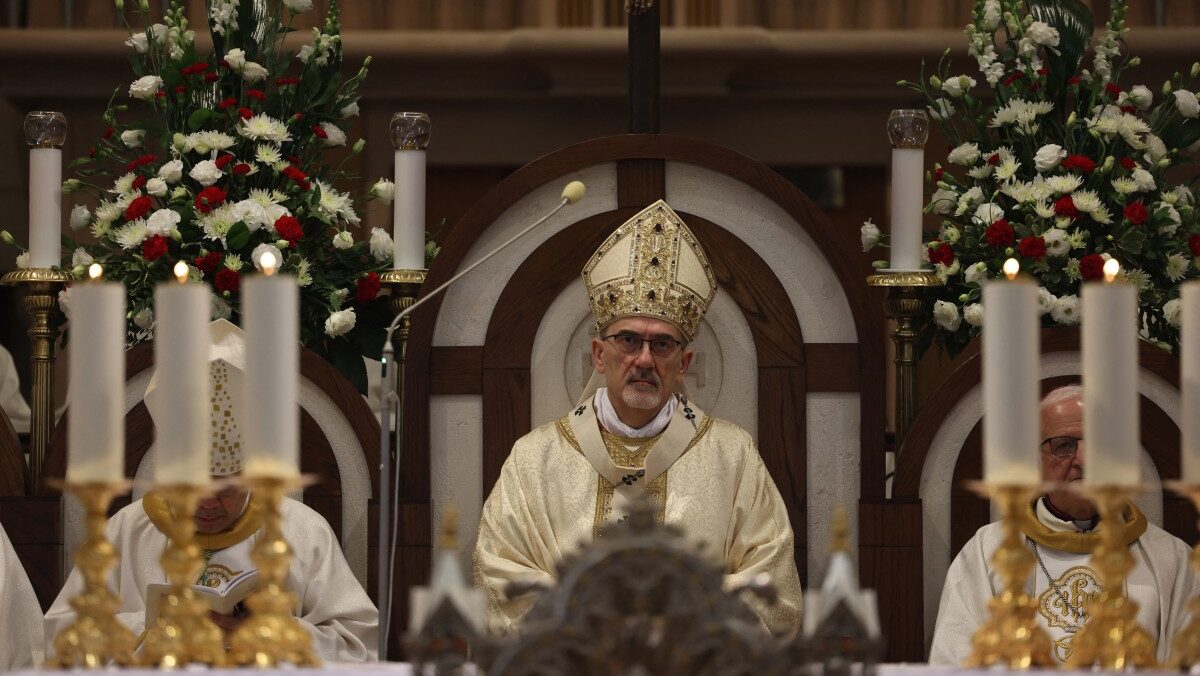
Latin Patriarch of Jerusalem Italian Pierbattista Pizzaballa leads a Christmas mass at the Church of the Nativity in Bethlehem, in the West Bank, on December 25, 2025.
HAZEM BADER / AFP
Israeli police stopped the Latin Patriarch of Jerusalem, Cardinal Pierbattista Pizzaballa, from entering the Church of the Holy Sepulchre on Palm Sunday, blocking him and another senior church leader from celebrating Mass at Christianity’s holiest site.
According to the Latin Patriarchate, Pizzaballa and the Custos of the Holy Land, Fr. Francesco Ielpo, were trying to enter quietly—no procession, no crowds—just the two top Catholic figures in the region on their way to lead the liturgy but were turned back by police.
The Patriarchate said that, for the first time in centuries, the Church’s senior leadership in the Holy Land was unable to celebrate Palm Sunday at the site traditionally associated with Christ’s crucifixion and resurrection.
“This incident is a grave precedent and disregards the sensibilities of billions of people around the world, who during this week, look to Jerusalem,” the Patriarchate said in a statement:
Preventing the entry of the Cardinal and the Custos, who bear the highest ecclesiastical responsibility for the Catholic Church and the Holy Places, constitutes a manifestly unreasonable and grossly disproportionate measure.
Palm Sunday marks the start of Holy Week, commemorating Jesus’ entry into Jerusalem. This year, Israeli authorities have imposed sweeping limits on public gatherings following the outbreak of war with Iran on February 28. Religious services across the country have been tightly restricted, with attendance capped at around 50 people.
Israeli police said the decision was part of broader security measures, noting that holy sites in Jerusalem remain closed and that the Old City’s narrow streets would make it difficult for emergency services to respond in the event of a major incident. They added that the Patriarch’s request had been reviewed and denied the day before.
The Church had already cancelled the traditional Palm Sunday procession from the Mount of Olives, which usually draws large crowds. Officials said they had complied with all restrictions since the war began, accusing authorities of acting hastily and undermining long-standing arrangements governing access to holy sites.
The decision was denounced by both French and Italian leaders. President of the French Republic Emmanuel Macron condemned the “decision by the Israeli police, which adds to the alarming proliferation of violations of the status quo of Jerusalem’s Holy Sites,” adding, “The free exercise of worship in Jerusalem must be guaranteed for all religions.”
J’apporte mon plein soutien au patriarche latin de Jérusalem et aux chrétiens de Terre Sainte, empêchés de célébrer la messe des Rameaux au Saint-Sépulcre.
— Emmanuel Macron (@EmmanuelMacron) March 29, 2026
Je condamne cette décision de la police israélienne, qui s’ajoute à la multiplication préoccupante des violations…
Prime Minister Giorgia Meloni of Italy also criticized the action, saying the incident was “an offense not only to the faithful but to any community that respects religious freedom,” while Italian Foreign Minister Antonio Tajani summoned Israel’s ambassador in Rome.
At the Vatican on Sunday, Pope Leo XIV paid tribute to “the Christians of the Middle East, who suffer the consequences of a terrible conflict and in many cases cannot fully live the rites of these holy days.”
According to 2023 estimates from the Latin Patriarchate of Jerusalem, Christians made up more than 18% of the population in the Holy Land—defined to include Jordan as well as Israel and the Palestinian territories—around the time the State of Israel was established in 1948. Today, they account for less than 2%, the majority of them Orthodox.