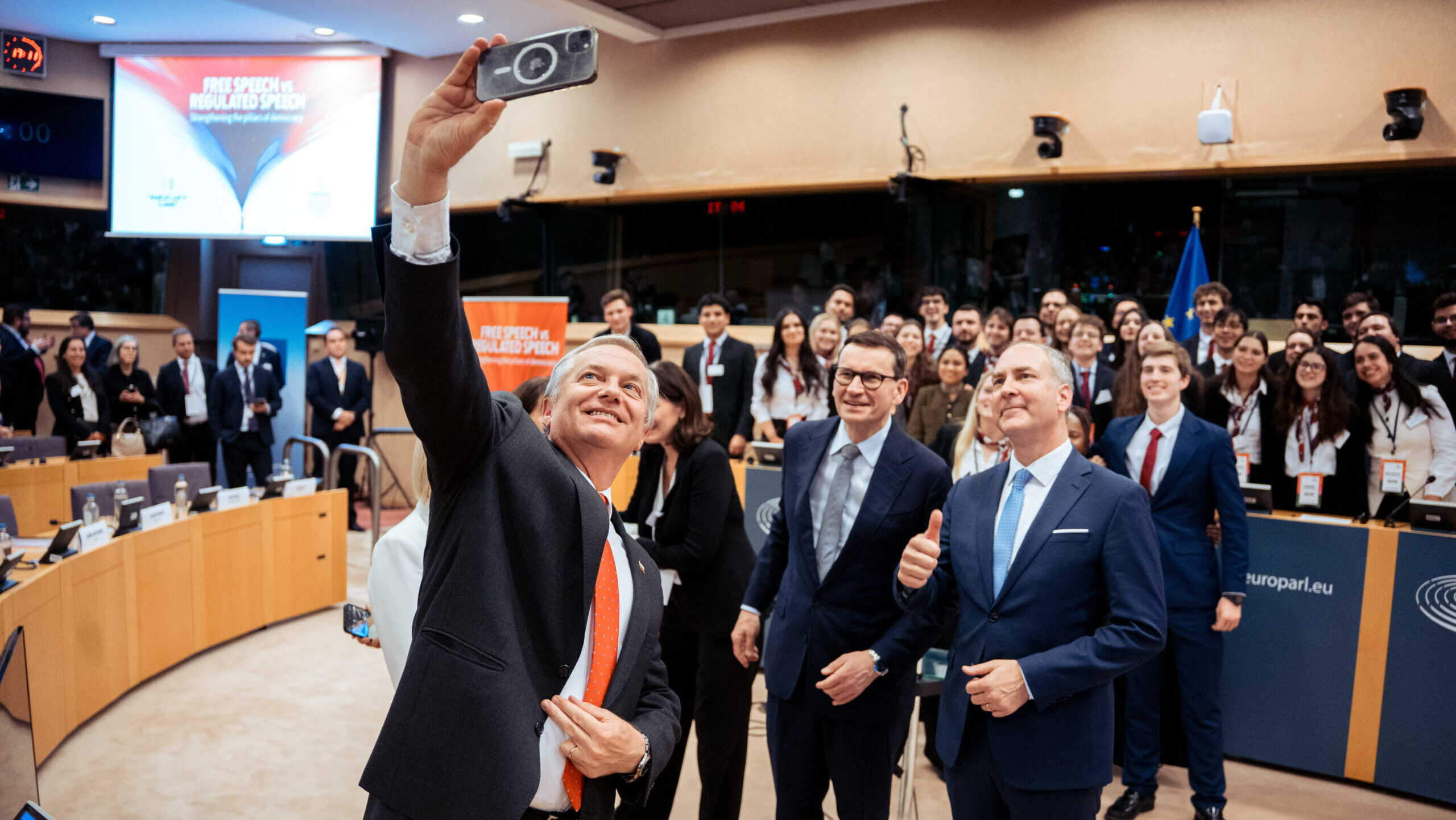
Chile’s president José Antonio Kast taking a selfie with Polish former PM Mateusz Morawiecki and Croatian MEP Stephen Bartulica in front of the gathering.
Political Network for Values
The closing session of the Summit of the Political Network for Values revolved around the address delivered by José Antonio Kast, introduced by the organizers as one of the conservative movement’s leaders with the strongest current electoral legitimacy.
His speech, marked by a clear Christian tone, deliberately moved away from the technocratic language typical of international forums and instead embraced a principles-based narrative centered on human dignity, freedom, the family, and the moral responsibility of political power.
Kast structured his message around a central premise: democracy cannot be sustained solely by procedures but requires solid anthropological foundations. “When the notion of the person is weakened, democracy is hollowed out from within,” he argued, linking the institutional crisis of the West to a cultural erosion driven—according to his analysis—by ideologies that pit freedom against security, rights against truth, and the individual against the community.
The Chilean leader unequivocally defended the role of the Christian tradition as one of the historical pillars of Western democracies, stressing that faith is not a relic of the past but a source of public meaning. His remarks were received as a unifying speech—political, moral, and cultural—fully aligned with the founding spirit of the Political Network for Values.
Throughout the summit, and especially during its final session, participants made clear their intention to build a coordinated international agenda in response to what they view as a dominant progressive consensus within multilateral organizations, European institutions, and global forums. In this context, Kast was seen as an example of a new generation of leaders unafraid of cultural confrontation and openly committed to the centrality of the family, educational freedom, and the defense of life.
These themes were not framed as part of a ‘culture war,’ but rather as a defense of what speakers described as democratic common sense. Criticism of radical environmentalism, ideological feminism, and identity-based indigenism was consistently linked to a recurring warning: social fragmentation and the erosion of national cohesion weaken democracy and open the door to forms of soft authoritarianism.
Alongside Kast, Santiago Abascal played a prominent role in his capacity as president of the Patriots for Europe Party. His speech emphasized the need to bring the cultural battle into the institutional arena, warning that the defense of free speech and national sovereignty is now fought, to a large extent, in Brussels.
Abascal argued that conservatism cannot limit itself to resistance; it must aspire to govern by building broad social majorities and offering security, stability, and historical continuity in contrast to projects of social engineering. In doing so, he explicitly echoed Kast’s message, highlighting the coherence between personal convictions and political action.
The Political Network for Values aims to consolidate itself as a strategic hub for international political coordination, with particular weight in Ibero-America and Europe. Far from remaining at the level of declarations, the meeting ended with a call for active participation, leadership-building, and the electoral translation of the ideas promoted.
The final ovation for José Antonio Kast symbolized more than support for a single leader. It represented the affirmation of a political project that unapologetically claims its Christian roots, its commitment to genuine democracy, and its determination to contest the cultural and political direction of the West.