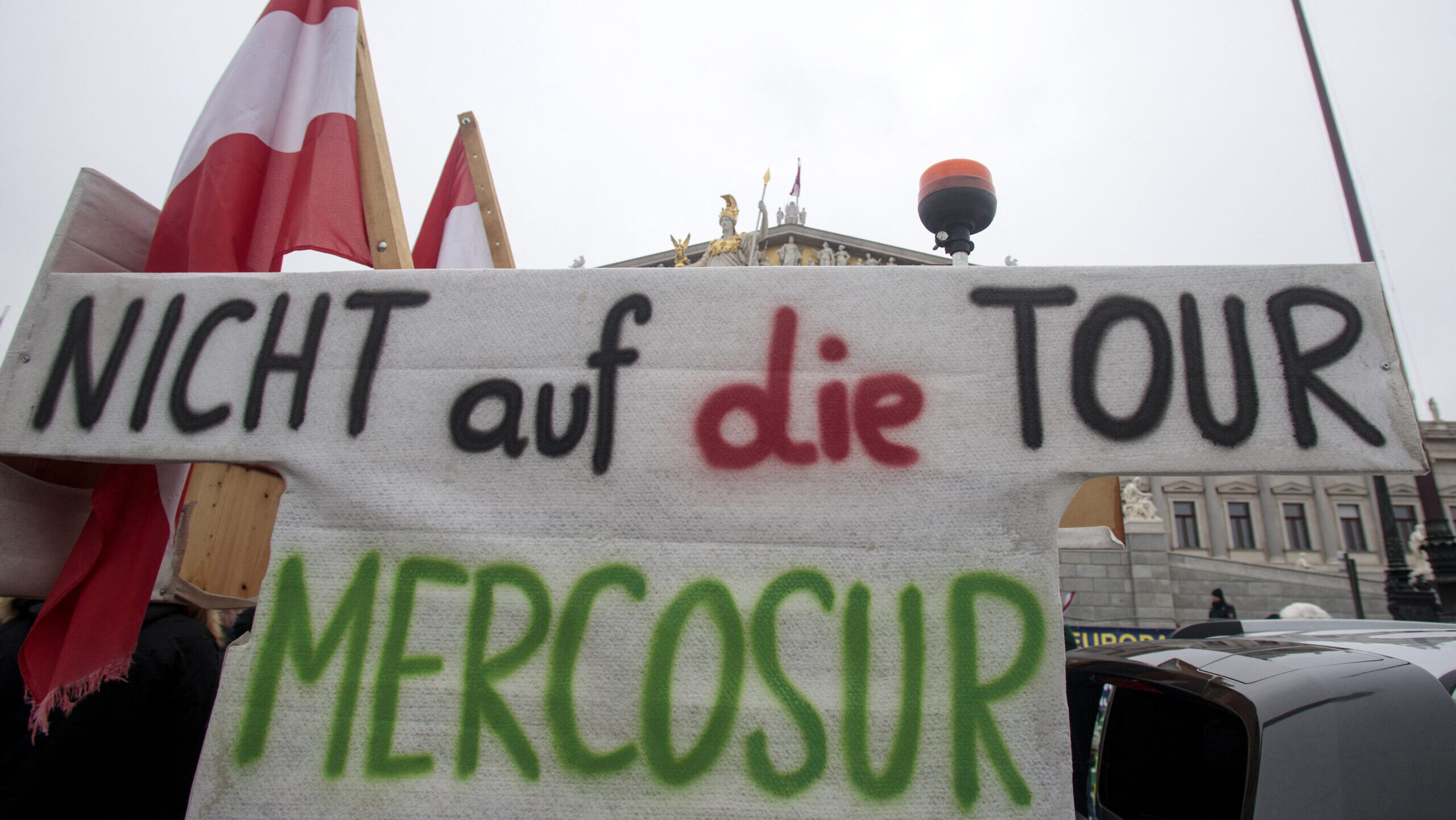
A placard denouncing the Mercosur Agreement is pictured as farmers with their tractors demonstrate against the current agricultural policy in front of the Austrian Parliament in Vienna on January 16, 2025.
Photo: Alex Halada / AFP
The European Commission has decided to exclude all Latin American countries from its list of “high-risk” deforestation zones under its new law against imported deforestation. Despite regions like the Amazon and the Gran Chaco suffering some of the planet’s worst environmental crises, Brussels chose to restrict its punitive measures to just four countries: Russia, Belarus, North Korea, and Myanmar. Conveniently, all of them are already facing international sanctions for reasons largely unrelated to environmental policy.
This decision cannot be understood without considering the political shift underway in the EU capital. Ursula von der Leyen’s Commission, now more pragmatic and amid rising trade tensions, has watered down one of its flagship Green Deal measures. What was once an emergency is now negotiable.
The law requires that products like beef, cocoa, coffee, soy, or timber exported to the EU not originate from deforested land. However, companies now get an additional year to comply. Moreover, the classification of countries by risk level (1%, 3%, or 9% inspection rates) loses its bite when nations with clear records of forest loss escape under the label of “standard” or even “low” risk.
Latin American countries—led by Brazil, Colombia, and Bolivia— lobbied intensely in Brussels and successfully avoided stricter scrutiny with the Mercosur agreements. They weren’t alone: the United States, Malaysia, Indonesia, and Canada also opposed a tougher application. The result is a defanged regulation that, though marketed as pioneering, ends up as little more than a set of soft guidelines.
The climate emergency Brussels preaches seems to be little more than a flexible narrative, subject to change depending on commercial or geopolitical interests. For the Commission, environmentalism can always wait—except when it comes to sanctioning political adversaries.