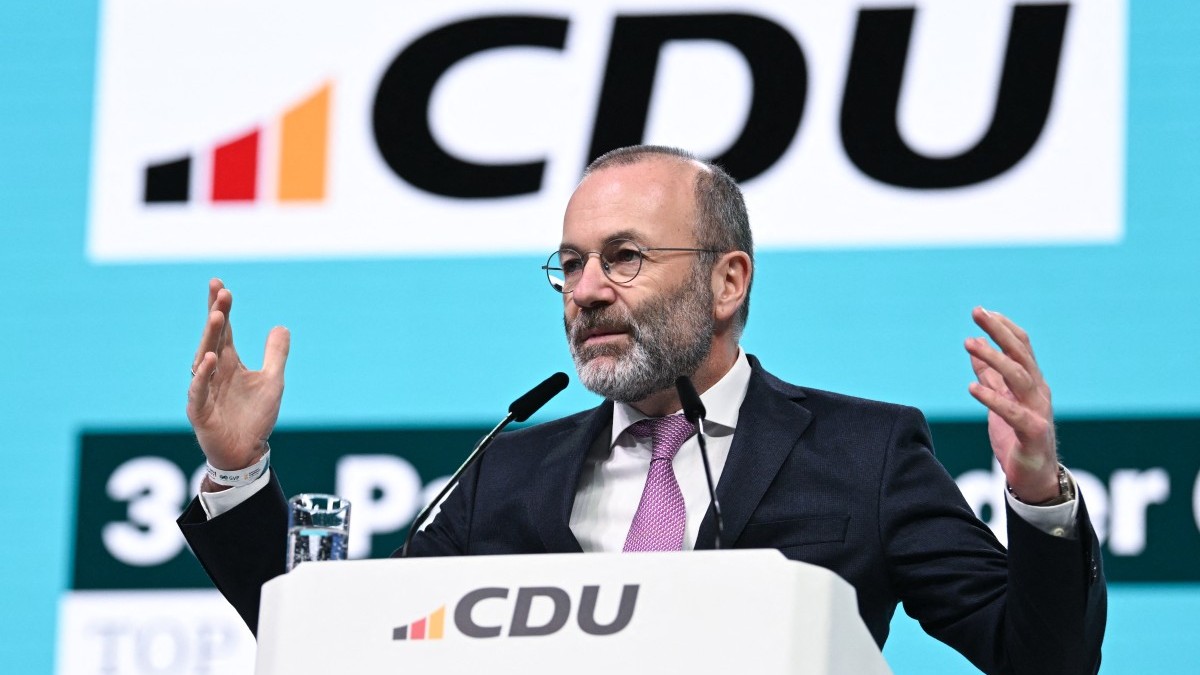
Manfred Weber, chairman of the European People’s Party (EPP), speaks at the party congress of Germany’s Christian Democratic Union (CDU) in Stuttgart, Germany, on February 21, 2026.
THOMAS KIENZLE / AFP
The European People’s Party’s (EPP) move toward tougher positions on migration policy and its contacts with parties to its right in order to facilitate deportations and strengthen border control have provoked a strong reaction from Socialists, Greens, and Liberals.
They accuse the largest party family in the European Parliament of “breaking the traditional consensus” that has sustained the centrist-liberal majority during the current term.
The controversy, however, once again shows that no relevant measure within the European Union can be approved without the support of the EPP, which has become the decisive actor for building majorities and, in practice, the true axis of political balance in Brussels.
The draft resolution on migration had been blocked for months due to the lack of agreement between centrists, Social Democrats and liberals—the Parliament’s classic majority—which led the EPP to seek alternative support to move the text forward in committee.
According to reports published by German media, the contacts included meetings between rapporteurs and discussions in working groups involving representatives of different political families to negotiate amendments and secure a sufficient majority.
The subsequent vote made it possible to unblock the file thanks to the support of MEPs outside the centrist coalition, which triggered—as expected—an immediate backlash from the European Left. A Left that, in recent years, has exercised too much influence over the EPP.
German Socialist MP Ralf Stegner stated that, if the contacts were confirmed, “a major taboo” would have been broken and that the resignation of the head of the EPP group would be “inevitable.”
The chairman of the SPD’s delegation in the European Parliament, René Repasi, also called for clarification regarding the extent of the talks and the role of the German delegation within the EPP.
From the Greens group, MEP Erik Marquardt warned that “integrating the far right into democratic processes could be the beginning of the end of liberal democracies in Europe,” and demanded that the cordon sanitaire against parties considered outside the European consensus be maintained.
Criticism was not limited to the left. Liberal MEP Marie-Agnes Strack-Zimmermann said that anyone who “publicly invokes democratic cooperation while playing dangerously with it behind the scenes” damages trust in European institutions, while figures within Germany’s CDU also called for a rapid clarification of what had happened.
EPP group chairman Manfred Weber rejected the accusations and denied that any political cooperation exists. “There is no doubt that the firewall still stands,” he said, insisting that the group’s strategy has not changed, even if recent events suggest otherwise.
Weber downplayed the technical contacts and said that, as group chairman, he sets the overall political line but does not control the conversations of staff members: “I do not control staff chat groups,” he declared when asked about the reports.
This shows that the EPP still fears freeing itself from the constraints imposed by its partners, and the fear of being labelled “far-right” remains alive in a European Union where common sense itself has become the real taboo.
On the other hand, the Socialists and the Greens know that without EPP votes, no major reform can move forward. They also know that the centrists retain the room to negotiate either toward the left or toward the right, depending on the issue. Migration policy, one of the most sensitive topics of the current term, has demonstrated how far the largest group can determine the final outcome of negotiations.