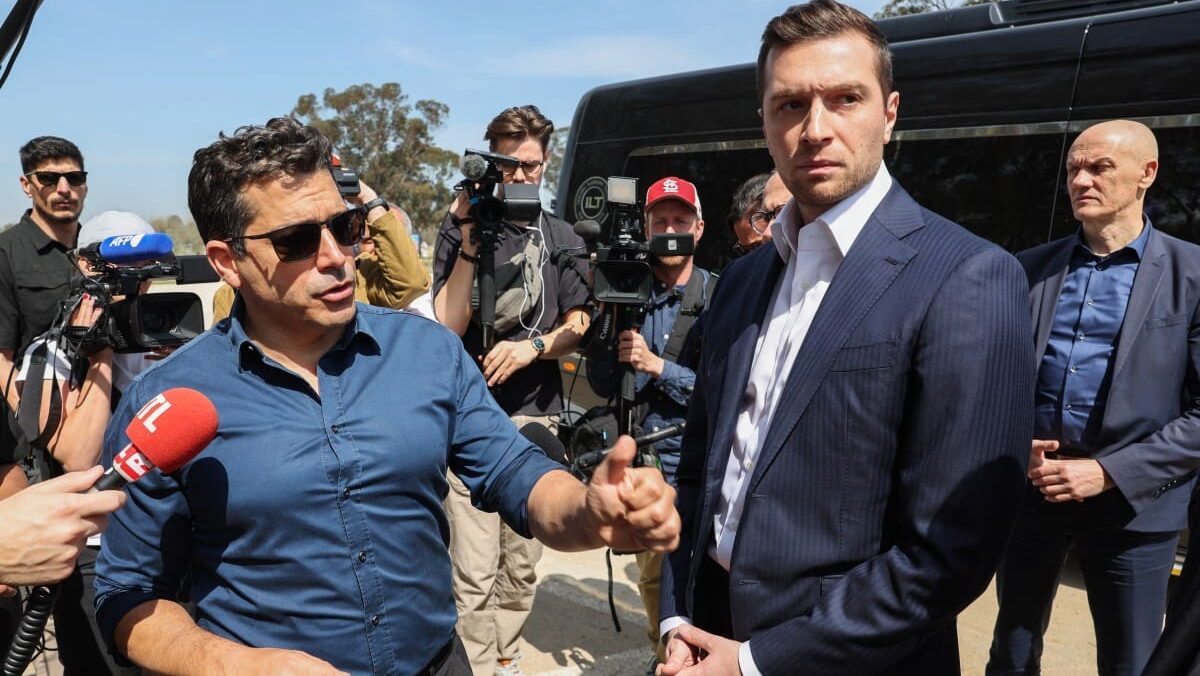
Leader of France’s National Rally (RN) Jordan Bardella (R) listens to Israel’s Minister of Diaspora Affairs Amichai Chikli during a visit to a memorial for victims and hostages of the 2023 attacks by Hamas terrorists at the Supernova music festival site near kibbutz Re’im in southern Israel on March 26, 2025.
Photo: Jack GUEZ / POOL / AFP
Jerusalem hosted an international event on antisemitism between March 26 and 27, organized by the Israeli Ministry of Diaspora and the Fight against Antisemitism, chaired by Diaspora minister Amichai Chikli, a representative of the more conservative wing of Likud, Prime Minister Benjamin Netanyahu’s party.
What should have been a platform to express a unified stance on the need to combat antisemitism has instead become the focus of international controversy because several leftist invitees could not stomach the fact that Israel had also invited representatives of the European right.
Jordan Bardella, leader of France’s National Rally (RN), was attending the conference, accompanied by Marion Maréchal, granddaughter of founder Jean-Marie Le Pen and current vice-president of the Reconquest party. “We have common enemies,” Maréchal told the conference, referring to radical Islamism, or, in her words, “Islamo-leftism.”
The Spanish delegation includes three VOX MEPs: Hermann Tertsch, Mireia Borrás, and Juan Carlos Girauta. Tertsch said,
Israel is a key partner against the Islamic threat shared by Europe.
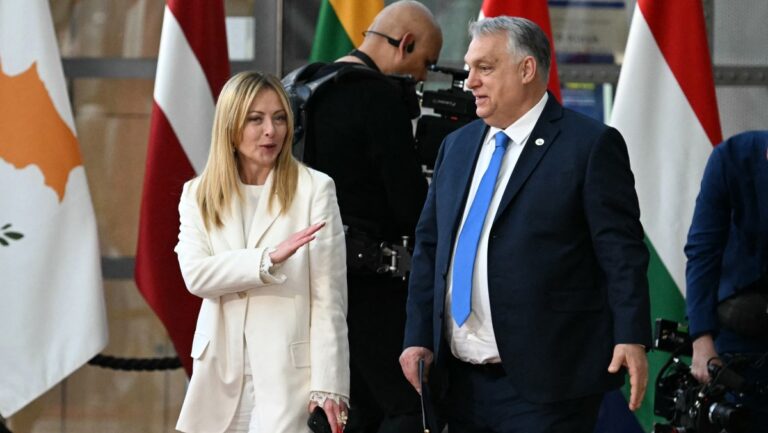
Equally significant was the presence of representatives from Hungary’s Fidesz party, led by Viktor Orbán, and from the Sweden Democrats, as well as former Slovenian Prime Minister Janez Janša.
In contrast, significant absences were recorded as a protest against the list of invitees. Among those who chose not to attend was far-left French philosopher Bernard-Henri Lévy, emblematic for his communist stances during the May ’68 civil unrest and a fierce critic of the Right. Lévy justified his withdrawal in an open letter to Israeli President Isaac Herzog, stating that transforming Jerusalem into “the capital of an illiberal international” represents a direct threat to the democratic values traditionally defended by Israel. In his words: “I have defended the people and army of Israel all my life, but not at the risk of turning Jerusalem for two days into the capital of an illiberal international that mocks the democratic values that are the pillars of Israel.”
Another significant absentee was Felix Klein, German Government Commissioner for Jewish Life and the Fight Against Antisemitism, who explained his decision to withdraw after discovering “who the other speakers were.” Renowned British academic and pro-Israel activist David Hirsh also criticized the event for “legitimizing ultra-right leaders,” emphasizing that
the problem is not only antisemitism but also racism and Islamophobia.
In a country still traumatized by the Hamas massacres, his words did not produce the expected effect. Israel is not Europe.
The Israeli government responded to the criticisms through Minister Chikli, who asserted that
the main threat to Jewish life in Europe today comes from radical Islam, not from right-wing parties.
According to Chikli, “the politically correct have been anchored in the past for 50 years,” explaining their discomfort with the current reality of antisemitism.
Conservative European and Israeli commentators, by contrast, perceive the event as a crucial step towards normalizing and recognizing the role nationalist parties play in combating radical Islamism and mass immigration, considered common threats for both Israel and Europe. The conference in Jerusalem is yet another sign of a clear strategic realignment of the Israeli government towards European right-wing actors. This shift demonstrates how current geopolitical challenges profoundly reshape traditional alliances on the international political scene.