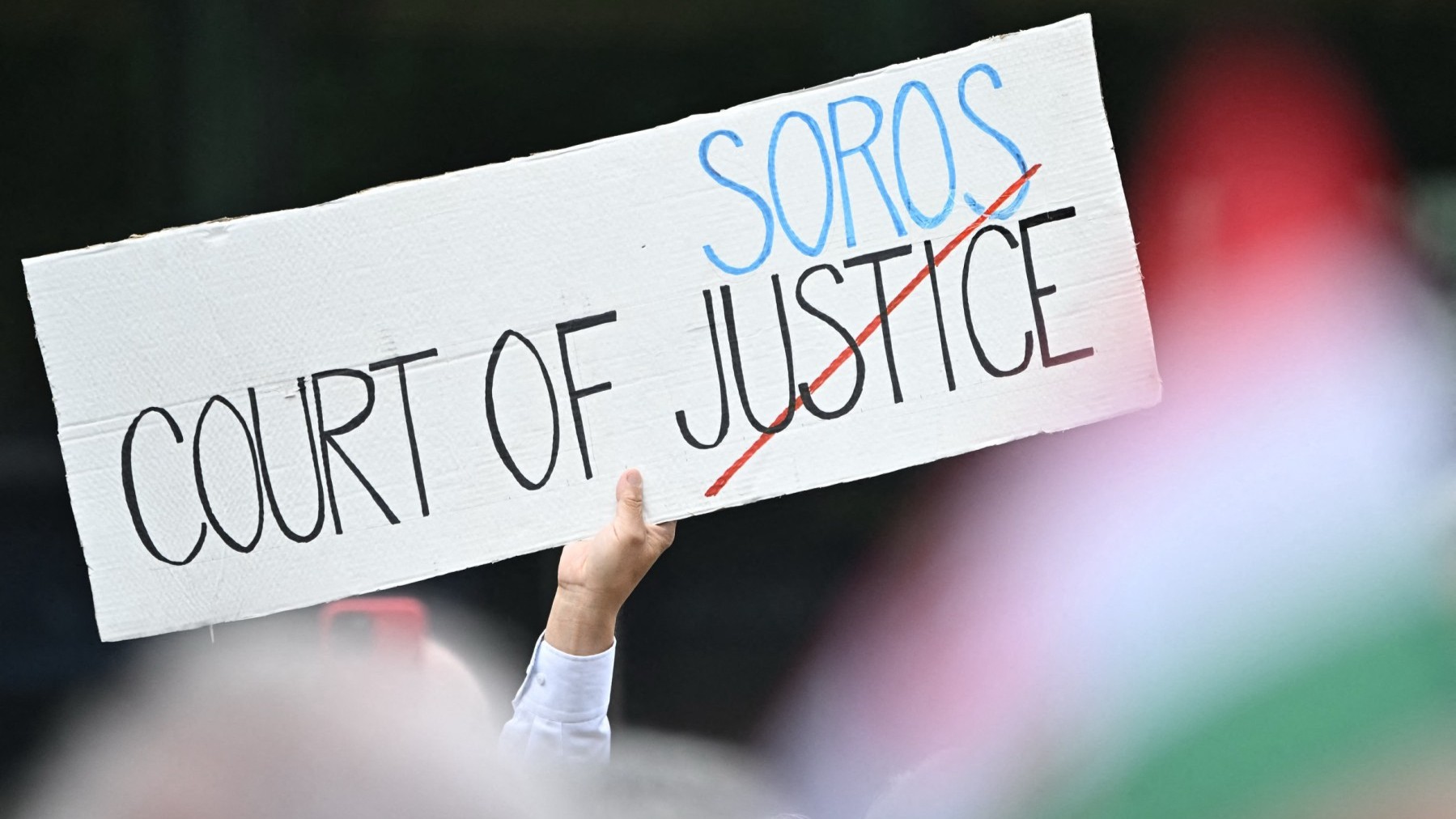
A participant displays a placard reading ‘Court of Soros’ at a protest in Budapest on June 14, 2024, against a decision of the European Court of Justice.
Attila Kisbenedek / AFP
The Court of Justice of the European Union held a decisive hearing today in the case brought by the European Parliament against the European Commission over the management of frozen funds for Hungary. The session, closely followed by European capitals, addressed whether Brussels applied political—rather than strictly legal—criteria when it decided to unfreeze part of the resources that Budapest had been denied since 2021.
The lawsuit, registered as C-225/24 Parliament v Commission, focuses on the application of the rule-of-law conditionality mechanism, an instrument intended to protect the EU budget from potential irregularities within member states. The Parliament accuses the Commission of having undermined its institutional credibility by releasing funds to Hungary in December 2023, at the height of negotiations on Ukraine’s accession process.
According to the MEPs bringing the case, the partial unblocking of the money amounted to a “blank cheque” for Viktor Orbán’s government. In Luxembourg, however, the Commission argued that its decision was based on verifiable judicial progress and the adoption of new rules on transparency and public procurement.
Sources close to the EU executive noted that Hungary has created an independent integrity authority, reformed judicial procedures, and strengthened internal control mechanisms. “This is not about indulgence, but about incentives for compliance,” summarized a Commission official after the hearing.
Budapest, for its part, maintains that the prolonged freezing of more than €18 billion has had an obvious political dimension, linked to its critical stance on EU migration and energy policies. Hungarian Minister for European Affairs János Bóka recently stated that “conditionality has become an instrument of ideological pressure rather than a guarantee of budgetary legality.”
The case illustrates a broader tension between EU institutions. While the Parliament has taken a tougher line against governments it deems ‘illiberal,’ the Commission prefers a gradual approach, combining pressure with cooperation. The credibility of the European system hangs in the balance: if conditionality is seen as a political weapon, its legitimacy could erode.
In this particular dispute, Hungary finds itself caught in the crossfire. Budapest demands full access to the funds, having implemented the reforms requested by the Commission, while the latter hesitates to release them further due to ideological reasons—even as the Parliament attacks the Commission for having already released a portion that was agreed upon based on Hungary’s rule-of-law improvements. Either way, Hungary continues to be denied funds that other member states have received without difficulty.
The Court will not issue a ruling for several months, but today’s hearing marks a milestone in the increasingly complex relationship between Brussels and Budapest. The Commission, whose executive authority is at stake, defends its discretionary margin of action; the Parliament, on the other hand, insists that financial decisions should be stricter and automatic.
The European Council is scheduled to discuss the general situation of the rule of law in Hungary on October 21, as part of the ongoing Article 7 procedure. For now, no member state has called for sanctions, and several countries, including Italy and Slovakia, are advocating a ‘constructive’ approach aimed at avoiding political rupture, particularly given the international context beyond Europe’s borders.