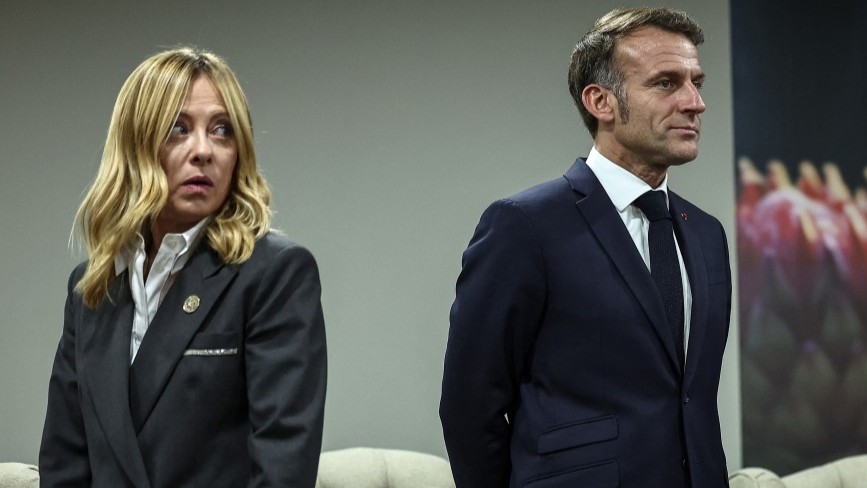
Italian Prime Minister Giorgia Meloni and French President Emmanuel Macron at the G20 Leaders’ Summit in Johannesburg on November 22, 2025 (image cropped)
HENRY NICHOLLS / POOL / AFP
The murder of Quentin Deranque, the 23-year-old patriotic activist who died after a brutal beating in Lyon on February 12th has escalated to a matter of diplomatic squabble between France and Italy.
Statements by the Italian prime minister, Giorgia Meloni, (correctly) describing the crime as “a wound for all of Europe,” provoked an angry response from French President Emmanuel Macron, who asked Rome not to “comment on what is happening in other countries.”
The hypocrisy coming from the Élysée is evident. “France knows the history of Italy very well, especially as they granted political asylum to Red Brigades members for decades,” Meloni quipped when asked to comment on Macron’s words.
The exchange reflects the extent to which the case has heightened tensions in French political debate, on the eve of the March municipal elections and with an eye on the 2027 presidential race, in which the patriotic Right hopes to consolidate its advance.
Quentin Deranque, a mathematics student and devout Catholic, died two days after being viciously attacked on the sidelines of a protest in Lyon. According to the investigation, he was assaulted by at least six people and suffered severe cranial injuries that proved fatal.
From Rome, Meloni denounced that the murder occurred in “a climate of ideological hatred that is spreading across several countries.” Her words were interpreted in Paris as interference in French internal affairs.
On an official visit to New Delhi, Macron responded with a proverb: “Let each stay at home and the sheep will be well looked after.” The French president added that he is struck by the fact that “people who are nationalists, who do not want to be bothered in their own country, are always the first to comment on what is happening in other countries.”
Tensions increased when Italy’s foreign minister, Antonio Tajani, replied that the killing is “a serious matter that concerns us all” and recalled similar episodes in Italian history, stressing the need to condemn all political violence to avoid returning “to a terrible past.”
On the judicial front, the Lyon prosecutor’s office’s prosecutor, Thierry Dran announced that he has requested murder charges against seven of the detained suspects, recommending that they remain in pre-trial detention to prevent disturbances to public order.
In total, eleven people—eight men and three women—were taken into police custody. Of the seven men who could be prosecuted for homicide, two exercised their right to remain silent. Others acknowledged being present at the scene and “some admit to having struck blows,” although all deny having had any homicidal intent.
Four suspects were released under judicial supervision, although they remain under investigation, and authorities do not rule out further arrests.
Among those detained are two parliamentary assistants and a former intern linked to the entourage of a deputy from the left-wing party La France Insoumise (LFI), which has added political dimension to the case.
The justice minister, Gérald Darmanin, called for “responsibilities to be assumed” if the judiciary finds “serious and consistent evidence” implicating public officials or their collaborators.