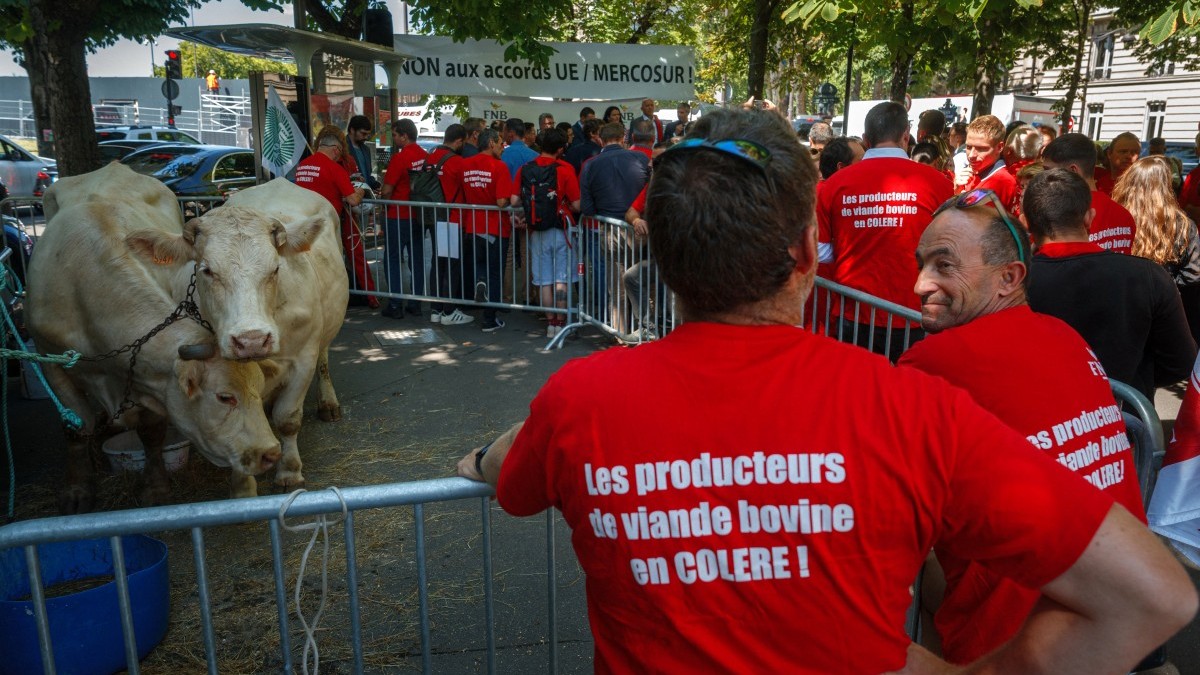
Farmers and members of the National Beef Federation demonstrate near the Brazilian Embassy in Paris on July 9, 2025 against the EU-Mercosur agreement.
Dimitar Dilkoff / AFP
The trade agreement between the European Union and the Mercosur countries—Brazil, Argentina, Uruguay, and Paraguay—is once again straining the seams of the Union. While Germany and France try to forge a common stance on the deal, internal divisions within the bloc are becoming increasingly apparent.
German Chancellor Friedrich Merz, who favors trade liberalization, met this Wednesday, July 23rd in Berlin with French President Emmanuel Macron. Macron is strategically leading the opposition to the pact for electoral reasons—particularly due to its implications for the European agricultural sector. As currently drafted, France insists that the treaty risks further worsening the crisis in European agriculture, already battered by green policies imposed by Brussels and by unfair competition from Latin American agricultural products that fail to meet EU standards. From Paris, there is open talk about the need for safeguards to protect European farmers from regulatory dumping that undermines prices and food sovereignty.
Meanwhile, Pedro Sánchez has embarked on a tour through the Southern Cone to express unreserved support for the treaty. From Montevideo to Asunción, the Spanish Prime Minister has vowed to pressure his European partners to unlock the agreement and has positioned Spain as its leading advocate. In his speeches, Sánchez has defended a multilateralist vision in contrast to “Trump’s protectionism,” and has even stated that he will respond with “proportionality and firmness” if Washington imposes 30% tariffs on European goods.
But his enthusiasm goes beyond trade. Sánchez signed a new circular migration agreement with Paraguay—based on a model already used with countries like Morocco—to bring in temporary labor for the agricultural and service sectors. In other words, while European farmers complain of institutional neglect, the Spanish premier is committing to importing more foreign workers to cover the system’s shortcomings.
Political backing for this strategy also came from Antonio Garamendi, the head of the Spanish employers’ association, who accompanied Sánchez on the trip. For Garamendi, the Mercosur deal represents a “historic opportunity” for Spanish businesses. The business leader even joked about French resistance to the agreement, noting that “people were already talking about this deal when Sánchez was still in short pants.”
However, the reality on the ground is far less optimistic. European farmers in Spain, France, Germany, or Poland argue that free trade agreements fail to provide a level playing field. While they must comply with stringent environmental and sanitary regulations imposed by the EU’s Green Agenda, products imported from Latin America are not subject to the same demands. The result is unfair competition that erodes farm profitability and accelerates rural abandonment.
Meanwhile, the European Commission continues its efforts to close the deal amid growing pressure from the United States and the threat of a trade war. However, within the EU, northern partners want guarantees, and they are unlikely to accept Sánchez’s voluntarist enthusiasm without clear conditions.
After decades of negotiation, the EU-Mercosur agreement may end up not as a diplomatic triumph, but as a symbol of a Union that sacrifices its agriculture in the name of globalization—where lofty speeches about “shared values” hide a stark reality: the benefits go to the elites and large corporations, while Europe’s farmers continue to pay the price.