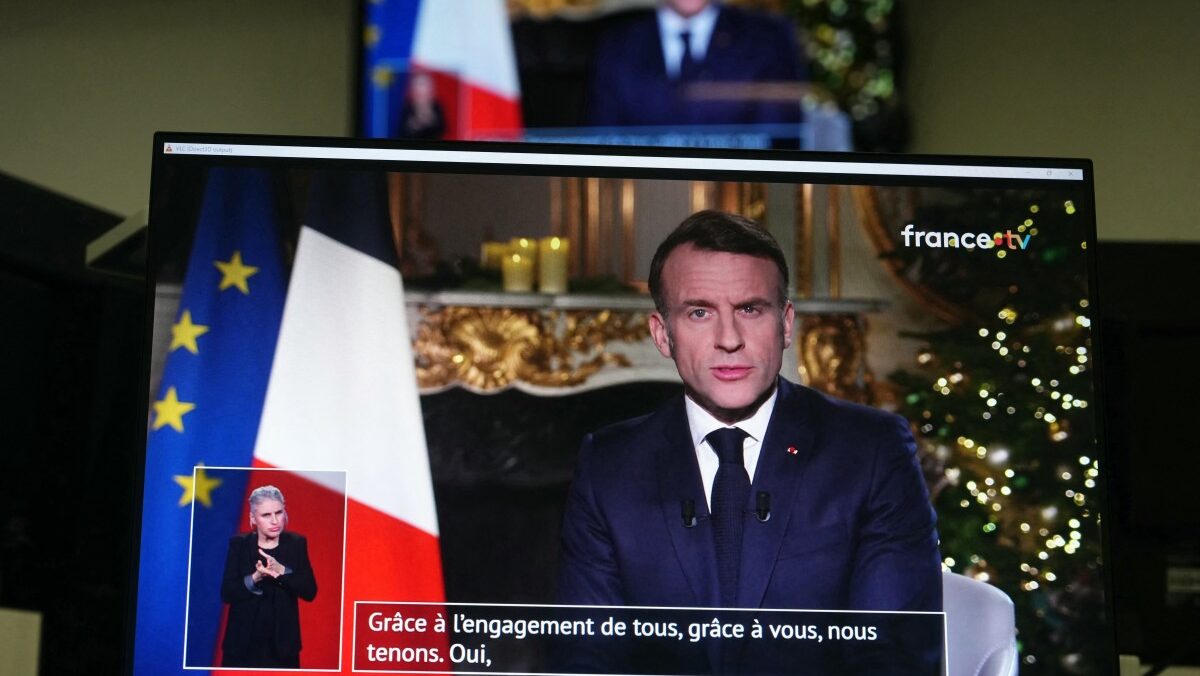
France’s President Emmanuel Macron delivering his New Year wishes during an address to the nation from the Elysee Palace, in Paris, on December 31, 2025.
Dimitar DILKOFF / AFP
French President Emmanuel Macron delivered a sombre message for 2026 during his official New Year’s address, which was met with coldness and consternation. He made the euthanasia vote one of his main objectives for the new year—as if programmed death has become the only horizon for the country he is increasingly struggling to destroy.
The president appeared in an unflattering setting, cramped in an overly tight suit that restricted his movements. His jerky delivery made him seem unnatural. True to his habits, he began by congratulating himself on hypothetical successes while absolving himself of any responsibility for the country’s failures—which he dismissed as mere “flaws” entirely dependent on external factors, such as “war” or “the return of empires.” At most, he consented to express a few “doubts.”
The salient feature of the French president’s speech is certainly his inability to think in terms of political deadlines. While the French are calling for their destiny to be returned to their own hands—either through dissolution or the president’s resignation—Macron preferred to evoke the vague concept of “useful political time” to explain that he intended to work energetically until the end of his term, which is due to end in spring 2027. Offering up a list of half-hearted measures and promises—some of which have been around since his first election in 2017—the president appeared lost and directionless. Just a year ago, he promised to consult the French people. A year later, his promise of direct democracy has gone unfulfilled.
His next projects include implementing the new national service, regulating access to social media for minors, and finally, finalising the end-of-life bill. A dull and inglorious horizon: a national service that is a shadow of its former self; social media regulations that are part of a broader strategy of ever-tighter control of information; and, finally, a societal advance that rhymes with death.
There is, of course, a whole symbolism here. Is the future of Macron’s France now to ‘die with dignity,’ which, let’s be clear, means in despair, human contempt and budgetary austerity? This may cynically be the only way Macron and his teams have found to restore public finances, since, as a professor working in intensive care at a public hospital explained to the press on December 19th, welcoming the ongoing debates on the subject: “Resuscitating everyone is not sustainable in financial terms, nor in human terms, and even less so in ethical terms.”
The incantations that are inseparable from the exercise of wishes—“unity, strength and independence”—have once again revealed the contradictions of a president who has neither the desire nor the energy to fight. He calls for independence while claiming to want to act “as a European,” even though his voice no longer carries weight, either in France or in Brussels, and he has never been so isolated among the heads of state and government of the member states.
Fifteen months before the deadline, Macron has already announced—something everyone already knows, since the constitution does not allow it—that he will not run in the 2027 presidential election. Coming from him, this unnecessary announcement sounded like an admission of failure. April 2027 will above all be a time of reckoning for him, and the campaign, we must wait and hope, should finally allow the truth to be told about the countless lies and failures of his presidency.
The New Year’s address was harshly judged: “sad,” “disappointing.” For several years now, the audience for this obligatory television appearance—all channels broadcast it, so it is impossible to avoid it by switching from one programme to another—has been in free fall. According to figures published by Médiamétrie, 8.9 million viewers watched the President’s New Year’s address. This is less than in 2024 and even less than in 2023. Close observation of viewers’ behaviour shows that they deserted the presidential address within the first few minutes… only to return en masse to their screens as soon as the president’s speech was over.
“Who cares about this litany of announcements that have already been betrayed a hundred times and empty words? He himself seemed ready to fall asleep while speaking. Something is broken in him and in the country,” thundered Jean-Luc Mélenchon, president of La France Insoumise, on X, with stark brutality in his words.
On the Right, in the Rassemblement National (RN), elected officials said they were struck by the degree of disconnect of President Macron, who dared to congratulate himself on the good results of the French economy: “an imaginary balance sheet,” according to MP Edwige Diaz. The final word undoubtedly goes to Éric Ciotti, president of the Union des Droites pour la République (UDR), allied with the RN: “The only wish we can make for France is for him to leave so that national recovery can begin,” he concluded.