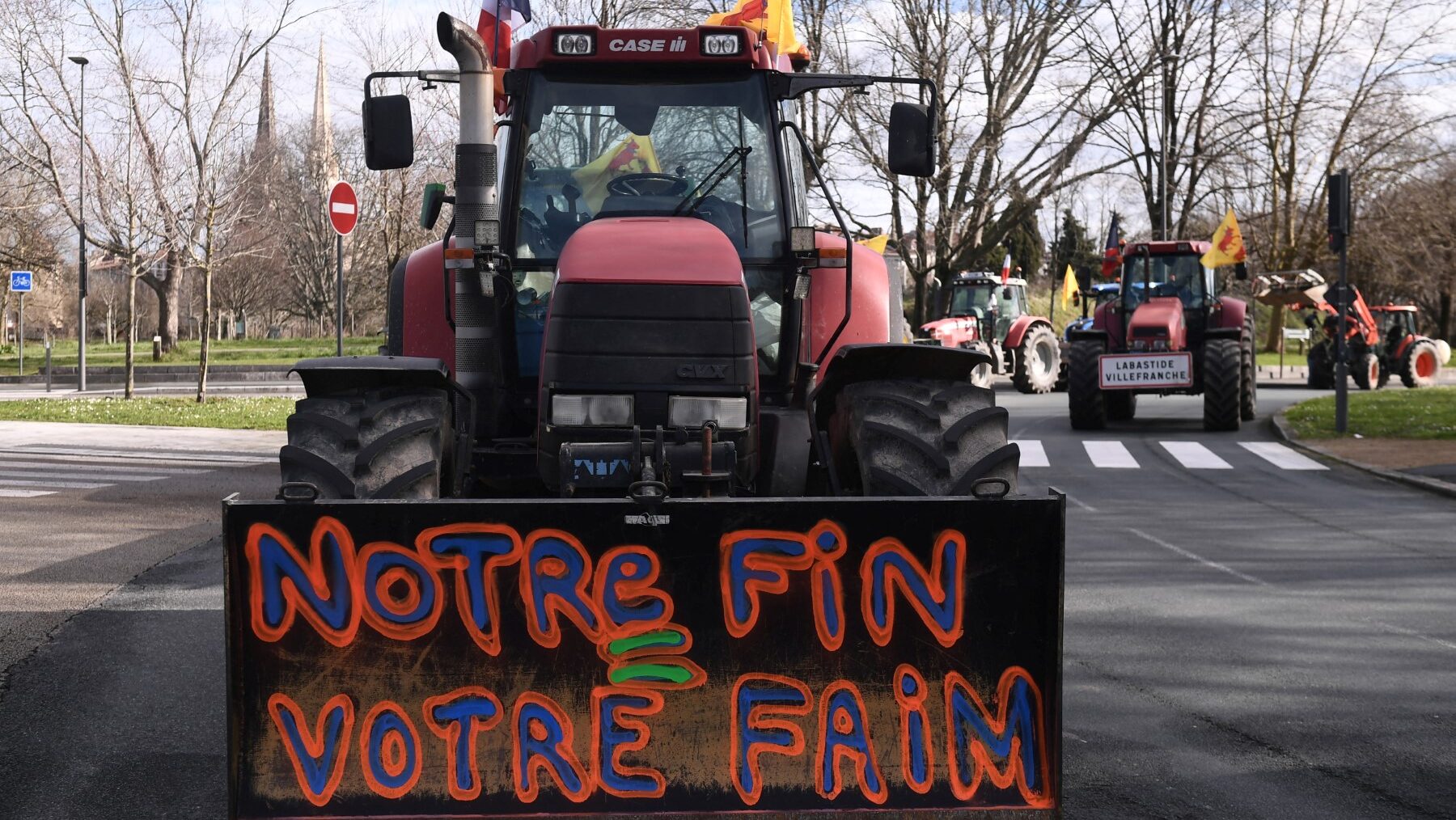
French farmers block with tractors the Saint-Leon roundabout during a “Non-union” mobilization against the EU/Mercosur trade agreement and the protocols to combat bovine tuberculosis in Bayonne, south-western France, on January 10, 2025. The text on the blade says “Our end, your hunger.”
Gaizka Iroz / AFP
Brussels will soon unveil the final text of the free trade agreement with Mercosur—the bloc formed by Argentina, Brazil, Paraguay, and Uruguay—after more than 25 years of negotiations. Yet the publication does not come without complications: the European Commission has informed its Latin American counterparts that it will introduce an internal mechanism to address the pressure from France, Italy, and Poland, who are concerned about the treaty’s impact on their farmers.
According to Mercosur diplomats, the Commission has suggested that these “safeguard clauses” would be applied unilaterally within the EU, without the need to alter what has already been agreed with Latin America. In this way, Brussels intends to shield sensitive sectors—beef, poultry, and other agricultural products—from a potential flood of cheaper imports, particularly from Brazil and Argentina.
The move seeks to neutralize the strong opposition of French President Emmanuel Macron, who, for years, has led the front against the accord. Macron has repeatedly insisted that Europe’s family farms cannot be sacrificed in the name of globalization and that unfair competition, arising from looser environmental and sanitary standards in South America, would put France’s primary sector at risk. Poland and Italy have voiced similar concerns, although Paris’ political weight has been decisive in the talks.
It is noteworthy that Macron now presents himself as a staunch defender of a way of life he has helped undermine by supporting climate policies at both the national and European levels for years.
The balance remains fragile: the deal has been split into two parts, one commercial and the other political. The first can be approved by a qualified majority in the EU Council, making its implementation easier, while the second—dealing with investments and national competences—requires unanimity, a far more complicated scenario.
For the Commission, the international context adds extra pressure. Washington’s aggressive trade policies, combined with the global surge in protectionism, have pushed Brussels to diversify partners and finally close a pact that has dragged on for a quarter of a century. At the same time, the new updated text of the agreement with Mexico will also be released.
The showdown, however, is not yet settled. France seems to have ensured that its voice carries more weight than those advocating unreserved openness, but only with the full publication of the deal will it become clear how much Brussels has conceded—and who, in the end, gets the upper hand.