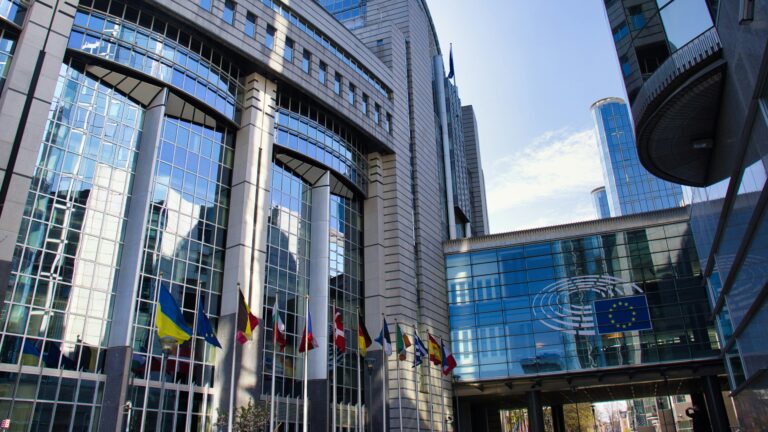
European farmers protesting the Mercosur agreement in Brussels on 18 December 2025.
Javier Villamor
The signing of the trade agreement between the European Union and Mercosur, initially scheduled for the end of December, has been suspended at least until January 12, 2026, following a last-minute intervention by Italian Prime Minister Giorgia Meloni.
The postponement, confirmed in Brussels by European Commission President Ursula von der Leyen, is neither a simple scheduling issue nor an isolated manoeuvre. It confirms that political pressure against the agreement had become asphyxiating and cross-cutting, to the point of turning its immediate approval into a genuine ticking time bomb.
According to what von der Leyen conveyed to heads of state and government gathered at the European Council between Thursday and Friday, Brazilian President Luiz Inácio Lula da Silva accepted Meloni’s request to delay the signing to give the Italian leader time to “reassure” her agricultural sector, which is concerned about competition from Latin American agri-food products, particularly beef and poultry. The move derailed a political objective the Commission had set for itself: to agree on December 20th, after more than two decades of intermittent negotiations.
The episode shows that opposition—or at least resistance—to the Mercosur agreement does not stem from a single political family, nor can it be dismissed as a reflex of ‘Euroscepticism’ or ‘national populism.’ Alongside the traditional criticism from France, Austria, or Poland, governments of very different political stripes have joined in, more or less explicitly, concerned about the economic, social, and strategic impact of the deal.
Each European leader is undoubtedly operating with his or her own electoral calculations. Meloni is no exception: Italy has a sensitive and well-organised agricultural sector, and the political cost of appearing to ‘hand over’ farmers to external competition would be high. But reducing what has happened to a purely domestic manoeuvre would be a mistake. The accumulated pressure had been building for years and was affecting a growing number of member states, including some that had initially aligned themselves with the Commission’s trade agenda.
Proof of this unease is that, alongside the postponement, EU institutions rushed to approve a supplementary text that would allow tariffs to be reimposed if beef and poultry imports from Mercosur were to destabilise European markets. It was an obvious attempt to extinguish a political fire that was already out of control.
The temporary suspension also has consequences on the other side of the Atlantic. Mercosur countries, and Brazil in particular, are watching with concern as a long-awaited economic opportunity is once again delayed. For Brazil, the bloc’s largest economy and one of the agreement’s main potential beneficiaries, expanded access to the European market is key to placing its agricultural products and strengthening its global trade position.
The risk is undeniable. If the European Union continues to project uncertainty and indecision, those countries will look elsewhere. Brazil is a member of the BRICS and maintains an increasingly close relationship with China, which not only demands raw materials and foodstuffs but also offers fast agreements, financing, and less political interference. Another European delay could accelerate that shift.
That said, the geopolitical landscape is more complex. Washington has stepped up its diplomatic and economic presence in South America in recent years, seeking to curb China’s expansion and regain influence in the region. European uncertainty may, paradoxically, create space for both Beijing and the United States, leaving Brussels in a position of strategic weakness.