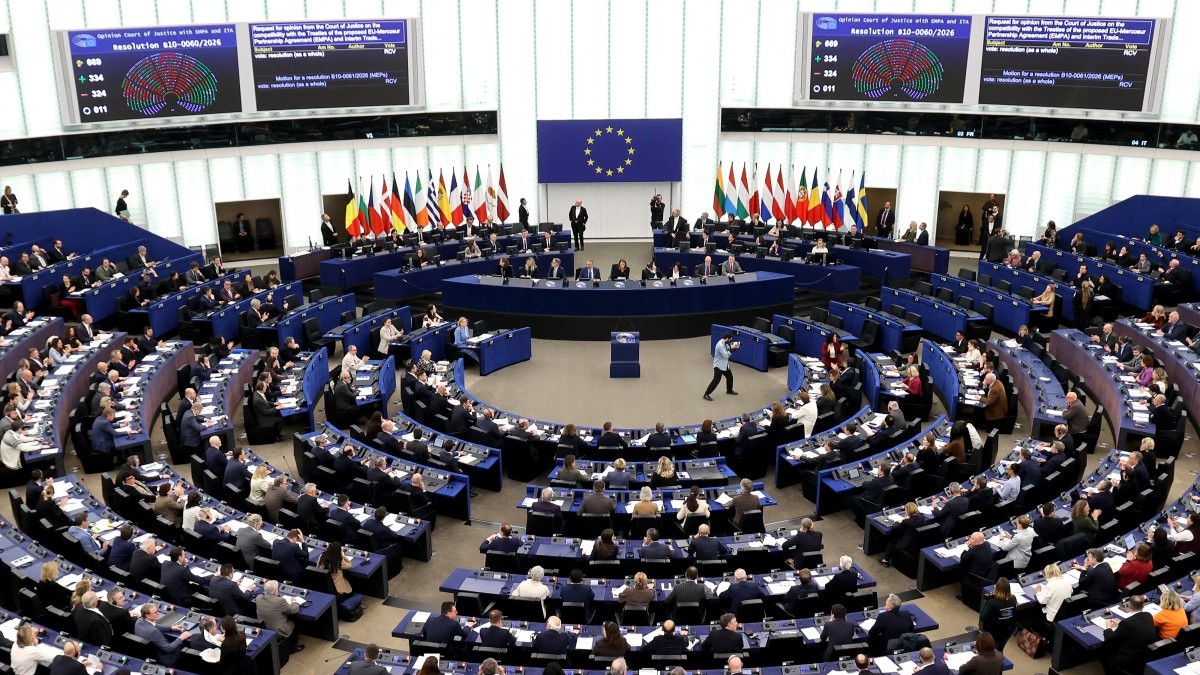
Screens displaying the results of the vote on the legal referral of the Mercosur deal to the EU courts during a voting session at the European Parliament in Strasbourg, on January 21, 2026
Frederick Florin / AFP
The ratification of the trade agreement between the European Union and Mercosur is not only reshaping balances among Member States, economic sectors, and lobbying groups. It is also triggering an internal division within the European Parliament’s main political force: the European People’s Party (EPP).
The group that has historically served as the backbone of European integration is now facing a structural tension between two Europes that are difficult to reconcile: the agricultural and the industrial.
Since the European Commission activated the ratification process of Mercosur, the EPP has ceased to function as a monolithic bloc on trade policy. Its enormous parliamentary weight—stemming from its ability to bring together conservative, Christian-democratic, and centre-right liberal parties from very different national realities—has become its main vulnerability. Mercosur has acted as a catalyst for a latent conflict over whom the EPP is meant to represent when national and sectoral interests collide head-on.
The rift is, above all, geographic and economic. On one side, delegations from countries with a strong agricultural base, such as France, Ireland, Poland, Belgium, and Austria, view the agreement as a direct threat to their producers, particularly in sensitive sectors like beef, sugar, and poultry. For these MEPs, Mercosur epitomises unfair competition: imported products produced under environmental, sanitary, and labour standards that are less stringent than those imposed on European farmers.
On the other side are representatives of heavily industrialized and export-oriented economies—such as Germany, Sweden, the Netherlands, or Spain—who view the agreement as a strategic opportunity. Tariff elimination, preferential access to a market of nearly 300 million consumers, and the diversification of supply chains at a time of mounting tensions with the United States and China are the core arguments of this camp. From this perspective, blocking Mercosur would amount to a major geopolitical and economic mistake.
The result is an EPP split between those who defend the logic of the single market and industrial competitiveness, and those who demand protection for traditional sectors that feel they have already paid too high a price for globalisation and Brussels’ green policies.
The handling of this internal crisis has put the leadership of Manfred Weber, the group’s president, under strain. Weber has sought to maintain an official line in favour of moving the agreement forward, aligned with the Commission and Europe’s major industrial interests. Internal votes and group meetings, however, have exposed a silent—and in some cases open—rebellion by dozens of EPP MEPs.
The most telling episode has been the group’s inability to enforce internal discipline without incurring a high political cost. Strategic abstentions, votes against the line, and public criticism have shown that the EPP no longer operates as a cohesive political machine, but rather as a confederation of national interests. Some senior figures have even questioned whether the group has become ideologically too broad to sustain common positions on key dossiers—particularly as forces to its right, such as Patriots for Europe, continue to grow.
The Mercosur debate goes well beyond a trade agreement. For many EPP MEPs from countries with traditionally strong agricultures, the treaty is the final straw after years of climate regulations, environmental requirements, and trade deals that, in their view, sacrifice European farming in the name of a globalist agenda designed in Brussels.
From the group’s industrial wing, the reading is the opposite: blocking Mercosur due to sectoral pressure would amount to yielding to protectionism and short-termism, weakening the EU’s international standing and its credibility as a global trading actor. This divergence is not temporary, but structural—and it threatens to resurface in future debates on trade, the energy transition, or industrial policy.
For the European Parliament and the Commission alike, the message is clear. Even the party most closely associated with economic integration is beginning to show deep internal cracks when Brussels’ decisions clash with very concrete national realities.