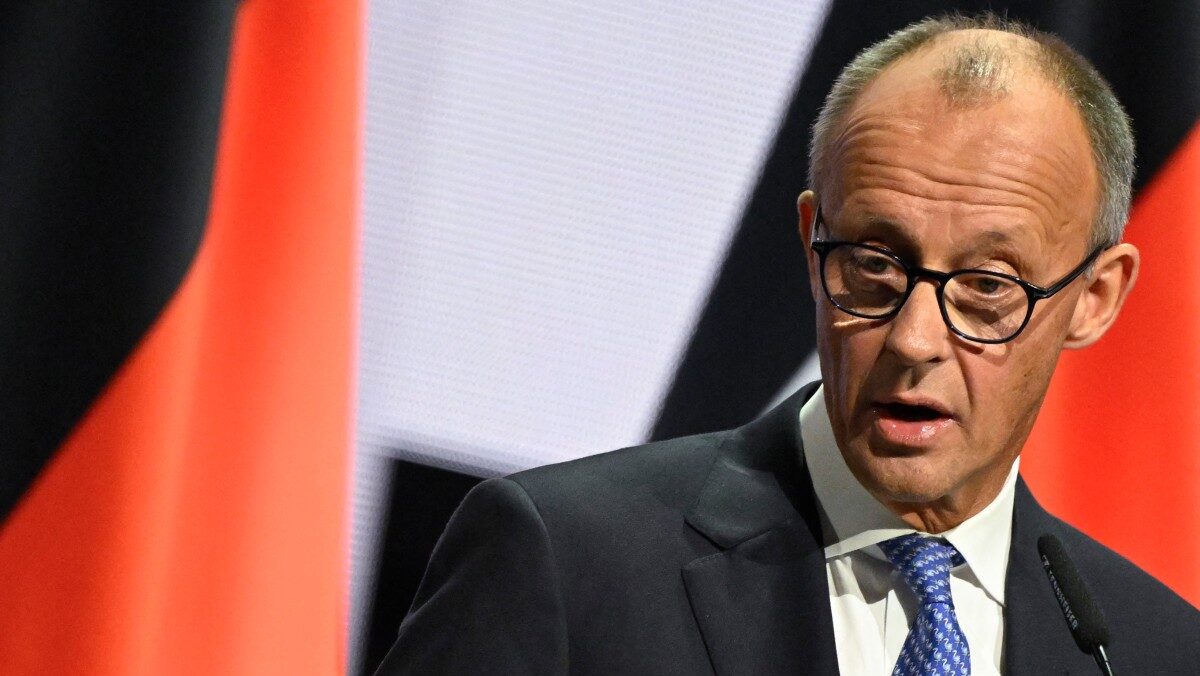
Germany’s Chancellor Friedrich Merz speaks during central celebrations on the Day of German Unity in Saarbrücken, southwestern Germany, on October 3, 2025. On October 3, 2025, Germany marked the 35th anniversary of the German Reunification.
Jean-Christophe Verhaegen / POOL / AFP
German Chancellor Friedrich Merz’s speech at the 35th German reunification day celebration, October 3, was expected to be a rallying cry to unify the population. And while the embattled chancellor did attempt that, his speech was long on platitudes and short on solutions.
Democracies like Germany and their “liberal way of life,” he warned, “are under attack, from both outside and within.”
Merz said the “irregular, uncontrolled migration” has “polarized the country”—as if the polarization, not the problems mass migration has brought, was the problem.
European democracies, he said, need to grow their economies and be ready to face up to “new alliances of autocracies” forming, and emphasized the need for Germany to “relearn how to defend ourselves” by “deterring our adversaries from further aggression.”
The average German might be more concerned about political and religious violence already inside the country, but for them, the chancellor had another message: To get through the “difficult time” ahead, Germans must embrace unpopular reforms. Social promises “that we have given to each other” will be so much more “difficult to uphold than they have been in the past,” Merz said. While not explicit, the message was clear: To build the defense capacity necessary to deter Russia, Germans must be ready to accept cuts to their social welfare system in the spirit of unity.
“Our nation is in the midst of an important, perhaps decisive, phase in its modern history,” he said. “Many things must change if they are to remain as good as they are, or even to improve.” To this effect, Merz expects the German people to “make a little more effort.”
Citizens, he said, cannot leave it to the politicians to fix things, but must take responsibility for social stability “through open dialogue, respect for differing opinions, and active participation in social life. When we hear debates and arguments, we are hearing democracy at work!” In the context of politicians filing police reports against citizens ridiculing them online and the ongoing efforts to sideline, or even ban, the Alternative für Deutschland (AfD) party, those words rang hollow.
Henning Hoffgaard, columnist in conservative Junge Freiheit, commented,
Friedrich Merz, whose plan for Germany apparently only lasted until the day of his election, would have had the chance to deliver a truly decisive speech. Because the country desperately needed one.
Invited to speak at the event was French president Emmanuel Macron, who called on Germans to “rebuild a 21st-century democracy” or risk becoming “a continent, like many others, of conspiracy theories, extremes, noise, and fury.” Former Chancellor Angela Merkel criticized Macron’s presence, explaining that it would have been more appropriate to invite a speaker from former East Germany instead.
Also speaking at the event, German President Frank-Walter Steinmeier contributed a comment that put President Macron’s remarks in an ironic spotlight. The president expressed concern that “the political center has less and less support,” especially in the eastern part of the country, which was formerly under communist rule. Steinmeier continued,
Today, we are also witnessing in our country that political forces are celebrating electoral successes that disregard democracy, despise its institutions, and seek to undermine them, that poison the debate so vital to democracy with hatred and incitement, and that spread misanthropy. Let us not allow our democracy to suffer any further damage! Let us stand against it!
President Steinmeier failed to explain how a democracy can suffer when the will of the people is expressed in its elections. Let’s not forget that in the Communist Deutsche Demokratische Republik (DDR), ‘democracy’ meant citizens could vote for any party they wanted—as long as it was one that the Communists had not outlawed.
With this in mind, it is shocking that the Bundespräsident would be tone deaf enough to demonize a party supported by over 25% of the citizenry and still talk about his country as a “democracy.”