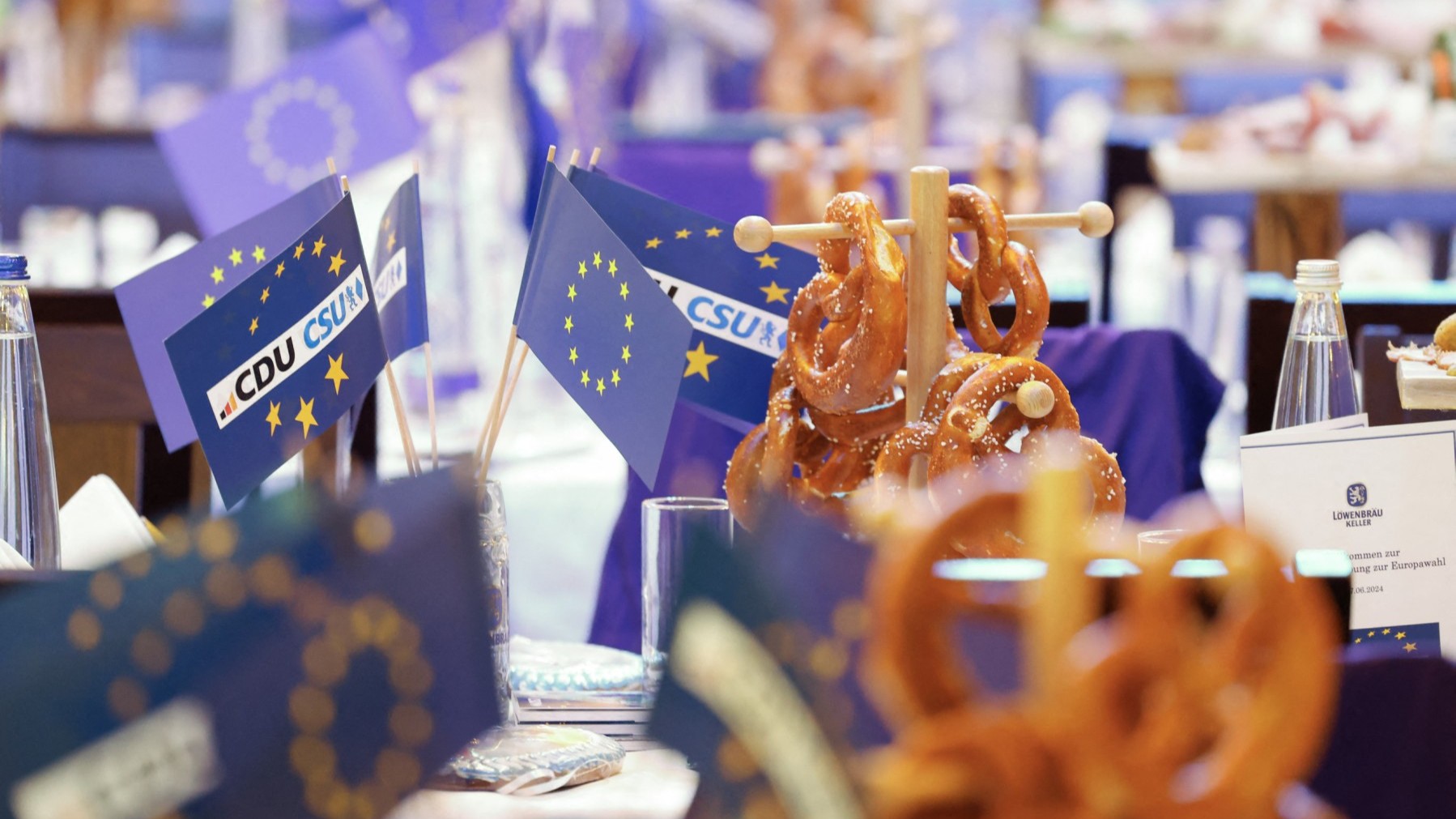
Pretzels and flags of the European Union with logos of the CDU and CSU parties before the start of the last rally for European elections in Munich on June 7, 2024.
Christof Stache / AFP
German media reported that on the night of Tuesday, August 11th, Chancellor and CDU leader Friedrich Merz gathered a small group of party leaders at the Chancellery to address what in recent weeks has turned into a worrying accumulation of political missteps. The meeting, which began at 9:00 p.m. and went on past midnight, according to press reports, took place amid growing internal tensions and polling numbers that show approval ratings well below expectations after his first 100 days in office.
The decision to limit arms exports to Israel—particularly those systems that could be used against the terrorist organization Hamas—has caused an upheaval within the CDU/CSU. Although Merz justified the measure as an adjustment to his government’s foreign policy, a significant part of the CDU and CSU saw it as an unnecessary shift that damaged relations with a strategic partner amid a security crisis in the Middle East.
But this was not the only matter on the table. According to Bild, the frustration over the unfulfilled promise to cut the electricity tax for all citizens—an agreement included in the coalition pact with the SPD—was also discussed, as was the chaos surrounding the recent failed election of candidates for the Federal Constitutional Court. Several regional leaders, especially from Hesse and North Rhine-Westphalia, have stepped up their private criticism, warning that the government is appearing erratic and without a clear course.
Attending the meeting were CDU Secretary General Carsten Linnemann, Education Minister Karin Prien, Saxony’s Minister-President Michael Kretschmer, State Secretary for Agriculture Silvia Breher, and NRW Health Minister Karl-Josef Laumann. The absence of other party heavyweights and several minister-presidents was notable, reinforcing the impression that this was more of a crisis meeting than a routine gathering, despite official explanations.
The situation is delicate. A Civey poll for web.de shows that 39% of citizens are dissatisfied with the coalition government. Among CDU voters, Merz’s approval remains positive—78% prefer him over Olaf Scholz—but among the general electorate, the perception is one of mistrust. Half of the respondents believe the government will not achieve progress in any of the nine major policy areas proposed, and only 36% trust in improvements in defense.
These figures reflect premature wear. Three months into his Chancellorship, Merz faces double pressure: from the opposition, eager to capitalize on his missteps, and from his own ranks, with party leaders fearing that the image of an indecisive chancellor will erode electoral prospects in the medium term. Last night’s discreet yet significant meeting suggests that within the CDU, the urgency to correct course is growing before the narrative of failure takes hold. The AfD’s predictions after the last general election—that the current government would not last until 2027—now seem more accurate than ever.