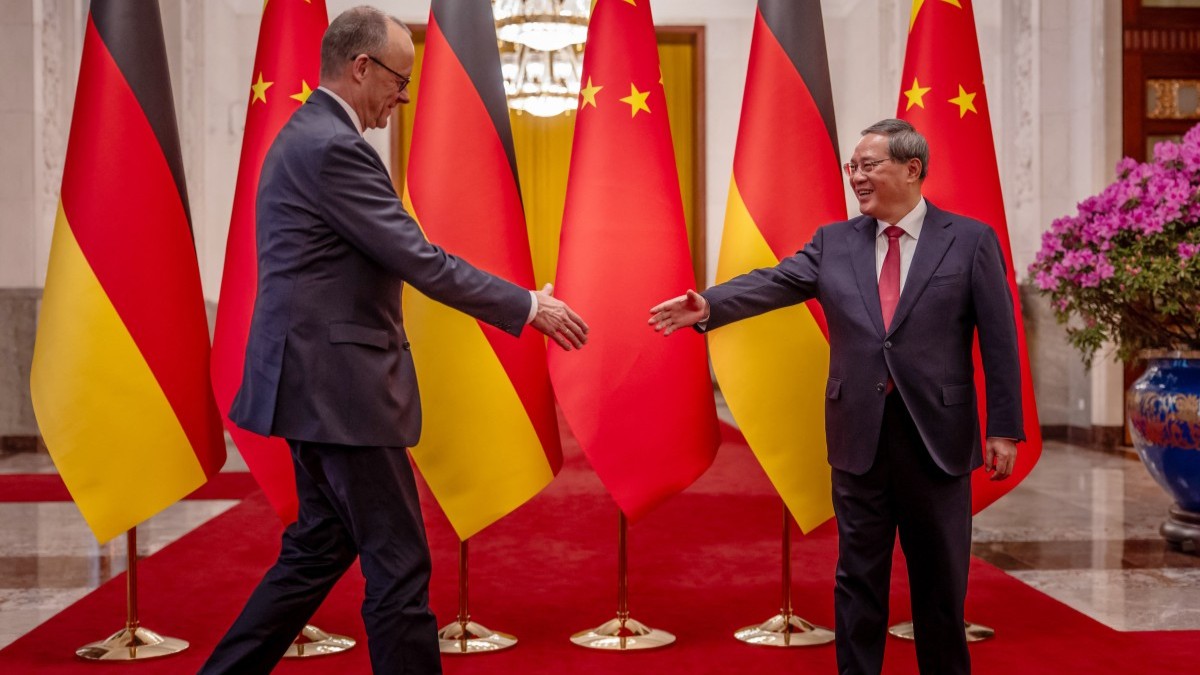
German Chancellor Friedrich Merz is welcomed by China’s Premier Li Qiang at the Great Hall of the People in Beijing on February 25, 2026.
MICHAEL KAPPELER / POOL / AFP
German Chancellor Friedrich Merz begins this week his first official visit to China since taking office at the Federal Chancellery.
The trip comes at a particularly delicate moment for relations between Berlin and Beijing, marked by political tensions and growing economic competition, but also by a commercial interdependence that neither power can ignore.
In recent months, several high-level German officials have traveled to Beijing in search of economic stability and avenues for dialogue in an increasingly complex international context.
China, far from being isolated, is consolidating itself as a central actor to which everyone turns, even those who maintain strategic differences with the Asian giant.
On the economic front, China was Germany’s main trading partner in 2025, with a trade volume of €251.8 billion, representing a 2.1% increase over the previous year. Trade with the United States, affected by Washington’s tariff policy, fell by 5%, although it remains Berlin’s second-largest trading partner.
However, the figures can mask structural tensions. China is the country that sells the most products to Germany —€170.6 billion in 2025, an 8.8% increase— while, as a destination for German exports, it ranks only sixth.
The asymmetry is thus evident. The German market absorbs Chinese industrial goods at highly competitive prices, increasing pressure on key sectors of German industry. In other words, by importing so many Chinese products, it ultimately undermines its own productive capacity. And Germany is not alone in this.
At the same time, the restrictions imposed by Beijing on the export of strategic raw materials, such as rare earths, add a geoeconomic component to the bilateral relationship.
For an industrial economy like Germany’s, dependent on complex supply chains and critical goods for the technological and energy transition, this factor is almost vital. The European Union as a whole finds itself in the same situation.
Merz is traveling accompanied by a delegation of around 30 business leaders, including the president of Volkswagen and the president of Siemens. For these companies, China is not only a market of 1.4 billion consumers, but also a laboratory of innovation in sectors such as electromobility and energy efficiency.
The business presence underscores that, despite warnings about “decoupling” or risk reduction, economic reality imposes pragmatism.
The program of the visit combines political diplomacy and an economic agenda. Merz was received with military honors by Prime Minister Li Qiang and will hold a meeting with President Xi Jinping focused on bilateral relations, the economy, and international security. The issue of Ukraine is on the table.
The chancellor will also take part in a German-Chinese economic commission and visit the headquarters of Mercedes-Benz in Beijing. He will later travel to Hangzhou, where he will meet with the Party secretary of Zhejiang province, Wang Hao, and visit the robotics company Unitree, as well as Siemens Energy facilities.
The agenda reflects the dual priority of strengthening political dialogue and securing the position of German industry in a key market.