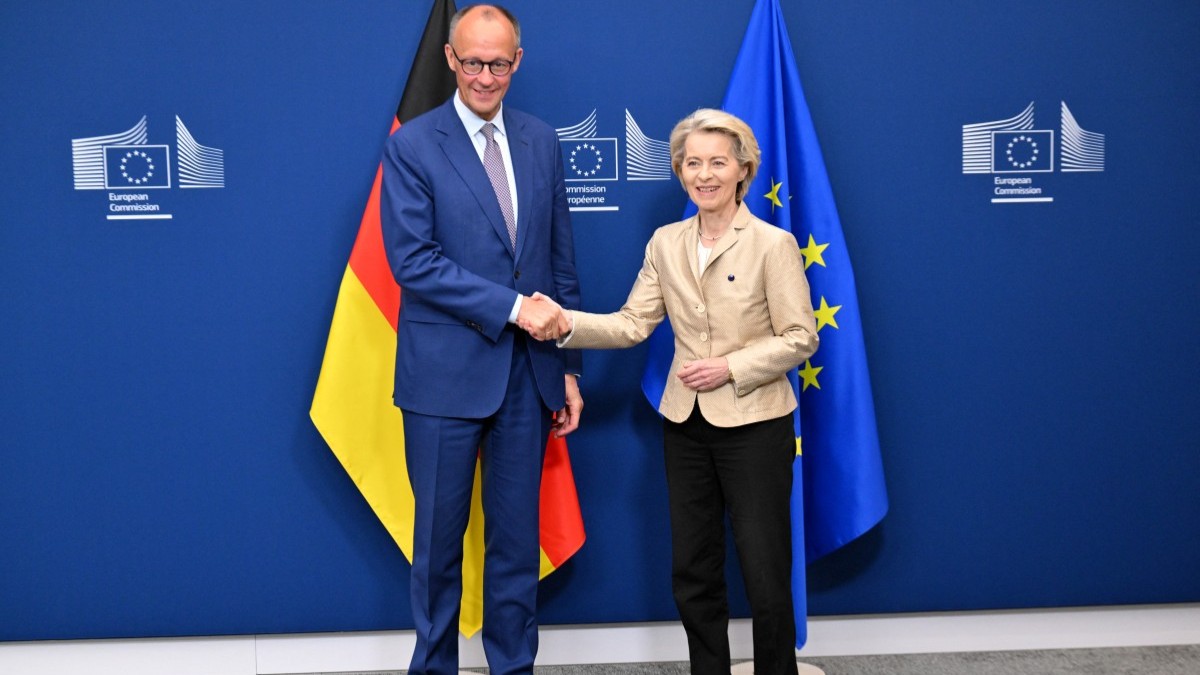
European Commission President Ursula Von der Leyen and German Chancellor Friedrich Merz shake hands prior to a meeting at the EU headquarters in Brussels on May 9, 2025.
Photo: Nicolas Tucat / AFP
Germany’s new Chancellor, Friedrich Merz, travelled to Brussels on May 9th after taking office this week, in a visit loaded with symbols but also cautious messages. The main one: he does not see Ukraine’s entry into NATO as feasible in the short term, despite pressure from Kyiv and some allied sectors.
The German chancellor took advantage of the visit to meet with the three European leaders: the President of the European Parliament, Roberta Metsola, the President of the Council, António Costa, and the President of the Commission, Ursula von der Leyen.
“Ukraine has the prospect of joining the European Union, which will surely come before any eventual NATO accession, if that ever materializes one day,” Merz declared after meeting with NATO Secretary General Mark Rutte. The German chancellor insisted that Kyiv must maintain its sovereignty to decide on its alliances, although everyone knows Moscow is watching every step closely.
In reality, behind the careful statements lies the growing discomfort in Berlin and other European capitals over the possibility of dragging NATO into an open conflict with Russia. Although the Alliance formally maintains its “open door”policy, there is neither a timetable nor firm consensus on Ukrainian membership, and the United States, under Donald Trump, has made it clear it is in no hurry.
During his visit to NATO headquarters, Merz was welcomed with praise by Rutte, who highlighted Germany’s central role in Europe and applauded its increased defense spending to build, in his words, a “stronger, fairer, and more lethal” Alliance. However, German pragmatism became evident when Merz rejected proposals to create new joint European debt as a way to finance continental rearmament. “This must remain exceptional,” he stated firmly, distancing himself from those voices who want to turn every crisis into a blank community check.
Merz also took the opportunity to underline Turkey’s strategic value as a key partner and announced he would accept President Recep Tayyip Erdoğan’s invitation to visit Ankara. This gesture seeks to balance relations at a time when the stability of NATO’s southern flank remains decisive.
Finally, amid trade tensions with the United States, Merz assured that Germany and the European Union will not break their united negotiating front to seek bilateral agreements with Washington. This was a veiled warning to President Trump, who is pressing to fragment the European bloc. European Commission President Ursula von der Leyen made it clear she would not travel to the White House unless a concrete package is on the table.