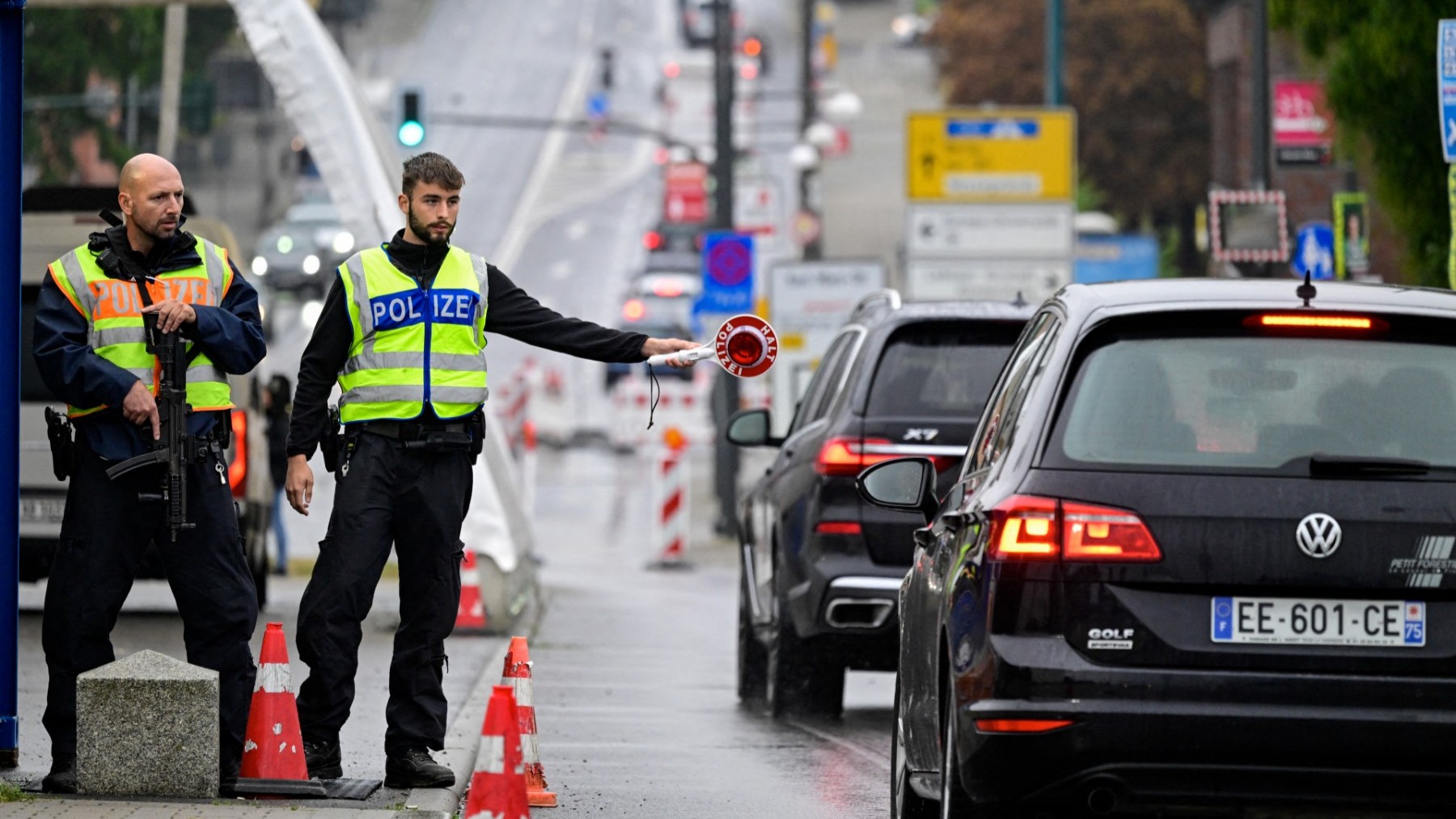
A German police officer flags down a car while controlling the traffic from Poland across the ‘Bridge of Europe’ near Frankfurt (Oder) on September 16, 2024.
John MacDougall / AFP
The EU’s 2026 migration pact is being slammed as a blueprint for legalising mass immigration—while doing little to stop the crisis at Europe’s borders.
Last week, the European Commission published a progress report on the implementation of the European Pact on Migration and Asylum, which is expected to be fully operational by June 2026. Although Brussels notes progress in technical areas like fingerprinting, it also issues an urgent call to Member States to reinforce several key areas, including border procedures and legal guarantees for migrants.
However, behind this technical appeal lies a troubling reality: the pact does not aim to curb immigration but to redirect it through legalized channels, opening pathways that previously did not exist. As many critical voices have warned, this strategy could lead to a profound transformation of the European model without addressing the causes of mass immigration or its consequences on host societies.
Far from establishing effective deterrence mechanisms, the new pact opts to convert illegal immigration into a “managed” reality. It does not propose harsher penalties for those who promote illegal immigration, nor concrete measures to eliminate the pull factor that overwhelms external borders. On the contrary, the phenomenon is made semi-official through new categories, procedures, and legal guarantees that grant more rights to migrants without reinforcing obligations or state control mechanisms.
The Commission insists on strengthening “solidarity” between countries and providing “free legal aid” to those who arrive on European soil, but avoids any mention of how to stop people coming in the first place.
Paradoxically, the report devotes little attention to protecting the Schengen Area. As sources in the European Parliament have warned, Schengen’s survival depends on the existence of effective immigration control mechanisms. If anyone can enter and move freely throughout European territory without genuine filters, the concept of a common area of freedom, security, and justice becomes meaningless. The result is an erosion of trust among States and a resurgence of internal border controls, as happened during the 2015 migration crisis.
Schengen was conceived as a free movement zone backed by strong external border control. However, if Brussels prioritizes the rights of those who enter illegally over the security of European citizens, it puts that agreement’s legal and political foundations at risk.
Criticism of the pact is not limited to the traditional sovereignist right. In a recent interview with europeanconservative.com, Balázs Orbán—chief adviser to Hungarian Prime Minister Viktor Orbán—warned that the new legal framework is a “backdoor” that would normalize mass immigration. He denounced that even conservative parties have accepted this pact without properly assessing its implications.
Orbán emphasized that an effective migration policy should focus on halting new entries, not enabling new mechanisms to facilitate them. He also expressed concern about the impact of these measures on Europe’s cultural cohesion and the pressure they place on Eastern Member States, which have traditionally adopted more restrictive policies in this area.
The imposition of this pact comes at a particularly sensitive time for the European Union, as support grows for parties advocating stricter migration control policies, and citizens increasingly see Brussels as a distant bureaucracy responding more to ideological agendas than to reality on the ground.
In many European cities, this policy has generated entire neighborhoods outside state control, a worrying rise in crime, the collapse of social welfare systems, and cultural fragmentation that threatens national cohesion.