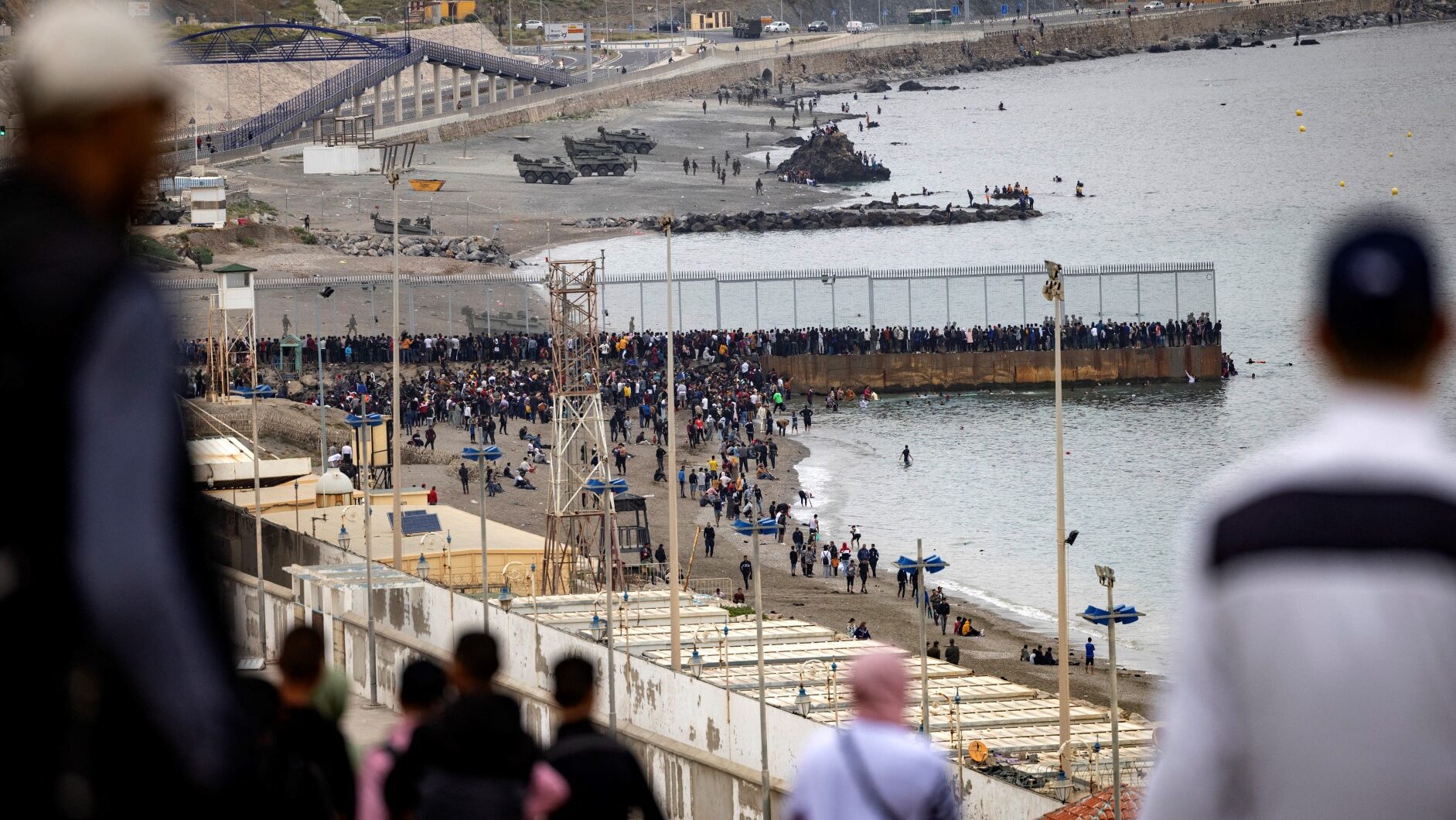
A Spanish Supreme Court ruling restricting the immediate return of migrants arriving by sea has been blamed for an influx that has overwhelmed the reception system in Spain’s North African territory of Ceuta.
Between 1,500 and 2,000 migrants, mainly from Morocco, reached Ceuta by sea over a period of nine or ten days, according to the city’s Mayor-President, Juan Jesús Vivas.
“In the last few days, more than 1,500 migrants, including adults and minors, have reached Ceuta by sea,” Vivas told journalists.
“The reception centers have collapsed and are over-saturated,” he said. Ceuta’s temporary migrant reception centre, which has 512 official places, was housing nearly 600 people, while more than 400 others waited outside.
“We are in a very serious situation. We are in a very difficult situation,” Vivas added, warning of conditions like those in May 2021, when around 8,000 illegal migrants stormed and entered Ceuta in just two days, equal to around 10% of the local population.
Footage circulating on the internet shows how easy it is to enter the exclave by sea, as migrants only need to swim around a short pier to bypass the fence that marks the Spanish-Moroccan border.
🚨BREAKING: An emergency has now been declared in the Spanish city of Ceuta after tens of thousands of illegal migrants break in from Morocco
— Inevitable West (@Inevitablewest) July 30, 2026
Pedro Sánchez is REFUSING to deploy the military to defend the borders. 🇪🇸 pic.twitter.com/OvtzvEZxBs
While mainstream media is still reluctant to address the possible causes of the sudden influx of migrants, Vivas offered a simple explanation right away.
In his address, the Mayor-President blamed the Supreme Court’s latest ruling issued in July, which found that migrants intercepted at sea or after swimming to Ceuta could not be summarily returned in the same way as those stopped while crossing the land fence. Instead, they must undergo the ordinary return process with the relevant legal and asylum safeguards.
Vivas warned that the decision had removed an important deterrent and called on Spain’s main parties to amend immigration law to restore immediate returns. Hundreds of migrants were meanwhile sleeping or waiting outside the overcrowded reception centre.
By Thursday, local authorities declared a state of emergency and asked the central government for an extraordinary national response, including a unified command and the temporary closure of the border with Morocco.
Interior Minister Fernando Grande-Marlaska was quick to acknowledge that there was an “extraordinary, exceptional situation” on the ground, and said the government was closely cooperating with Morocco to curb illegal departures. To no effect, so far.
The minister also promised to “guarantee the safety of citizens and the integrity of the nation’s border,” but refused to call a national emergency.
Meanwhile, the Spanish Civil Guard, the Maritime Rescue Service, and the Red Cross had been deployed on the scene to rescue the migrants in the water, where over 60 of them died over the course of last year.
Thousands of illegal migrants have poured into the tiny Spanish territory of Ceuta from Morocco.
— AF Post (@AFpost) July 30, 2026
Spain’s Interior Ministry disingenuously claims to “guarantee the safety of citizens and the integrity of the nation’s border” but has declined to declare a national emergency over… pic.twitter.com/xqmuk9Yjds