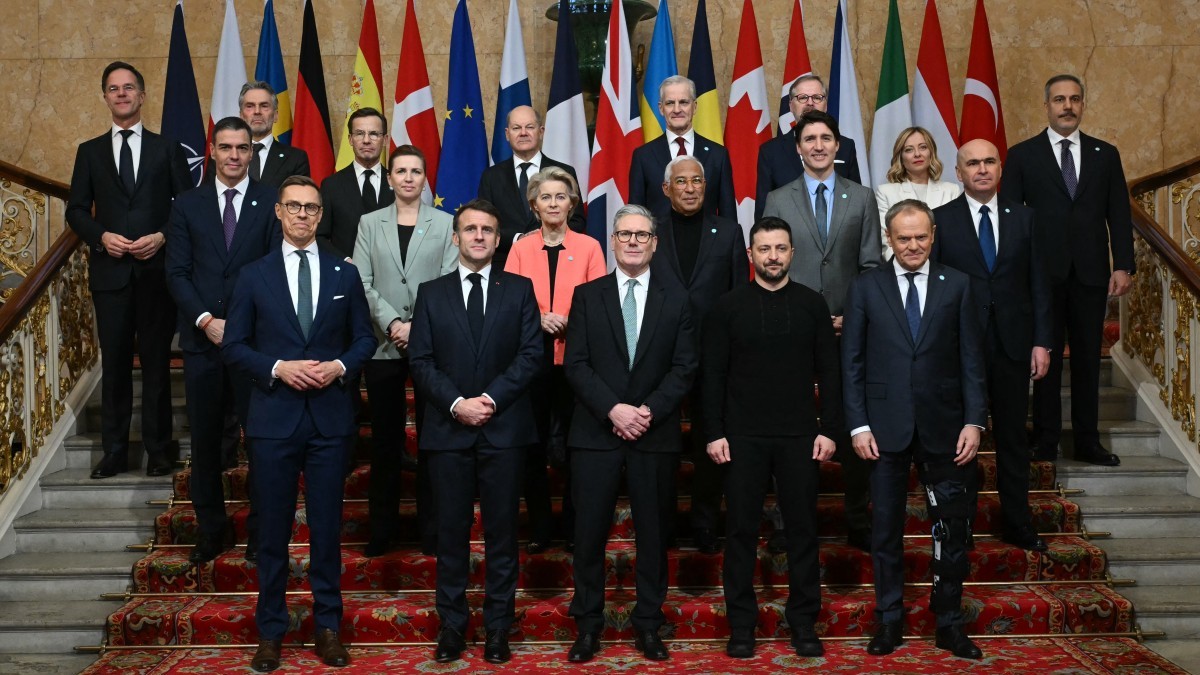
Family photo of European leaders with then Canadian PM Justin Trudeau, Turkish Foreign Minister Hakan Fidan and Ukraine’s President Volodymyr Zelensky on March 2, 2025 at a London summit.
Justin Tallis / POOL / AFP
Spain has been publicly humiliated at the NATO summit after new Secretary General Mark Rutte flatly denied Pedro Sánchez’s claim of an exemption from the Alliance’s new 5% defence spending goal.
Rutte dismantled the Spanish prime minister’s headline claim last Sunday in just a few minutes — that he had secured an “exception” to avoid reaching the new 5% of GDP defence spending goal. Rutte was blunt: “There is no alternative. Everyone must meet the 5%. There is no exception for Spain.”
Rutte also exposed the naivety of media outlets that echoed Sánchez’s narrative without fact-checking. The Dutch NATO chief made clear that there is no special arrangement for Spain, and that the Alliance expects it to spend roughly 3.5% of GDP on military defence and another 1.5% on national security—just like every other member.
Donald Trump, the main driver behind the 5% goal, expressed his disappointment with Spain’s stance from Air Force One en route to The Hague: “There is a problem with Spain. Not accepting 5% is very unfair to the rest.” Trump has demanded a fairer distribution of the defence burden within the Alliance, warning that the U.S. could reconsider its involvement if “freeloaders” fail to pull their weight.
Despite the diplomatic embarrassment suffered by Sánchez, Rutte downplayed the risk of derailing the summit: “I don’t think Spain will ruin the summit,” he said.
Donald Trump also once again left his European partners reeling by questioning the essence of NATO’s Article 5—the collective defence clause that commits allies to defend any member under attack. Asked about his commitment to this cornerstone of NATO, the former president simply stated: “I am committed to security. We’ll see.”
His words, in the middle of a war in Ukraine and with increasing threats from Russia, China, or Iran, cast doubt on NATO’s viability as a strategic shield. While Rutte tried to reassure that “the U.S. is fully committed”, the truth is that Trump has made it clear that commitment depends on the allies’ financial compliance: no pay, no protection.
Another explosive moment came from European Commission president Ursula von der Leyen, who claimed that Ukraine’s arms industry is being integrated “as if Ukraine were already in the EU.”
We are integrating our defence industries as if Ukraine was in the EU.
— Ursula von der Leyen (@vonderleyen) June 24, 2025
This is good for Ukraine. And just as good for Europe, as Ukraine is now home to extraordinary innovation.
In the end, strength is the ultimate security guarantee ↓ https://t.co/W2tiPCurLc
This is a deeply concerning leap. The EU has no unified foreign or defence policy, yet it allows a practical merger of its industrial base with a country at war. The justification is Ukraine’s “extraordinary innovation” in military tech, from which — according to Von der Leyen — Europe must learn. However, the truth is that a non-member state is being funded, supported, and tied to the EU’s strategic core without an explicit political mandate or consensus among all member states.
To facilitate this integration, the Commission has launched the SAFE programme. This financial tool allows EU members and third countries like Ukraine, the UK, or Japan to access EU funds for joint arms production. Moreover, EU regulations will be amended to allow dual-use (civil-military) projects to be deployed on shared platforms. The obsession with “dual use” rapidly transforms the EU’s civilian nature into a military-industrial complex.
In parallel, Ukrainian President Volodymyr Zelensky called on all European NATO members to devote at least 0.25% of their GDP to military support for Kyiv and met with Von der Leyen, Rutte, and European Council President António Costa to coordinate the new financial and industrial support plan. Costa supported advancing Ukraine’s EU accession and announced new sanctions against Moscow, including lowering the Russian oil price cap from €60 to €45 per barrel.
The Hague summit is becoming a showcase of all the fractures running through the West: financial blackmail from the United States, political improvisation from Brussels, relentless pressure from Kyiv, and the widening gap between European citizens and the decisions of their ruling elites.
While Pedro Sánchez plays domestic politics with figures that neither he nor anyone can sustain, reality bites: Spain will have to meet the 5% defence target to remain in the club.