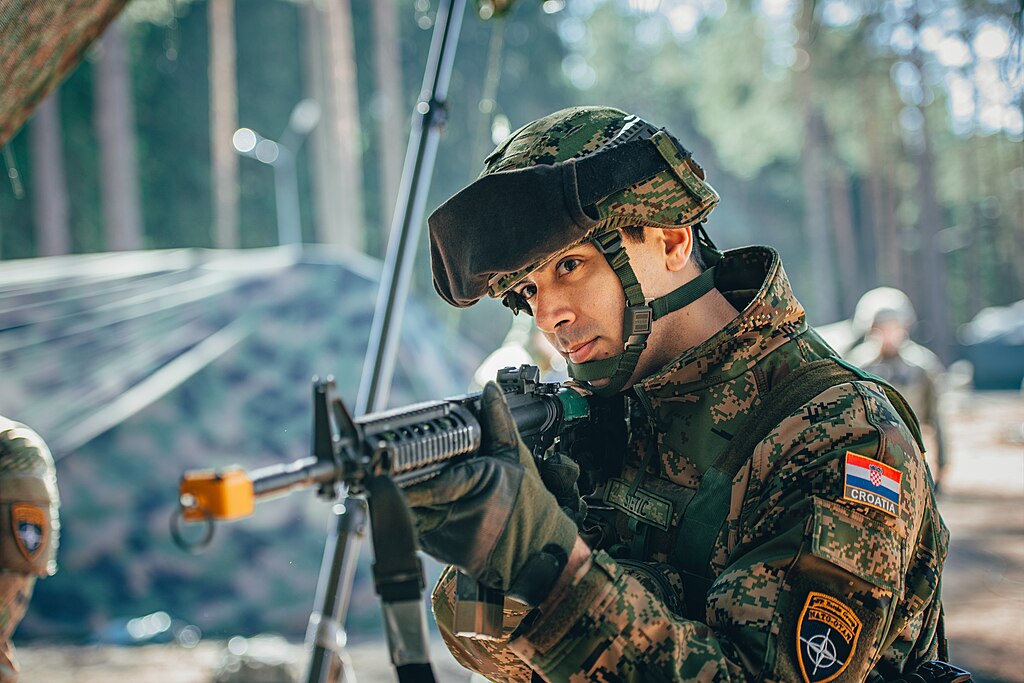
A Croatian soldier, operates a M4 carbine as part of the training phase for the Expert Infantryman Badge and the Expert Soldier Badge in Bemowo Piskie, Poland, March, 24, 2020. The soldiers participating in EIB and ESB are deployed in support of NATO’s enhanced Forward Presence Battle Group-Poland.
U.S. Army photo by Sgt. Timothy Hamlin, Public domain, via Wikimedia Commons
NATO’s latest report shows how, while almost all member states have already met the 2% defense spending target relative to their GDP, the European Armed Forces are facing a serious personnel problem. The Atlantic Alliance warns that several national armies are unable to replace losses or meet new operational needs, which is threatening to undermine Europe’s military credibility in a context of growing tensions with Russia and U.S. pressure to reinforce the eastern flank.
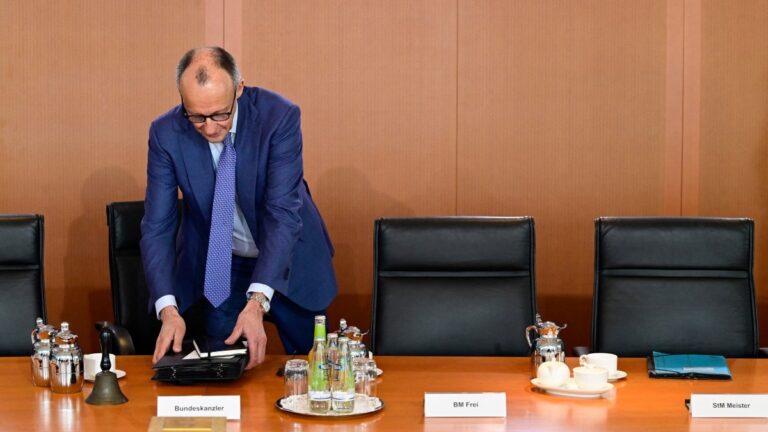
The country that has reacted most clearly to this trend is Germany. Chancellor Friedrich Merz’s government approved a bill to reinstate military service in a mixed format this week: initially voluntary, but with the option to reintroduce compulsory service in case of emergency. The measure responds to the Bundeswehr’s difficulty in attracting recruits in a competitive labor market and the fact that the German army, with 186,400 troops, must expand its capabilities if it wants to meet NATO commitments.
Berlin could become the reference point for other European states. The combination of demographic aging, the declining appeal of the military career, and a radical change like war forces governments to consider unpopular reforms. In Brussels’s diplomatic circles, there is already talk of a ‘domino effect’ that could spread in the coming years to countries such as France, Poland, or even Italy, where replacement rates are increasingly low.
NATO identifies a cross-cutting phenomenon: the lack of interest among young people in enlisting. One factor noted by experts is the perception that modern warfare has lost its ‘human’ and camaraderie dimension, replaced by the growing prominence of drones and artificial intelligence on the battlefield. Testimonies from soldiers deployed in Ukraine indicate that the massive use of unmanned systems increases the sense of vulnerability and reduces the motivation to sign up for combat missions.
Added to this is salary competition: in many countries, a newly graduated lieutenant earns less than a police officer or customs agent in comparable conditions. NATO notes that although defense budgets have grown significantly since 2022, much of this increase goes to equipment purchases and technological programs, while investment in personnel is reduced.
As we’ve previously pointed out, the low interest in enlisting also points to a significant cultural shift in Europe, where Brussels’ policies have steadily eroded national identity. For years, many national governments—shaped by post-national ideologies—have portrayed patriotism as something suspect, often equating it with the ‘far right’ or even fascism. Yet today, these same governments appear to expect citizens to enlist en masse and be ready to defend not only their countries, but an amorphous ‘Europe’ that most have no innate loyalty to.
The report highlights a clear gap between countries. While Poland has doubled its forces in just a decade, from 99,000 to 233,800 troops, other Western states show the opposite trend. The United Kingdom has lost 30,600 personnel in the same period, Italy 12,300, and Spain 3,600, placing them among the three European countries with the most significant drop in manpower.
France maintains a solid base with more than 200,000 service members but struggles to sustain its expeditionary forces in Africa and the Middle East. Greece and Turkey, for their part, show a more stable situation thanks to the tradition of compulsory military service. However, in Turkey’s case, the figures also respond to a context of strong domestic nationalism.
The return of the conscription debate threatens to open a new political front in Europe. In Germany, the Greens and Liberals have already voiced their reservations, while in France, President Emmanuel Macron resists reviving a model of universal conscription abandoned more than twenty years ago. Prime Minister Pedro Sánchez’s government has ruled out any similar measure in Spain, although experts warn that the country faces the same demographic and motivational challenges as its neighbors.
The report concludes that, unless the trend is reversed, Europe could in a few years have armies better equipped than ever, but incapable of deploying in sustained operations due to a lack of human personnel.