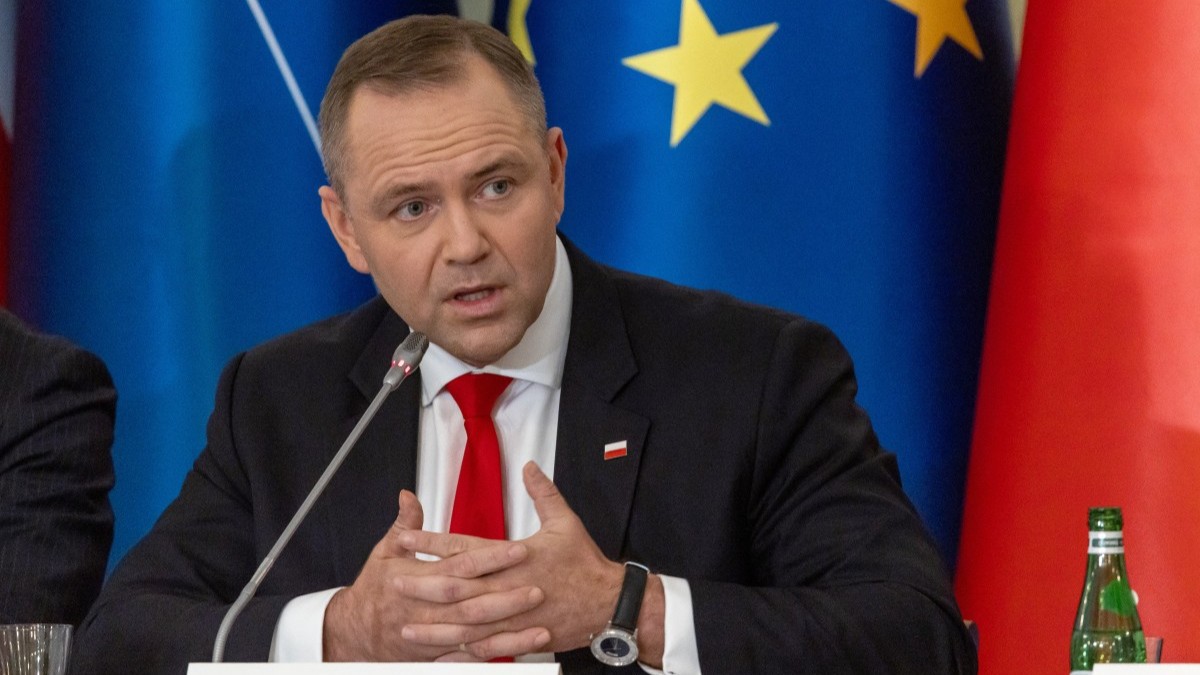
Poland’s President Karol Nawrocki speaks at the beginning of the National Security Council convened by him at the Presidential Palace in Warsaw on September 11, 2025, a day after Warsaw accused Moscow of carrying out a drone raid on its territory.
Wojtek Radwanski / AFP
In a decisive move responding to a significant breach of its sovereignty, Polish President Karol Nawrocki has granted formal approval for the deployment of enhanced NATO military forces to Poland. This authorization comes directly after last week’s incident where Russian drones violated Polish airspace during a mass strike on Ukraine.
The president’s National Security Bureau (BBN) officially confirmed the development on Sunday through a post on X. The statement clarified that President Nawrocki had “signed a resolution granting consent for the presence on the territory of Poland of a component of foreign forces from NATO as reinforcement of Poland as part of Operation Eastern Sentry.” This procedural step was necessary to legally enable the broader and more robust foreign military presence required for the new mission.
Operation Eastern Sentry itself was announced by NATO on Friday, September 12th. It represents a strategic and rapid reinforcement initiative aimed at fortifying the alliance’s eastern flank, with a particular focus on integrated air and missile defense capabilities. In a joint statement, NATO Secretary General Mark Rutte and Supreme Allied Commander Europe (SACEUR) General Christopher G. Cavoli said three Rafale fighter jets from France, four Eurofighter jets from Germany, and a contingent from Denmark comprising two F-16 fighter jets supported by an anti-air warfare frigate would be first deployed. NATO headquarters emphasized that this initial wave is just the beginning, stating,
These forces and more will reinforce existing allied forces and enhance NATO’s deterrence and defensive posture where and when needed.
The momentum behind the operation continues to build, with additional nations pledging resources. The Netherlands announced it would accelerate the planned deployment of its advanced Patriot air defense systems to Poland. The Czech Republic has also dispatched a helicopter unit to contribute to the enhanced security system.
The broader strategic context of this deployment was highlighted by Polish Defense Minister Władysław Kosiniak-Kamysz in a statement on Saturday. He praised NATO’s collective “tough, clear response” to Russia’s provocative actions, characterizing Operation Eastern Sentry as “a very serious operation, probably one of the largest in NATO’s history” in terms of its scope and strategic importance for regional defense. He emphasized that the goal is to counter “all types of threats that may arise,” indicating a long-term and persistent defensive strategy. The minister also revealed that eight NATO member states have already formally declared their participation in the operation.
The escalation follows the incursion of around 20 Russian drones into Polish airspace on the night between Tuesday and Wednesday, crossing the border from Belarus and Ukraine. Polish air defense shot down some of the drones. On September 10th, Prime Minister Donald Tusk announced in the Sejm that Poland had invoked NATO’s Article 4 to trigger allied consultations, and Polish authorities summoned Russia’s top envoy in Warsaw. The following day, Foreign Minister Radoslaw Sikorski requested an emergency UN Security Council meeting, in light of what he called “an unprecedented Russian drone attack on a member of the UN, EU, and NATO.”
Russia has denied responsibility, with a senior diplomat in Warsaw claiming the drones came from Ukraine, while Moscow’s defense ministry said its strikes targeted facilities in western Ukraine and had no intention of hitting Poland.
While NATO leaders have supported Poland’s position, U.S. President Donald Trump suggested the incursions “could have been a mistake” by Russia.