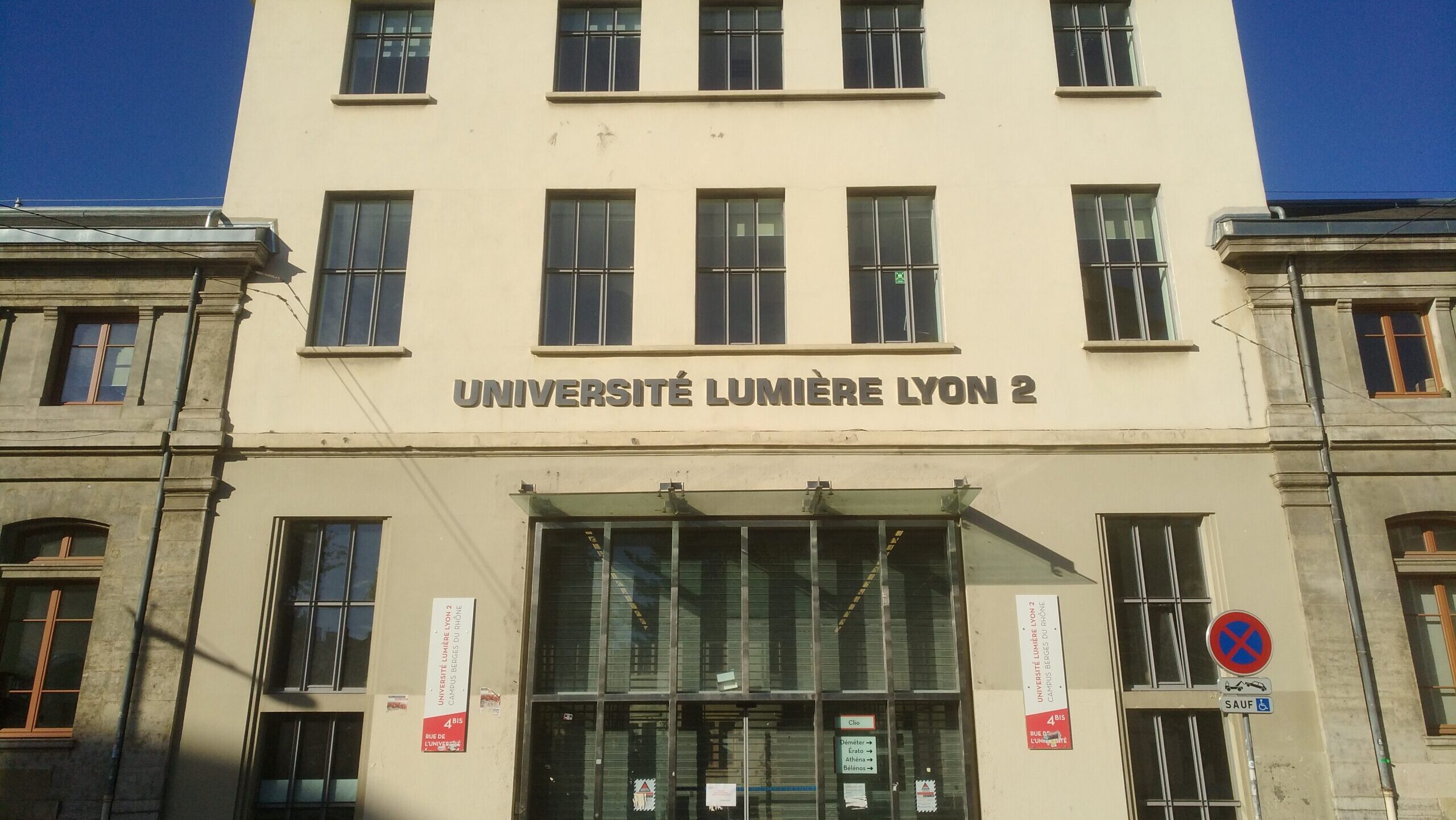
Lyon 2 university
Sebleouf, CC BY-SA 4.0, via Wikimedia Commons
At a time when pro-Palestinian MEP Rima Hassan is being welcomed with honours at the Institut d’Etudes Politiques de Lyon (Sciences Po Lyon), Professor Fabrice Balanche, just a few metres away, is under the protection of a private security firm for having opposed the holding of a Ramadan fast-breaking banquet on the premises of Lyon 2 University.
The revelation comes from Professor Balanche himself: he has had to teach under the protection of two security guards from a private security company since he was intimidated eleven months ago during one of his lectures by masked individuals, whom he identifies as belonging to “the anti-fascist nebula that reigns on campus.” The reason: he opposed the organisation of Ramadan fast-breaking banquets at the University of Lyon 2, where he teaches political geography of the Middle East. About fifteen masked activists came to disrupt his class, shouting “Racists, Zionists, you are the terrorists,” accusing him of being “pro-Assad, an accomplice to genocide.”
Since then, he has been living under constant threat. His name is spray-painted on the walls of the campus: “Balanche, get lost!” “Balanche Nazi,” “Balanche, get out.” Living in constant fear of physical attack, he now teaches with two private security guards—not police officers—stationed outside the door of his lecture theatre.
In October, a poster campaign carried out jointly in the buildings of Sciences Po Lyon and Lyon 2 targeted him in particular. It was at Sciences Po Lyon that the pro-Palestinian MEP Rima Hassan was invited on February 12th. The La France Insoumise (LFI) activist was greeted by a counter-protest organised by the feminist identity Collectif Némésis, which in turn triggered violence from Lyon’s antifas, leading to the lynching of Quentin Deranque, who had come to protect his friends from the Némésis group.
Young Quentin was a mathematics student at the University of Lyon 2. Professor Balanche deplores the fact that nothing was organised by the institution following his tragic death: “No tribute, no minute’s silence, no display of Quentin’s portrait.” For him, the facts are clear: “Quentin died because he opposed the destruction of the university by the far left.” The university administration focused its communication on the “political exploitation” of Quentin’s death and scarcely expressed its compassion to the victim.
Among professors at Lyon 2 and Sciences Po, the leftist narrative is widely accepted: Quentin remains a “neo-Nazi,” and the “far right,” suspected of having set up an ambush, ultimately got what it deserved. Le Figaro had access to an internal discussion group between professors at Sciences Po Paris, entitled “Débats Privés Enseignants ScPo” (Private Debates among Sciences Po Teachers), which leaves no doubt about their biased interpretation of the facts. The victim, Quentin, is portrayed as “a nationalist activist who was there to protect transphobic racists from Némésis.” Throughout the conversation, comments that deny the very existence of far-left violence are legion. The exchanges, which took place over several days, became so heated that some teachers ended up concluding that “these neo-Nazis got what they were looking for, in more ways than one.” Some teachers ended up demanding an apology from the author of this statement—an economics teacher, who refused to comply and preferred to remain silent.
In Lyon, divisions are only deepening. The favourite candidate for mayor of Lyon, Jean-Michel Aulas, asked the current mayor, the ecologist Grégory Doucet, to display Quentin’s portrait on the façade of the town hall. The latter refused, describing the request as “indecent.” Doucet is known for having ostentatiously displayed his support in the past for La Jeune Garde, the anti-fascist movement responsible for Quentin’s death. For Professor Balanche, there is “an objective ecosystem uniting the city of Lyon, the town hall, Lyon 2 and Sciences Po Lyon.”