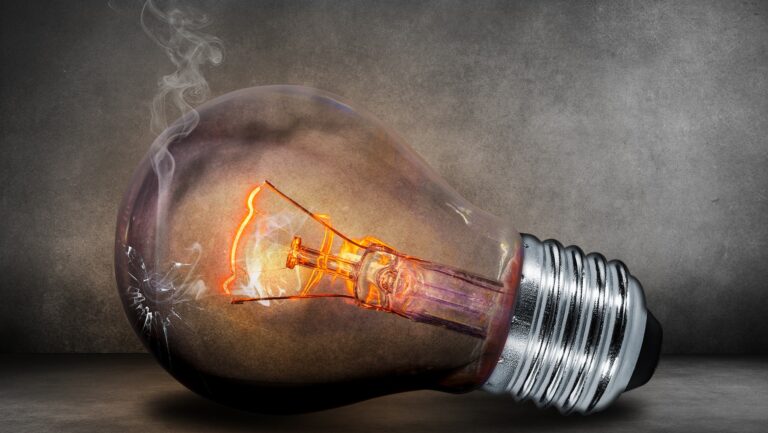
Demonstrators protest for nuclear power with a banner reading ‘Habeck, keep the light on’ before the party congress of the Greens at the World Conference Center in Bonn on October 14, 2022.
Photo: Ina Fassbender / AFP
For decades, nuclear energy was the ecological villain par excellence. Across Europe, ‘nuclear’ was shorthand for disaster: radioactive waste, three-eyed fish, apocalyptic meltdowns. The Green movement—from activist groups to political parties—built its identity on the firm rejection of nuclear power. But times change, and so, it seems, do principles. Today, nuclear energy is making a comeback, not despite the climate emergency, but because of it. And what’s more surprising than the policy shift is who’s starting to support it: some of the very environmentalists who once campaigned fiercely against it.
In January 2023, the European Commission formally included nuclear energy in its “green taxonomy”—the EU’s list of sustainable activities eligible for favorable financing. That label, crucial for investments, allowed nuclear power to be treated as a climate-friendly option. There was a caveat, of course: only plants authorized before 2045 would be eligible, and they must present a clear waste management plan. But the message was clear: nuclear is now green. At least until 2045.
That “at least” is doing a lot of work. It reflects not only the scientific ambiguity some policymakers still want to signal, but also the political caution of a European elite that knows how sensitive the subject remains among its traditional green base.
What followed was remarkable. The inclusion of nuclear in the taxonomy was a technocratic decision, but it triggered a discursive shift. Suddenly, media that once warned of Fukushima-style disasters began highlighting nuclear’s low emissions. Young climate activists, once loyal to the anti-nuclear gospel, began calling for an “evidence-based” environmentalism that includes nuclear alongside renewables. And yes, even some green parties—most notably in Finland — started to adjust their language.
A new wave of pro-nuclear environmental organizations has emerged. Groups like WePlanet, Nuklearia (Germany), Econucleares (Spain), and Italy’s L’Avvocato dell’Atomo advocate for nuclear energy as a necessary part of any serious decarbonization strategy. Their leaders are not industry lobbyists but scientists, engineers, and climate-conscious activists. Many are young, and most share a frustration with what they call decades of “ideological obstruction” within mainstream environmentalism.
James Hansen, the former NASA climate scientist who helped bring global warming to public attention in the 1980s, became a vocal defender of nuclear power. “The opposition to nuclear energy is irrational,” he said. “The fears—radiation, waste, accidents—lack scientific grounding.” This perspective is echoed by a growing number of younger activists. Swedish teenager Ia Aanstoot, once an ally of Greta Thunberg, launched the campaign ‘Dear Greenpeace’ in 2024, urging the organization to abandon what she called an “outdated and unscientific” opposition to nuclear power. She was joined by like-minded environmentalists from Poland, France, the Netherlands, and Finland.
Meanwhile, in Finland, the Green Party—long opposed to nuclear power—officially reversed its position in 2022. Its members now support extending the life of existing plants until at least 2050. For Finnish activist Tea Törmänen, nuclear energy is no longer taboo. “Going backwards won’t save our children,” she says. “As a mother, I want climate solutions that work — not just slogans.”
The shift isn’t limited to northern Europe. In Sweden, the government has unveiled plans to build at least ten new reactors by 2045. In Italy, Prime Minister Giorgia Meloni has brought nuclear energy back into the national energy strategy. Even Japan, which moved to phase out nuclear after the 2011 Fukushima disaster, is now reversing that course. China is building more than 30 new reactors. Canada, the UK, and the United States have pledged to triple their nuclear capacity by 2050.
And then there’s Spain—still planning to shut down its five operating nuclear plants between 2027 and 2035, despite nuclear currently supplying nearly 20% of the country’s electricity. In 2019, the Spanish government under environment minister Teresa Ribera announced the phased closure. But public opinion is shifting: a 2025 survey by Sigma Dos found that 68% of Spaniards would oppose the closures if they meant higher electricity bills. Another poll in 2024 showed 58% of citizens wanted to keep the reactors running.
Even the argument about waste, often the last resort of nuclear opponents, is being re-examined. So, what explains this reversal? One could argue it’s scientific enlightenment, but a more cynical interpretation is also plausible: once Brussels certified nuclear as ‘green,’ the narrative space changed. The media, the markets, and even some NGOs followed. Suddenly, those who had long called nuclear a “dirty” or “dangerous” energy had to find more nuanced language. Some are still trying.
Greenpeace, for instance, maintains its opposition, calling the pro-nuclear environmental groups “tokenistic.” Its spokesman, Francisco del Pozo, recently declared: “You can’t be a pacifist and pro-nuclear. And certainly not an environmentalist.” Yet public pressure is rising, and the green movement is no longer ideologically monolithic.
The shift is also generational. Younger activists tend to view nuclear energy with less suspicion and more pragmatism. Many see climate change not as a distant danger but as a present threat that requires immediate, scalable solutions. And unlike older generations traumatized by Chernobyl, they did not grow up in the shadow of the Cold War.
Still, the contradiction is hard to miss. For decades, being “green” meant being anti-nuclear. Now, with the EU’s blessing and growing scientific support, nuclear is being rebranded as the very definition of sustainable. The atom is back. And this time, it’s wearing green.