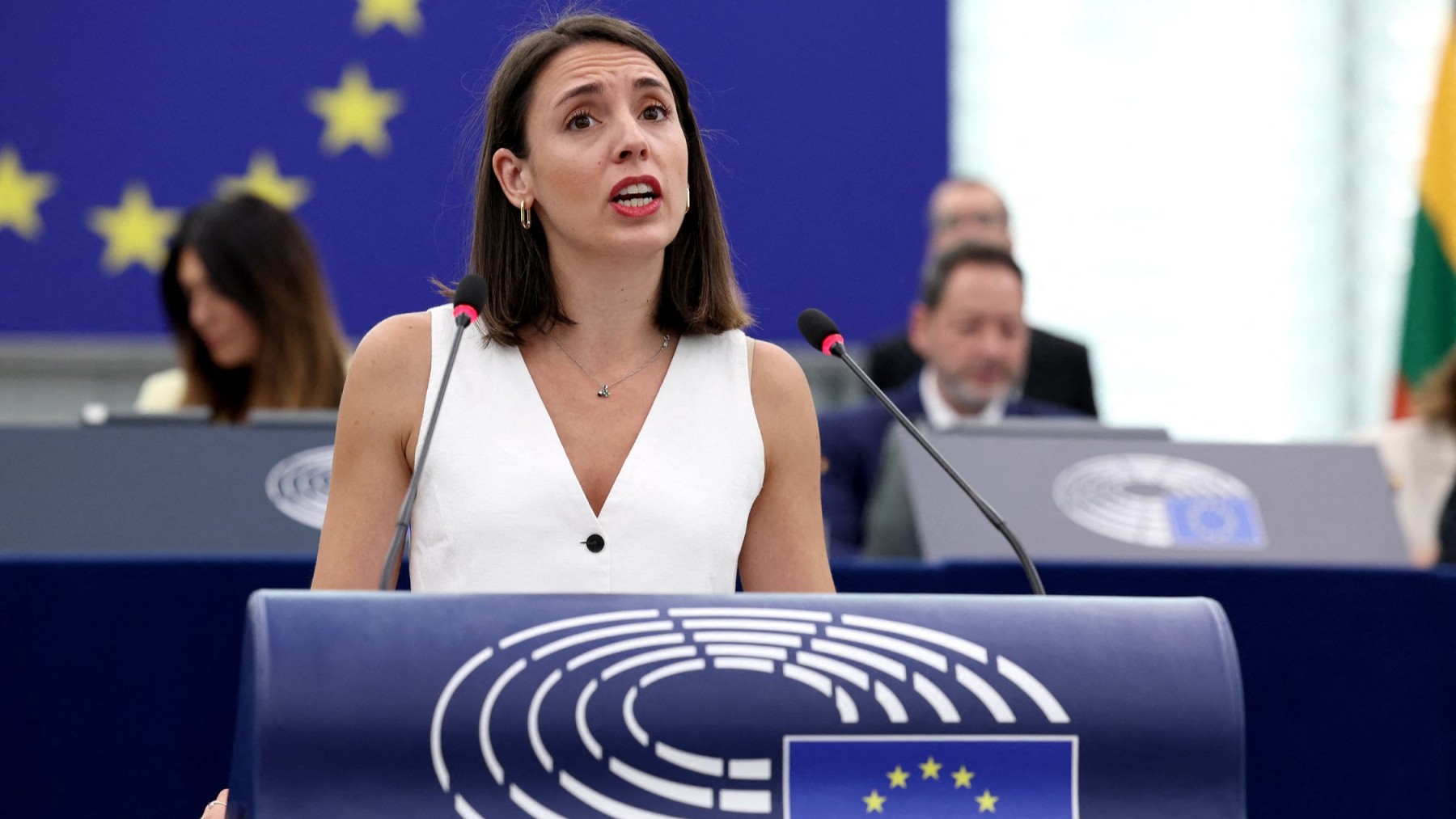
MEP Irene Montero speaks during a voting session to elect the new President of the European Parliament during the first plenary session of the newly-elected European Assembly in Strasbourg on July 16, 2024.
FREDERICK FLORIN / AFP
A short video clip from Spain has reverberated far beyond, exposing a fault line in Europe’s migration debate and fueling claims that parts of the continent’s far left view immigration not only as a social policy but as an electoral instrument.
The footage shows Irene Montero, a senior figure in Spain’s hard-left Podemos, former equality minister and currently serving as an MEP, addressing a public event. In it, Montero expresses her hope that immigration will help “sweep this country of fascists and racists,” a remark widely interpreted by critics as endorsing demographic change to alter voting outcomes.
Since circulating on X, the video has surpassed five million views, rapidly becoming a focal point in international political commentary.
🇪🇸 | The leader of the Spanish far-left admits at an event that she is in favor of replacing the native population with foreigners to alter voting dynamics:
— ʜᴇʀQʟᴇs ᴇɴɢ (@Herqles_eng) January 31, 2026
«I hope for 'replacement theory,' I hope we can sweep this country of fascists and racists with immigrants. Whatever their… pic.twitter.com/f4vzpGx7jn
What might once have remained a domestic controversy instead exploded onto the global stage after being amplified by prominent international voices. Dutch commentator Eva Vlaardingerbroek framed the clip as a rare moment of candor from Europe’s radical left, arguing that it confirms long-held suspicions about demographic engineering being used as a political strategy.
This woman, who is calling for the replacement of White people, is married to a White man and has three White children.
— Eva Vlaardingerbroek (@EvaVlaar) February 1, 2026
This level of betrayal not just of your own people, but your own children, can only be qualified as extreme pathology or pure evil —or both. https://t.co/SCvx3QZpVo
The debate escalated further when Elon Musk, owner of X, weighed in, condemning the remarks in stark terms and accusing Montero of advocating the elimination of a political group through demographic means. His intervention ensured that the controversy reached audiences well beyond European policy circles.
In the United States, conservative intellectual Jared Taylor described the applause Montero received at the event as “chilling,” underscoring how normalized such rhetoric can become within certain ideological spaces.
For critics, the episode has become emblematic of a broader phenomenon across Europe’s far left: the convergence of pro-migration advocacy with explicit electoral calculations. Parties like Podemos argue that increased immigration strengthens diversity, social justice and economic sustainability. Opponents counter that this language often masks a more instrumental logic — one in which demographic change is openly welcomed as a way to reshape the electorate.
While mainstream center-left parties typically emphasize integration and labor-market needs, Podemos has long positioned itself at the ideological edge of European politics. Its discourse frequently blends identity politics with structural critiques of capitalism and nationalism, placing it in line with similar movements in France, Germany and parts of the Nordic left.
Supporters of Montero insist her words were metaphorical, aimed at denouncing racism rather than calling for the replacement of native populations. Yet the choice of language—invoking “replacement” in a continent already sensitive to demographic anxiety—has proven politically combustible.
Irene Montero’s comments have provided critics with a powerful example to argue that parts of Europe’s extreme left no longer merely tolerate demographic change but actively welcome it as a political lever. For international observers, Podemos now serves as a case study in how migration policy, identity politics and electoral strategy can merge—and how quickly such moments can escape national boundaries.
As Europe heads into another cycle of elections marked by polarization and distrust, the controversy underscores a central question: can democratic societies sustain open migration debates without sliding into rhetoric that treats populations as tools rather than citizens?