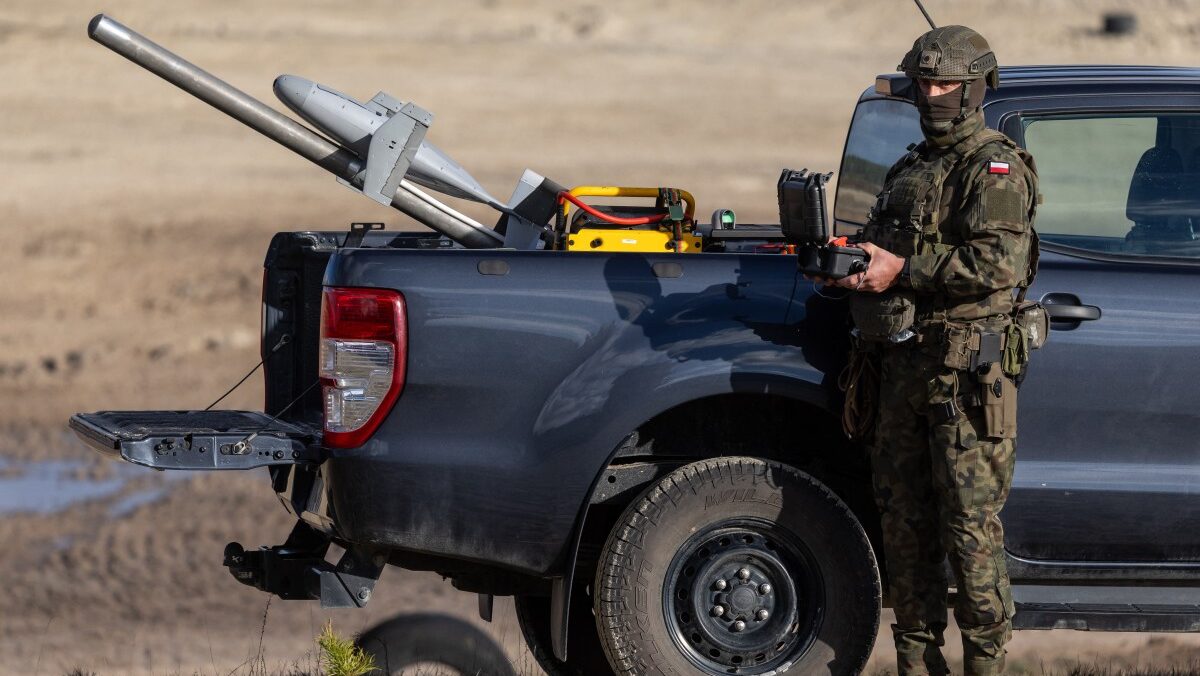
A Polish soldier launches an interception drone of the American MEROPS counter drone system during tests at the Nowa Deba military training ground, south-eastern Poland, on November 18, 2025.
WOJTEK RADWANSKI / AFP
Poland’s parliament has approved legislation enabling the country to tap into the European Union’s flagship SAFE defence loan scheme, but the decision has deepened political divisions and triggered a fierce backlash from the conservative opposition, which warns that Warsaw is trading sovereignty for debt.
Lawmakers in the Sejm voted 236–199, with four abstentions, to pass the bill establishing a special financing mechanism that would allow Poland to borrow up to €43.7 billion under the Security Action for Europe (SAFE) programme.
The funds would be channelled through a new instrument managed by state development bank BGK and are intended to support the modernisation of the armed forces.
The government of Prime Minister Donald Tusk argues that SAFE offers uniquely favourable terms, including low-interest, long-term loans with a 10-year grace period for principal repayments, at a time when Poland plans to spend nearly 5% of GDP on defence.
Finance minister Andrzej Domański told parliament that the programme would deliver “billions” for the military, while defence minister Władysław Kosiniak-Kamysz called the vote historic.
However, the opposition national-conservative Law and Justice (PiS) party and the right-wing Confederation bloc voted against the bill, warning that the loans would burden Poland with decades of repayment and expose defence spending to political pressure from Brussels.
PiS leader Jarosław Kaczyński said the SAFE loans were not additional defence funding but a mechanism that would lock Poland into long-term dependence on Brussels, warning in particular against “the principle of conditionality—in effect political blackmail, which gives the EU the right to suspend payments at any moment” and “the lack of statutory guarantees that the money will go to the Polish defence industry.”
Pożyczki z SAFE nie są dodatkowymi środkami na obronność. Mają zastąpić część już istniejących funduszy. Wejście w ten program w takim kształcie to wieloletnie finansowe uzależnienie się od katalogu produktów, który został wskazany przez Komisję Europejską. To tak naprawdę…
— Jarosław Kaczyński (@OficjalnyJK) February 12, 2026
Opposition figures have repeatedly raised concerns about the principle of conditionality, under which disbursements could be suspended, and about money flowing to European firms instead of Polish companies.
Former defence minister Mariusz Błaszczak argued that SAFE, in its current form, undermines national sovereignty and blocks the independent development of Poland’s armed forces. PiS MP Łukasz Schreiber said the government had rejected amendments that would have guaranteed the vast majority of funds for Polish defence firms.
Those doubts are shared by President Karol Nawrocki, who has urged caution over what he described as a “huge debt” that would be repaid for years. Nawrocki has pressed the government to publish the full list of projects to be financed and warned of the risk that SAFE could favour large West European manufacturers over domestic companies.
His stance raises the prospect of a presidential veto, which the ruling coalition lacks the numbers to override.
Adding to the controversy, PiS has announced it will seek an urgent parliamentary committee hearing after media reports alleged that a private company with political links to the current government could emerge as a major beneficiary of SAFE funds.