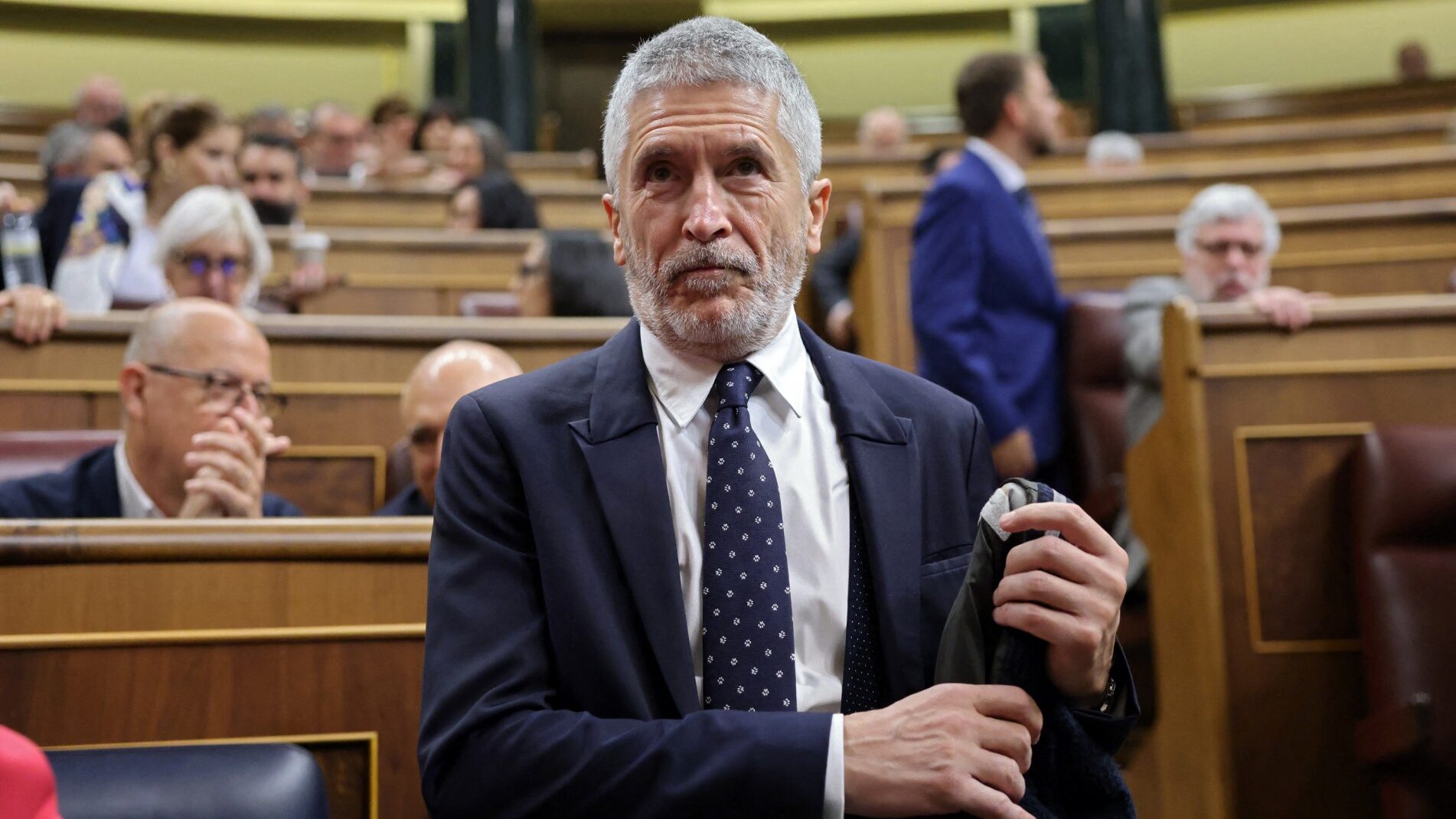
Spain’s Minister of Interior Fernando Grande-Marlaska
Thomas Coex / AFP
Spain’s Interior Ministry is facing a new scandal that has put national security in the spotlight. Several senior National Police commissioners have flatly contradicted Interior Minister Fernando Grande-Marlaska’s assurances about using Huawei technology to store judicial wiretaps.
According to officers consulted by The Objective, the Chinese tech giant has direct access to classified data collected by the Integrated Telecommunications Interception System (Sitel), a risk they describe as a direct threat to Spanish sovereignty.
“The repository of the wiretaps is there—how could they not access it? Of course they can,” said a senior police official, referring to the OceanStor 6800 V5 mass storage system built by Huawei and installed at several Police Data Processing Centers.
The controversy follows revelations that the Spanish government paid Huawei more than €12 million to provide the infrastructure where thousands of recordings of calls linked to terrorism, drug trafficking, and corruption investigations are stored. The move starkly contrasts with bans imposed by the United States and most of the EU on Huawei since 2018, citing China’s Intelligence Law, which obliges companies to cooperate with Beijing in strategic matters.
Police sources confirm that Sitel stores not only voices and phone numbers but also investigation summaries, geolocation data, the identity of all interlocutors, and even details of the telecom operators under surveillance. All of this material is retained for five years. “This isn’t just storage; it’s a full repository of highly sensitive judicial data,” said one commissioner, warning that Huawei has the technical ability to access it.
Marlaska insists the system is “sealed” and accessible only to judges and authorized officers. But police insiders dispute that: the Data Processing Centers are interconnected, and it is precisely in those connections that the system is most vulnerable. “The public may be told nothing is wrong, but we know how it works,” they said.
The revelations have triggered alarm in Washington. The U.S. Congress has already demanded explanations from Madrid and has warned that intelligence sharing with Spain could be restricted if there is a risk of leaks to China.
Sitel, the Integrated Telecommunications Interception System, was introduced in Spain in the early 2000s under then-Interior Minister Mariano Rajoy. The software allows the interception of calls and text messages and the identification of numbers, dates, times, and locations. All data is automatically recorded and stored in central repositories for later judicial access.
The Supreme Court has repeatedly upheld its use, ruling it legally valid when backed by judicial authorization. But the system has been politically controversial from the start. Although it was purchased by a Popular Party government, in 2009, the PP accused Socialist Prime Minister José Luis Rodríguez Zapatero’s administration of using it to wiretap opposition leaders illegally.
That accusation sparked what became known as the “Sitel case,” with heated debates in parliament and a public showdown with Interior Minister Alfredo Pérez Rubalcaba, who denied any misuse. Still, suspicions of illegal eavesdropping have dogged the program ever since, leaving it tainted in the public eye as a tool potentially abused beyond its judicial mandate.
The fact that such a sensitive system is now tied to Huawei raises even greater concerns. Beyond the distrust of Spain’s international partners, critics warn of the vulnerability of entrusting the custody of strategic information to a foreign company.
Police commissioners are calling for an urgent contract review and an independent audit to assess Huawei’s actual access. “We cannot allow a foreign actor with its geopolitical interests to hold the keys to our most sensitive investigations,” one official said.