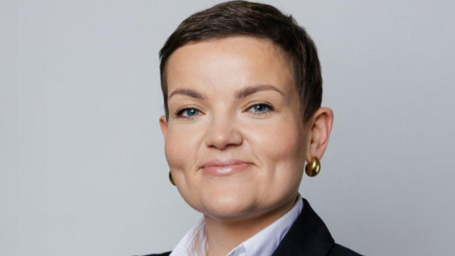
Polish Cultural Minister Marta Cienkowska
By Ministry of Culture and National Heritage – https://www.gov.pl/web/primeminister/marta-cienkowska2, CC BY 3.0, https://commons.wikimedia.org/w/index.php?curid=170801331
Poland’s culture minister has said she hopes her country will not take part in next year’s Eurovision Song Contest if Israel is permitted to compete—comments that come as a wave of political and social hostility toward Israel is spilling into cultural and sporting arenas across Europe, fueling a surge of antisemitic incidents.
Marta Cienkowska told the Polish public broadcaster, “It is with a very heavy heart that I watch what is happening in that part of the world. It’s hard to have fun [at Eurovision] in this context.”
Her remarks echo boycott threats from a number of other countries—Ireland, Iceland, the Netherlands, Slovenia, and Spain among them—and mark an intensifying pressure campaign to exclude Israel from next year’s contest in Vienna.
Yet this hostile climate is not confined to cultural spaces. The European Commission on September 17th unveiled its most extensive package of pressure against Benjamin Netanyahu’s government, including suspending tariff advantages Israel has enjoyed for three decades, proposing sanctions against ministers deemed extremists, and freezing bilateral cooperation programs. Brussels argued that “red lines” had been crossed, citing Israel’s military actions and humanitarian restrictions in Gaza.
Among EU countries, Spain has become one of the most outspoken enemies of Israel. Spanish prime minister Pedro Sánchez has called for Israel to be treated similarly to Russia in terms of exclusion from certain competitions, saying that “Israel cannot continue to use any international platform to whitewash its image.” Minister of Sports Pilar Alegria stated: “Sport is not, and cannot be, an island independent of what happens in the real world, especially when that real world tells us that human rights are being destroyed.” Culture Minister Ernest Urtasun said Spain must “ensure that Israel does not take part in the next edition of Eurovision.”
These government positions have played out against a backdrop of vigorous and sometimes chaotic public demonstrations across Spain. Since October 2023, large pro-Palestine protests have frequently disrupted city life; organizers and demonstrators say they are mobilizing over humanitarian concerns, while critics warn that some demonstrations have veered into intimidation and disorder. Recent disruptions included a Vuelta a España stage in Madrid that was aborted after protesters blocked the road and knocked down barriers; the incident forced cyclists to abandon the stage and cancelled the winners’ ceremony.
The consequences for Jews in Spain are palpably worrying. Incidents of vandalism, such as slogans painted on a Jewish community centre in Girona, and the foiled plot to attack Madrid’s largest synagogue have stoked alarm. Antisemitic incidents in Spain surged dramatically in 2024, with a reported 321% year-on-year rise and a 567% increase versus 2022.
All this feeds into the debate over Eurovision. For Poland’s culture minister, the contest is not merely an entertainment event but a setting where political choices are more important than allowing cultural institutions to remain spaces of openness and reconciliation.