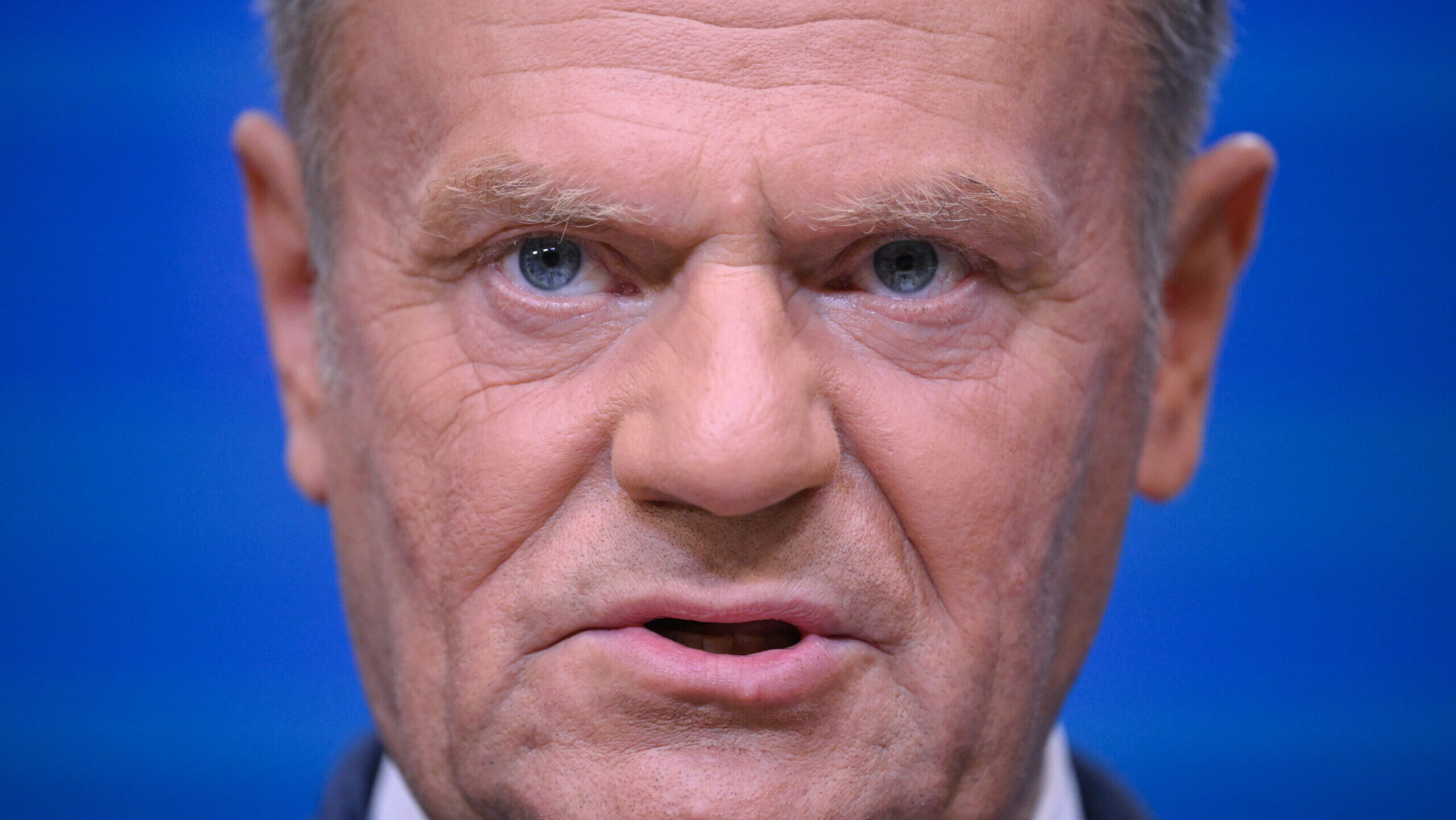
Poland’s Prime Minister Donald Tusk looks on as he gives a press conference after working sessions at the European Council in Brussels on June 26, 2025.
John Thys / AFP
Two weeks after the victory of conservative Karol Nawrocki in the Polish presidential elections, the liberal establishment aligned with Brussels continues to push the narrative of alleged electoral fraud, with the clear aim of stripping the national Right of the presidency.
Nawrocki, president of the Institute of National Remembrance (IPN) and supported by the Law and Justice (PiS) party, obtained 50.89% of the vote compared to the 49.11% garnered by his rival, the liberal Rafał Trzaskowski, mayor of Warsaw and a leading figure in Civic Platform (PO), the party of Prime Minister Donald Tusk. The narrow margin has served as the perfect excuse to cast doubt on the result, despite the lack of concrete evidence to support claims of systematic fraud.
According to a recent SW Research poll for Rzeczpospolita, 40% of respondents consider it possible that the elections were rigged. This figure, though significant, reflects the country’s climate of polarization more than any shared certainty about serious irregularities.
From Brussels, Tusk himself seized the opportunity to publicly question the transparency of the process: “Only a thorough examination of all irregularities can guarantee they didn’t affect the result,” he stated last week. So far, tens of thousands of electoral complaints have been submitted, driven mainly by government-affiliated sectors seeking either a repeat of the election or at least to undermine the new president’s legitimacy.
The underlying strategy is clear: after taking control of the government and consolidating influence over the legislative power and much of the media, the liberal-globalist bloc now seeks to crown its institutional hegemony with the head of state. Trzaskowski’s defeat, though minimal, was a setback for that agenda.
One of the main arguments used by the Left to fuel suspicion has been the composition of the Constitutional Court, which is in charge of reviewing complaints. This court, whose judges were appointed during the previous conservative government, has been the target of constant attacks by the European Commission, which questions its independence despite offering no clear evidence of bias. The same EU that ignored irregularities in other member states for years is now extraordinarily active when the election outcome does not favor its allies.
The attempt to delegitimize the presidential election result is not just another episode of Poland’s political polarization, but a reflection of the ideological struggle between a sovereigntist, conservative bloc and a liberal elite operating in sync with Brussels’ power centers. Far from accepting the verdict of the ballot box, Tusk’s government appears determined to erode Nawrocki’s victory by any means necessary.