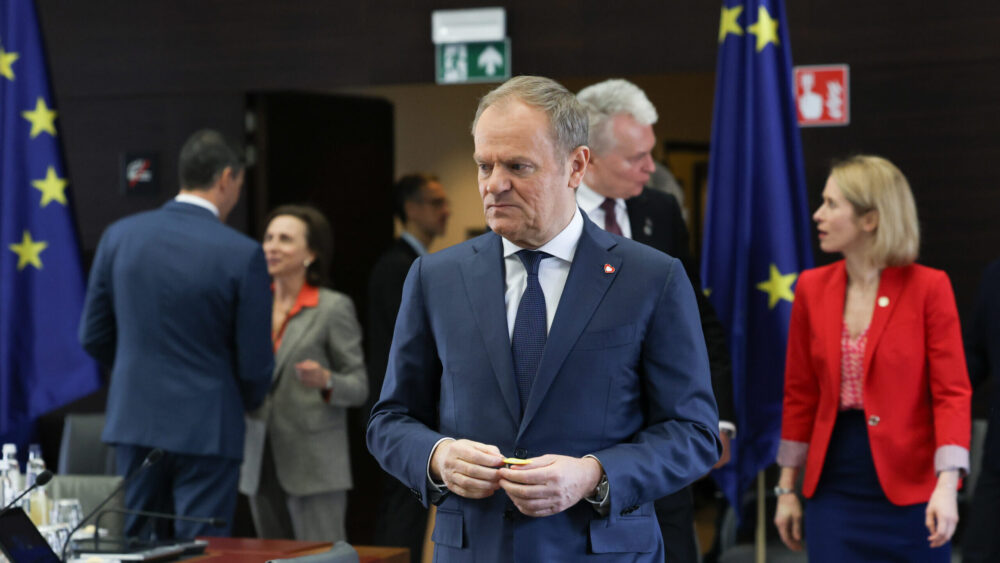
Polish PM Donald Tusk
Photo: European Council, 2025
Poland’s liberal prime minister has called a vote of confidence in his government following the victory of the conservative opposition-backed candidate Karol Nawrocki in Sunday’s presidential election.
The move is a clear attempt to repair PM Donald Tusk’s broken image and restore a sense of authority that he needs to continue his sweeping reforms, which are now at renewed risk of being blocked by a conservative president.
“I want everyone to see, including our opponents at home and abroad, that we are ready for this situation, that we understand the gravity of the moment, but that we do not intend to take a single step back,” Tusk said on Monday evening.
Despite the theatrics, the move is largely symbolic. No one in Tusk’s three-party center-left coalition is likely to break ranks and risk the return of a conservative government under the right-wing PiS party, so the confidence vote is more a political message than a real test for governance.
Furthermore, a renewed parliamentary mandate does not change the fact that the remaining 2.5 years of Tusk’s term will be a drawn-out political tug-of-war between the government and the presidency. Nawrocki will be fully prepared to veto any legislation he deems an overreach or overly progressive reform that the majority of Poles would oppose.
Tusk has already begun to dismantle the previous constitutional order by setting up parallel institutions and disregarding court rulings, but the same political deadlock with outgoing conservative president Andrzej Duda prevented him from implementing the most controversial reforms, such as introducing same-sex partnerships or on-demand abortion.
The Tusk government already had a weak mandate for ushering in such changes in the deeply religious, conservative country. The national conservative PiS came up on top in the last election in late 2023 (but fell short of a majority), so Tusk’s centrist Civic Platform, finishing in second place, had no choice but to partner with the Leftist opposition parties for a chance at governance.
Knowing that at least a plurality of Poles are still against progressive social reforms and look for Duda to block them, the Tusk government was waiting until the 2025 presidential election to gain control of both wings of the executive branch. With those hopes shattered, so is the chance of deciding things over the heads of ordinary Poles.
“Tusk’s reform agenda is, if not dead in the water, then at least dying,” said Ben Stanley, an associate professor at the SWPS University in Warsaw.
Beyond social reforms, the Polish Right sees Nawrocki’s victory as a last-minute chance to prevent Tusk from seizing absolute power by completely reshaping the constitutional order and ruthlessly silencing opposition parties, media, and NGOs.
As Polish MEP Jacek Saryusz-Wolski said in an interview with europeanconservative.com ahead of Sunday’s vote, the victory of the liberal side would have given Tusk “a Brussels-sanctioned license to dismantle democracy—all under the Orwellian pretext of ‘defending democracy.” The MEP explained:
Tusk’s idea of “militant democracy” means suppressing opposition and dissident voices through legally dubious or outright illegal means. This is not liberalism; it’s the logic of fascism or Bolshevism. Once democracy is dismantled, it’s extraordinarily difficult to restore.
What is equally important, Nawrocki’s victory is a crushing defeat not only for Polish progressives but also the mainstream EU elite, which treated Poland as a liberal experiment on how to defeat right-wing populism for good and prevent them from coming back to power with all means possible, legal and illegal. Even Politico, the favorite media outlet of Eurocrats, admitted that “mainstream Brussels has lost a role model for how to counter populism.”
Nawrocki’s unexpected election sends a clear message to Brussels: Polish democracy is alive, and won’t stand by while those from outside are trying to rewrite its fate.