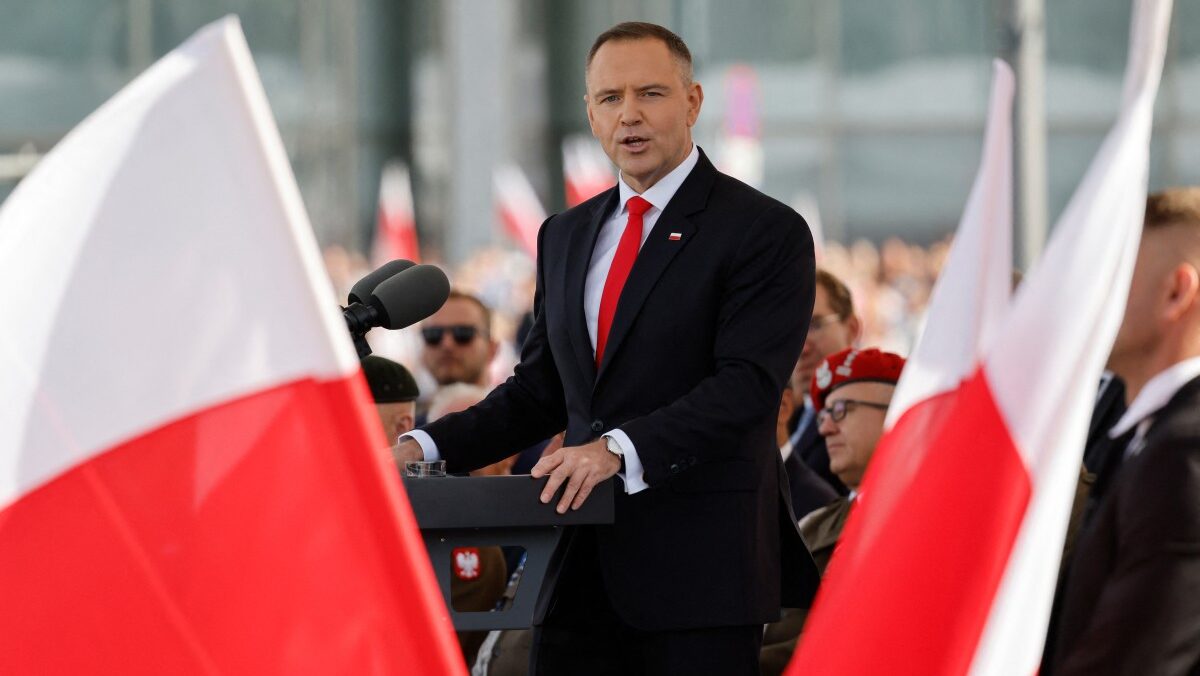
President Karol Nawrocki speaks at an official ceremony to assume command of the Polish Armed Forces in Warsaw on August 6, 2025.
Wojtek Radwanski / AFP
The new Polish president, Karol Nawrocki, on Thursday announced his veto of a law that sought to ease restrictions on the construction of onshore wind farms and extend the freeze on electricity prices until the end of 2025. This marks the first veto of his term, which began on August 6th, and represents a direct confrontation with Donald Tusk’s government.
Nawrocki explained at a press conference that he will present an alternative legislative proposal, limited exclusively to prolonging the freeze on energy tariffs. “The so-called windmill project is a form of blackmail by the parliamentary majority and the government. This legislation is about wind turbines, not about lowering electricity costs,” he stated. He announced that his proposal regarding energy prices would be identical and ready for a vote in September.
Currently, the maximum tariff for households is set at 500 zlotys (around 120 euros) per megawatt hour, which expires at the end of September. The government had included its extension within a broader package that reduced the minimum distance between homes and turbines from 700 to 500 meters and scrapped the so-called “10H rule,” which since 2016 had prevented the installation of wind turbines at a distance of less than ten times their height from residential areas.
The president justified his decision by pointing to public opposition to expanding wind farms in populated areas. “People don’t want 150-meter turbines next to their houses,” he declared. He also emphasized that the real solution to reducing costs is “moving away from the European Green Deal and the emissions trading system,” rather than imposing more wind infrastructure.
The move has opened a new front with Tusk’s progressive government, which defended the law as a tool to boost renewable energy and guarantee low prices. The prime minister accused the head of state of making electricity more expensive for families. At the same time, energy minister Miłosz Motyka warned that the veto represents “a blow to the country’s energy security and to industry.”
However, Nawrocki assured that his office has not changed “a single comma” in the section concerning the tariff freeze and that parliament can approve it immediately. The new president seeks a different relationship with parliament, among other things, to limit the pressure Tusk exerts with an iron fist.
Przygotowanie nowej formuły współpracy Prezydenta RP z parlamentem – to zadanie, które powierzyłem dwójce posłów, byłych ministrów, Marcinowi Horale i Szymonowi Szynkowskiemu vel Sęk
— Karol Nawrocki (@NawrockiKn) August 21, 2025
Dziękuję za podjęcie tego wyzwania! pic.twitter.com/aav80x5OYb
The political battle over Poland’s energy future—shaped by coal dependence and Brussels’ pressure to accelerate the green transition—has thus created an institutional struggle between the Executive and the Presidency.
The President also convened the Council of Ministers in full on August 27th, within the framework of a Cabinet Council, to analyze major infrastructure investments and the state of public finances. The meeting will also strengthen his role as guarantor of stability at a time when the energy debate has become one of the main axes of national politics.