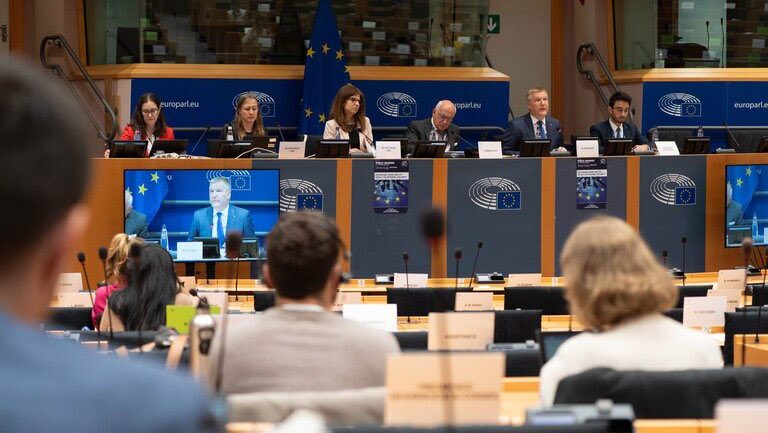
LIBE committee meeting, Wednesday, June 4, 2025.
Photo: @EUCssrMcGrath on X, 4 June 2025.
The corruption scandals affecting the family and political circle of Spanish prime minister Pedro Sánchez are no longer merely a domestic issue—they are fast becoming a rising concern in the European Parliament. On Wednesday, Brussels became the stage for yet another chapter in the growing institutional unease surrounding Spain’s political and judicial situation.
During a session of the Committee on Civil Liberties (LIBE), European Commissioner for Justice Michael McGrath stated that the Commission will continue cooperating with Spanish authorities to “promote the rule of law”—referring, among other matters, to the stalled process of renewing the General Council of the Judiciary (CGPJ). Although his tone was cautious, the session clarified that something had changed. The wall of silence that for years protected Spain’s socialists—both in the media and within institutions—is beginning to crack. MEPs from different political groups—some for the first time—openly questioned Brussels’s lack of response to a growing number of cases that have become increasingly hard to ignore.
Pleased to have the opportunity to exchange with MEPs in the @EP_Justice’s first ‘structured dialogue’ at the @Europarl_EN
— Michael McGrath (@EUCssrMcGrath) June 4, 2025
Topics?
🔹the Rule of Law, incl. in Hungary
🔸support for civil society
🔹data protection and the future of the GDPR
🔹media freedom
🔸the Democracy Shield pic.twitter.com/FryhVtFzgy
VOX MEP Jorge Buxadé denounced the “ideological bias” with which the Commission judges legality in the member states. He asked why silence is tolerated in investigations implicating the Spanish government, while other countries are subjected to relentless scrutiny over lesser matters. McGrath replied that the Commission evaluates institutional frameworks, not individual cases, insisting that its work is “objective and consistent.” Nevertheless, he acknowledged that accusations must be addressed at the national level by the relevant authorities, briefly mentioning the State Attorney General’s Office.
More revealing was the intervention of Portuguese MEP Ana Miguel Pedro, from the European People’s Party (EPP), who directly questioned the corruption allegations involving members of the prime minister’s inner circle. Until now, European centrists—led by Commission President Ursula von der Leyen—had avoided such topics for political reasons. The fact that a voice from the EPP broke this silence marks a turning point: the tacit protection of the PSOE is beginning to waver, along with the strategy of complicit silence that has upheld the progressive bloc within the European Parliament.
The Spanish Socialist Party is facing at least five open legal cases. Among those under investigation are Begoña Gómez, the prime minister’s wife, and his brother, David Sánchez, a civil servant at the Badajoz Provincial Council. While several of these investigations have been ongoing for some time, it is only now that political and social pressure is spilling beyond Spain’s borders. The situation has become unsustainable—even for EU partners who previously chose to look the other way.
This tolerant attitude has exposed the European Commission’s double standard in dealing with rule-of-law challenges within the Union. While Hungary and Poland have been subject to severe reports, funding freezes, and threats of sanctions, the Amnesty Law pushed by Sánchez’s government has been awaiting formal evaluation by Brussels for over two years. This law, which benefits those convicted of crimes against the constitutional order, including Catalan separatist leader Carles Puigdemont, has caused deep internal fractures within Spain. Yet, it continues to receive no institutional response from the Commission. This inaction is widely interpreted as a political maneuver to avoid destabilizing the support keeping von der Leyen in office.
This is far more than a minor legal issue—the credibility of European institutions is at stake. The Commission claims to act with neutrality, but the facts suggest otherwise. The swift action taken against conservative governments stands in sharp contrast to the deliberate sluggishness in addressing cases involving socialist allies. The delay in addressing the amnesty law, along with the absence of a dedicated report on alleged corruption within Sánchez’s inner circle has fueled public distrust. Many citizens now see Brussels not as a guarantor of impartiality, but as a vehicle for the dominant political interests.
What happened yesterday in the LIBE Committee suggests that the atmosphere in the European Parliament is beginning to shift. Questions are no longer being raised only by parties labeled ‘far right by their opponents. Within the EPP and liberal bloc, a debate is starting to emerge about the institutional cost of ignoring the obvious.