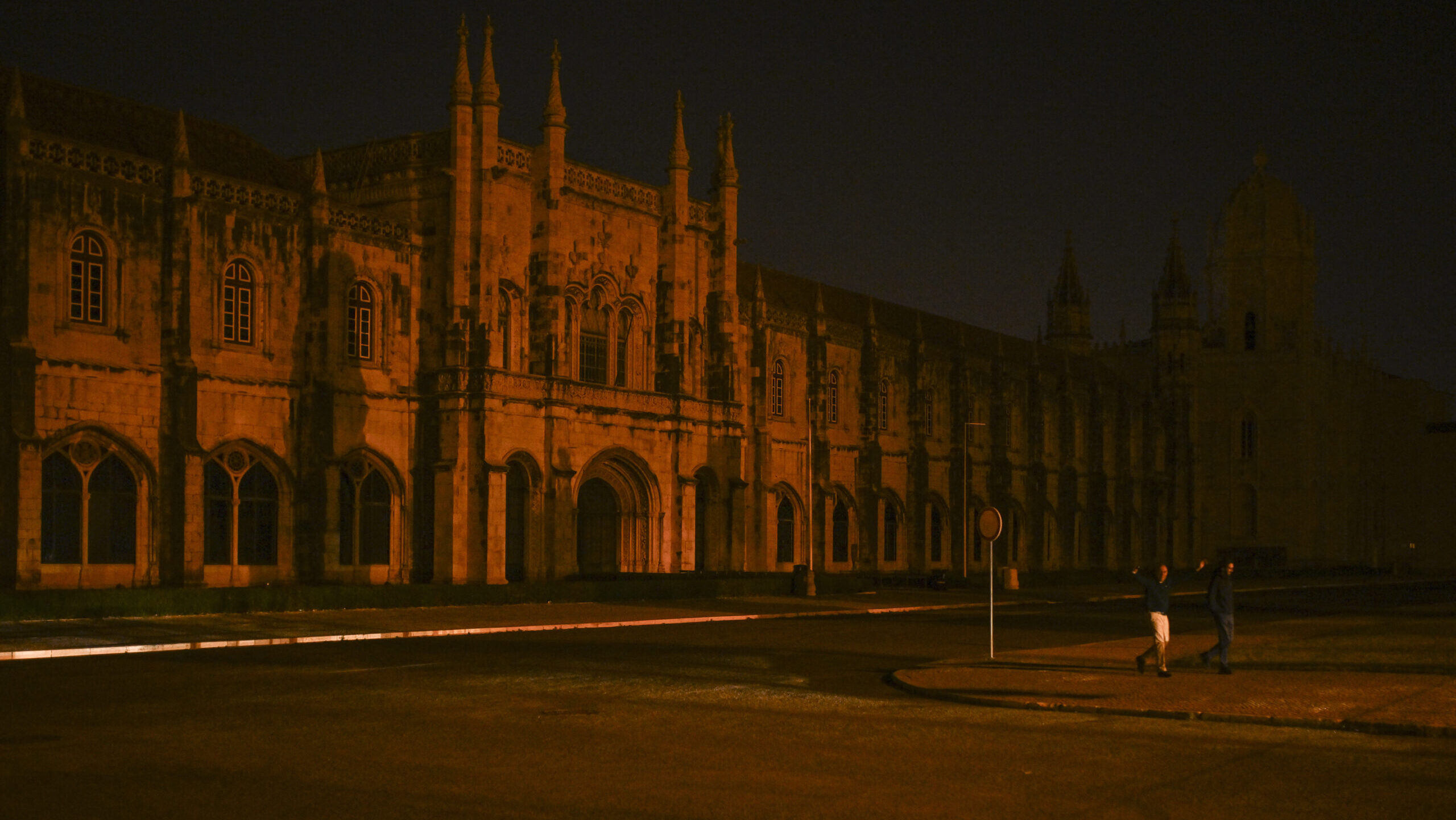
This photograph shows the Jeronimos Monastery in the dark following a massive power cut affecting the entire Iberian peninsula and the south of France, in Lisbon on April 28, 2025.
Photo: Patricia De Melo Moreira / AFP
The Portuguese government has openly accused France of obstructing cross-border electricity connections with the Iberian Peninsula after the massive blackout on April 28th, which left millions of homes and businesses in Portugal and Spain without power. This incident—still lacking an official explanation and with no apparent urgency from authorities to find one—may have played a decisive role in the outcome of Sunday’s Portuguese elections, having exposed the country’s energy vulnerability.
Portugal’s Energy Minister, Maria da Graça Carvalho, has not hesitated to describe the lack of interconnections with France as a direct barrier to the European single market. According to Lisbon, systematic delays by the French government in expanding electricity infrastructure across the Pyrenees have contributed to the energy isolation of both Spain and Portugal, multiplying the impact of the recent system collapse.
This is not a new accusation. But while France relies heavily on nuclear power—68% of its electricity was generated by nuclear in 2024—Portugal and Spain have taken pride in their transitions to ‘green energy’ sources, which are notoriously less reliable. In 2024, 71% of Portugal’s electricity needs were met by renewable energy sources, while Spain touted their first day of covering energy needs 100% with renewables only days before the blackout.
For decades, both Madrid and Lisbon have accused Paris of resisting the flow of cheap (but unreliable) electricity from the Iberian Peninsula to protect its own nuclear power plants and maintain its control over the European energy market. France’s electricity grid operator (RTE) denies any obstruction.
The blackout came at the worst possible time for the Portuguese government, which was seeking re-election amid growing criticism over its energy management. In a country that imports up to 35% of its electricity from Spain, the fragility of these interconnections is not just a technical issue, but a matter of sovereignty and independence.
The supply cut, which began in Spanish territory and quickly spread due to structural weaknesses, has been interpreted by many analysts as “the last straw” for a public already on edge. Lisbon’s self-imposed restrictions on Spanish electricity imports following the blackout—labeled as a “precautionary measure”—have only raised domestic prices and fueled public discontent.
Portugal has announced that it will take the case to the European Commission, requesting formal intervention against France for violating the principles of the EU’s internal energy market. The EU had set a target for member states to have electricity import capacity equal to 10% of national generation by 2020 and 15% by 2030. However, the connection between Spain and France barely exceeds 3%.
So far, Brussels has shown little resolve, merely describing Iberian interconnections as a “priority” without taking real legal action against the French blockade. Some observers suggest that Paris may be strategically maneuvering to strengthen its energy influence on the continent, just as Europe seeks to reduce its dependence on external sources and stabilize its internal markets.
On the other hand, the lack of coverage this situation has received—both from mainstream media and influential power structures—is striking. The excuses came quickly: both the Spanish national government and the European Commission say they expect technical reports in six months. This delay in accountability signals a complete lack of interest in identifying those responsible.
So, who is to blame? France? The energy system itself? Renewables and EU-level planning? One thing is clear: barring any foreign attack, the answer will not please Europeans.