Spain’s Prime Minister Pedro Sanchez (R) walks with Castilla y Leon regional president Alfonso Fernandez Manueco (L) after landing for a brief visit to the areas affected by the wildfires in Villablino, province of Leon, northwestern Spain on August 17, 2025.
Cesar Manso / AFP
The wave of fires ravaging Spain for over a week has become the greatest environmental catastrophe in the country’s recent history. With more than 200,000 hectares burned, almost 40 active hotspots across different regions, and more than thirty people arrested for deliberately starting some of them, the country is living through a critical situation. Thousands of residents have had to abandon their homes, the air has become unbreathable in provinces such as Ourense and León, and forest brigades are working on the verge of collapse.
In this context, Prime Minister Pedro Sánchez’s slow response has sparked harsh criticism. After spending a whole week in his holiday residence of La Mareta, in Lanzarote, the head of government briefly interrupted his vacation to visit two of the areas most affected by the fire in Galicia and Castilla y León. The visit lasted barely a few hours and was marked by the absence of contact with the local population, with no spontaneous statements or answers to uncomfortable questions from the press, and with the sole company of his closest team.
The images starkly contrast with past crises, where leaders appeared alongside those affected. On this occasion, Sánchez avoided any improvised encounters—no hugs with evacuees, no conversations with farmers or ranchers who have lost their livelihoods. Everything was reduced to controlled staging: a helicopter flyover, a visit to the coordination center in Ourense alongside the president of the Xunta, Alfonso Rueda, and a walk through the town of Villablino, accompanied only by political and military authorities.
The strategy seems clear: to minimize risks and avoid an uncomfortable photo becoming a symbol of public discontent. The president returned that same day to Lanzarote, to the fortress of La Mareta, from which he is not expected to leave again until the end of the week.
The most striking aspect of his appearance was announcing a future “State Pact against the climate emergency,” scheduled for September—a proposal that hit like a slap in the face in the middle of the tragedy. While residents of Orense, León, and Cáceres watched the flames consume houses and forests, the president shifted the discussion to the ideological and climatic terrain, ignoring the fact that most of the fires were—deliberately or accidentally—set by humans and that security forces have already arrested more than 30 people.
The message has been received with indignation among the opposition and bewilderment among the affected, who demand immediate solutions and material resources, not abstract debates. The idea that Spain needs to “resize its policies” in the face of climate change may make sense in an international forum, but it appears disconnected from the concrete drama that thousands of families suffer.
The president’s stay in Lanzarote while the country faces this wave of fires has not gone unnoticed. La Mareta, a residence donated by King Hussein of Jordan to Spain and turned into Sánchez’s refuge, has been surrounded by an impressive security deployment. Forty Civil Guard officers have been sent to the island, and teams of divers have been mobilized to monitor the coast.
The people of Lanzarote, used to seeing the president in other summers strolling through markets or taking photos with locals, now know him as cloistered within the palace walls. He will not even travel to Gran Canaria to meet with the regional president, Fernando Clavijo; instead, Clavijo will travel to Lanzarote to see him. The island has grown used to an invisible Sánchez, far removed from the social contact he cultivated in years past.
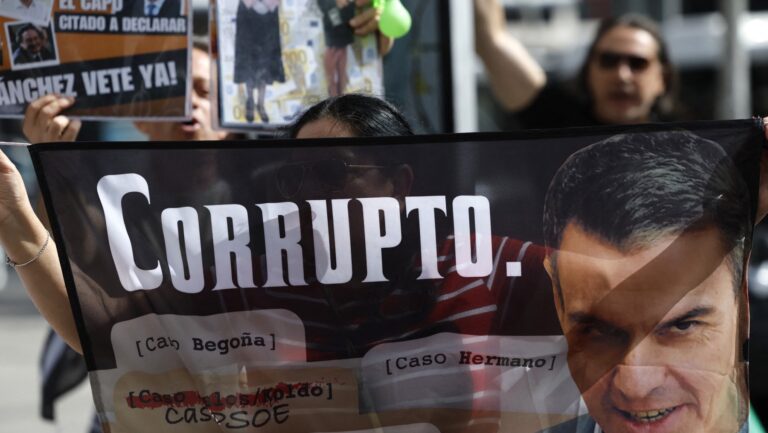
With the wildfire crisis still ongoing, the political atmosphere is suffocating. The Popular Party accuses him of frivolity and failing to rise to the magnitude of the catastrophe. VOX reproaches him for being out of touch with reality and for his climate obsession. Even within the PSOE, some privately admit that the president’s communication has been a mistake.
Every day Sánchez remains hidden away in La Mareta feeds the perception of a weak government, more concerned with controlling its image than facing the country’s problems head-on.