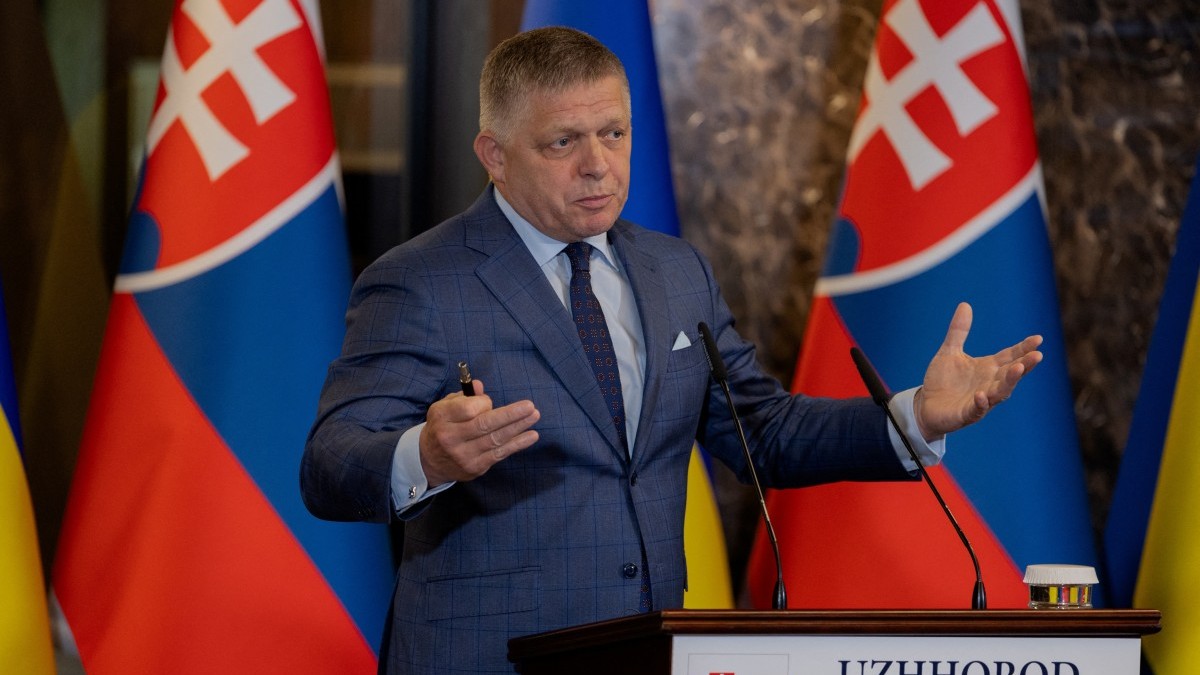
Prime Minister of Slovakia Robert Fico speaks during a joint press conference with Ukraine’s President in Uzhhorod on September 5, 2025.
Tetiana Dzhafarova / AFP
Slovak Prime Minister Robert Fico warned on Thursday, September 11th, that his government will block any new sanctions against Russia if Brussels does not modify its climate and energy objectives.
Fico has made defending the automotive industry one of his political banners and clarified that he will not support additional measures if the European Commission does not present “realistic” alternatives that protect factories and heavy industry across the continent.
“Europe cannot continue setting unattainable goals while destroying jobs at home,” Fico said after meeting in Bratislava with European Council President António Costa. “I will not support new sanctions until we have real proposals on energy and how to reconcile climate objectives with the needs of car manufacturers throughout Europe.”
Prime Minister of the Slovak Republic Robert Fico today welcomed the President of the European Council António Costa @eucopresident at the historic building of the Government Office of the Slovak Republic in Bratislava.
— Robert Fico 🇸🇰 (@RobertFicoSVK) September 11, 2025
They are currently discussing the European Union’s priority… pic.twitter.com/iD44FpUTh5
The warning again brings the EU’s green agenda to the forefront, particularly its proposed ban on selling new combustion-engine cars from 2035. The target represents an existential challenge for Slovakia, whose 5.4 million inhabitants produce over 1 million vehicles annually.
Slovakia previously blocked the EU’s 18th sanctions package on Russia, securing exemptions for key energy imports because of its reliance on Russian supplies.
Now , the prime minister has also called for Brussels to change the electricity pricing system. “It is a matter for the EU, and the way we regulate it will determine the result,” he said, warning that inflation and energy costs threaten the competitiveness of Slovak and European industry alike.
Ukraine has separately demanded that Slovakia attribute responsibility to Moscow for Russian drones that crossed into Polish airspace this week. Fico called for an independent investigation, while Foreign Minister Juraj Blanár said the drones appeared to have entered Poland accidentally. The comments drew criticism from Kyiv.
Slovakia’s stance comes amid wider EU divisions over energy and Ukraine policy. For years, Europe either did not know how or did not want to build alternative energy options, and today it pays the price with a crisis that is hitting households and industries alike. Member states’ differing visions and interests have also prevented the forging of a standard policy toward Ukraine, divided between realists such as Hungary and idealists such as Germany. Today, the latter suffer more than the former, and yet the former, in many cases, are dragged along by the latter.
Analysts say this lack of unity has left the EU with limited influence over the Ukraine war and dependent on NATO for security guarantees.
In this political vacuum, leaders such as Fico raise their voices, aware that the war in Ukraine and the energy transition test not only European unity but also the economic viability of countries that cannot afford ideological experiments.