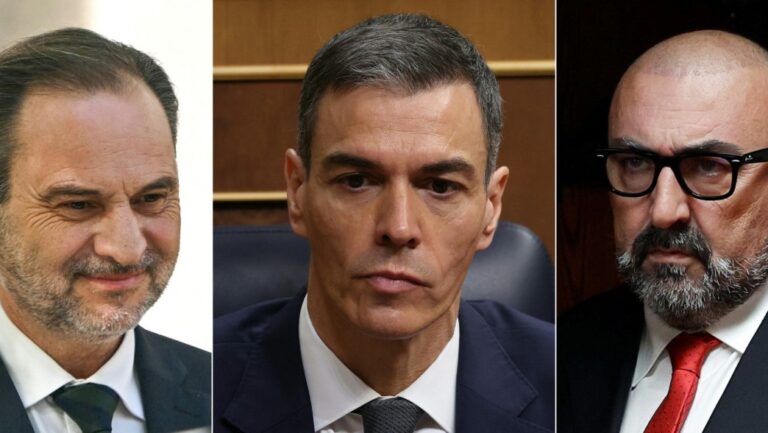
Left to right: ADF Executive Director Paul Coleman, ADF Senior Counsel for Europe Adina Portaru, and American author Rod Dreher.
Photo: @ADFIntl on X, 21 May 2025
No one could have predicted how rapidly things would change for the worse just three decades ago, when the West was still celebrating Fukuyama’s misunderstood final victory of the liberal democratic order.
Yet here we are, a continent that’s grown to take its freedoms for granted, only for them to be gradually eroded year by year by the very institutions that claim to be the greatest defenders of democracy. This is how Paul Coleman, executive director of ADF International, summarized the situation.
ADF is a Vienna-based global advocacy group made up of lawyers specializing in human rights, including freedom of thought and expression. The organization’s perhaps most well-known client is Finnish parliamentarian Päivi Räsänen, who’s been charged with the “hate crime” of tweeting Bible verses to explain her views on LGBT issues and is still facing a criminal sentence despite already having been acquitted twice. ADF has been representing hundreds of people like Räsänen and continues to raise awareness about censorship worldwide.
Wednesday’s first-of-its-kind, cross-party event was held in the European Parliament on May 21st, co-hosted by conservative MEPs Stephen Bartulica (ECR) and Virginie Joron (PfE). The focus was the EU’s Digital Services Act (DSA), whose impact on global free speech was recently condemned by both the U.S. State Department and the House Judiciary Committee.
“Free speech is again under threat on this continent in a way it hasn’t been since the nightmare of Europe’s authoritarian regimes just a few decades ago,” Coleman said in his speech, warning that through the DSA, social media has become “the frontline” of this battle for free speech and political narratives.
As a human rights lawyer, Coleman has spent his career researching and advocating against restrictions on the freedom of expression. His 2016 book Censored documented over fifty ‘hate speech’ cases in Europe to demonstrate a trend that was already concerning back then, but has since become much worse.
Looking back, 2016 was a watershed moment for the West, with Brexit and Trump’s first victory sending shockwaves across the political and media establishment, who scrambled to understand what went ‘wrong.’ But instead of genuine self-reflection, those in power decided to blame disinformation, propagating the narrative that “people were tricked and brainwashed to vote the wrong way,” Coleman explained.
What followed in the EU was an ever-growing censorship regime to “save democracy,” built by successive legislation year by year. What began with the 2016-2018 “voluntary” codes of conduct against ‘hate speech’ and ‘disinformation’ then gradually evolved into the DSA by 2022, now with enforceable content removal obligations for social media companies. And it’s not over, as the next step is the so-called Democracy Shield, which will add an army of EU-funded ‘fact checkers’ to the mix to work as local censors in each member state.
People have a hard time catching up with what’s happening because ‘hate speech’ and ‘disinformation’ sound bad enough for them to support these measures, but they are also deliberately vague enough to be used as political weapons to silence any dissent. “The lack of definition is a design feature, not a bug,” explained Coleman, calling the DSA “a blank check for digital political censorship.”
Furthermore, as Washington rightfully pointed out recently, forcing social media platforms to comply with these rules in Europe could easily have a global impact, simply because maintaining a separate moderation regime for EU users different from the rest of the world is not economically viable. Also, when there are crippling fines for not censoring enough but no penalties for too much censorship, the platforms will inevitably end up erring on the wrong side.
Coleman concluded that EU member states need to fight back, reminding lawmakers that the treaties do give countries the power to initiate the annulment of the DSA, while the European Parliament must not remain silent when its review comes up later this year.
Fantastic event at the European Parliament this morning on the threats to free speech posed by the Digital Services Act.
— ADF International (@ADFIntl) May 21, 2025
Excellent speeches by @Paul_B_Coleman, @v_joron, @StjepoBartulica and @roddreher.
It was great to see @MarionMarechal there!
Video content coming soon 👀 pic.twitter.com/E4KY6Gh6EE
The two MEPs on the panel added further political context, with the Patriots’ Virginie Joron calling the law “The Digital Surveillance Act,” saying it contradicts several articles in the EU treaties and “risks undermining not only the freedom of expression but the very foundation of our democracy.”
Croatian MEP Stephen Bartulica (ECR) presented concrete examples of the political mainstream already weaponizing the DSA, with the German Green leader Robert Habeck, for example, reporting over 700 citizens for “hate speech” simply for criticizing the government online. “And this comes from a party that claims that President Trump is a dictator,” Bartulica commented, adding that if it wasn’t for Musk’s X and its commitment to free speech, Trump wouldn’t even be president now.
The last speaker was Rod Dreher—a bestseller American author and columnist at europeancoservative.com, among other publications—who gave the discussion a bit more philosophical depth.
Having spent years researching the psychology of totalitarian regimes of the 20th century, Dreher explained that one of the conclusions of his book Live Not By Lies applies to the EU as well. “Any system that doesn’t allow vital information to the survival of its leadership to get through is destined to fall.” The EU elites are not only shielding the citizens from the political reality via their censorship today, but also themselves from the true extent of people’s dissatisfaction—and by the time they realize what’s happening, it will be too late.
Furthermore, it’s really time to call a spade a spade, Dreher said.Despite their differences, both Orwell’s and Huxley’s systems are rightly called “totalitarian,” and it’s time to recognize that the EU has become one as well. While not as direct as Nazi or Soviet oppression, it’s still a “soft totalitarian” system that, rather than physically demanding it, rewards total ideological compliance with “an almost therapeutic” sense of comfort and righteousness.
But this suppression of free and open debate will have “tremendous costs,” he warned, first and foremost the total collapse of people’s trust in public institutions, just like we’ve seen during the pandemic, when officials knowingly hid the truth to protect their narrative. This could lead to a very dangerous situation, as those who make peaceful change impossible eventually make violent revolution inevitable.
Still, Dreher’s interviews with Soviet dissidents taught him two basic rules for any society to pick up the fight. First, refuse to participate in any discussion that’s based on lies, and secondly, be prepared to suffer for the truth. “Eventually, if enough people do this, it will bring down any empire built on lies.”
At our European Parliament event this morning, @roddreher draws on the wisdom of Soviet dissidents to recommend how to live in today's 'soft totalitarianism' in the West:
— ADF International (@ADFIntl) May 21, 2025
"Refuse to participate in any event where one cannot speak the truth.
Prepare to suffer for the truth." pic.twitter.com/7OP5NNG7RC