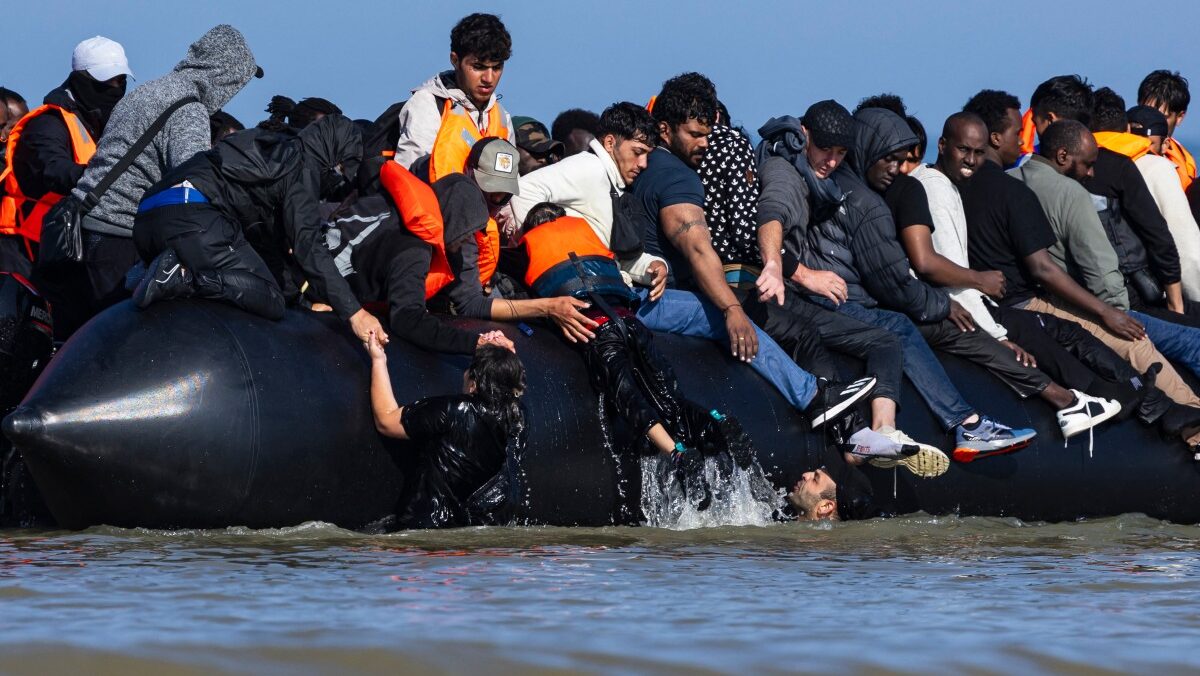
Migrants try to board a smuggler’s boat in an attempt to cross the English Channel off the beach of Hardelot in Neufchatel-Hardelot, northern France on June 30, 2025.
Sameer Al-Doumy / AFP
Italy, Spain, Greece, Malta, and Cyprus have sounded the alarm over a proposed UK-France migrant returns deal, warning it could destabilise the EU’s asylum system and saddle southern Europe with an even greater share of the migration burden—just as French president Emmanuel Macron continues his high-profile state visit in London.
In a joint letter to the European Commission, the five Mediterranean countries expressed “serious concerns” about the draft agreement, under which France would take back migrants deported from Britain, in exchange for the UK accepting a similar number of asylum seekers from France.
But under the EU’s Dublin Regulation, asylum seekers can be returned to the first EU country they entered. The Med-5 nations fear this bilateral arrangement could trigger a chain reaction—where migrants bounced back to France are then redirected to frontline states like theirs, which are already struggling with high levels of illegal arrivals.
“We take note—with a degree of surprise—of the reported intention of France to sign a bilateral readmission arrangement,” the Med-5 countries wrote in their joint letter.
The European Commission has now stepped in, requesting legal clarification from both France and the UK. A spokesperson said the deal must comply with “the spirit and letter” of EU law.
The timing of the row could not be more awkward. Macron’s state visit to the UK—the first by a French president in more than a decade—is meant to showcase renewed Anglo-French cooperation. Lavish ceremonies at Windsor Castle and Westminster have so far stolen the spotlight, but the real political work is happening behind closed doors.
The migrant returns deal was supposed to be the centrepiece of Thursday’s bilateral summit with Prime Minister Keir Starmer. According to Reuters, the two leaders have discussed the plan at length, but French officials have postponed any announcement while Brussels reviews its legal implications and southern member states dig in their heels.
For the Med-5, this is about more than just numbers. They see the deal as a dangerous precedent—one that allows larger member states to strike side deals that ignore the principle of solidarity. Whether the agreement survives the week now depends on Macron’s ability to bridge a widening gap: between the UK’s political demands and the EU’s internal balance.