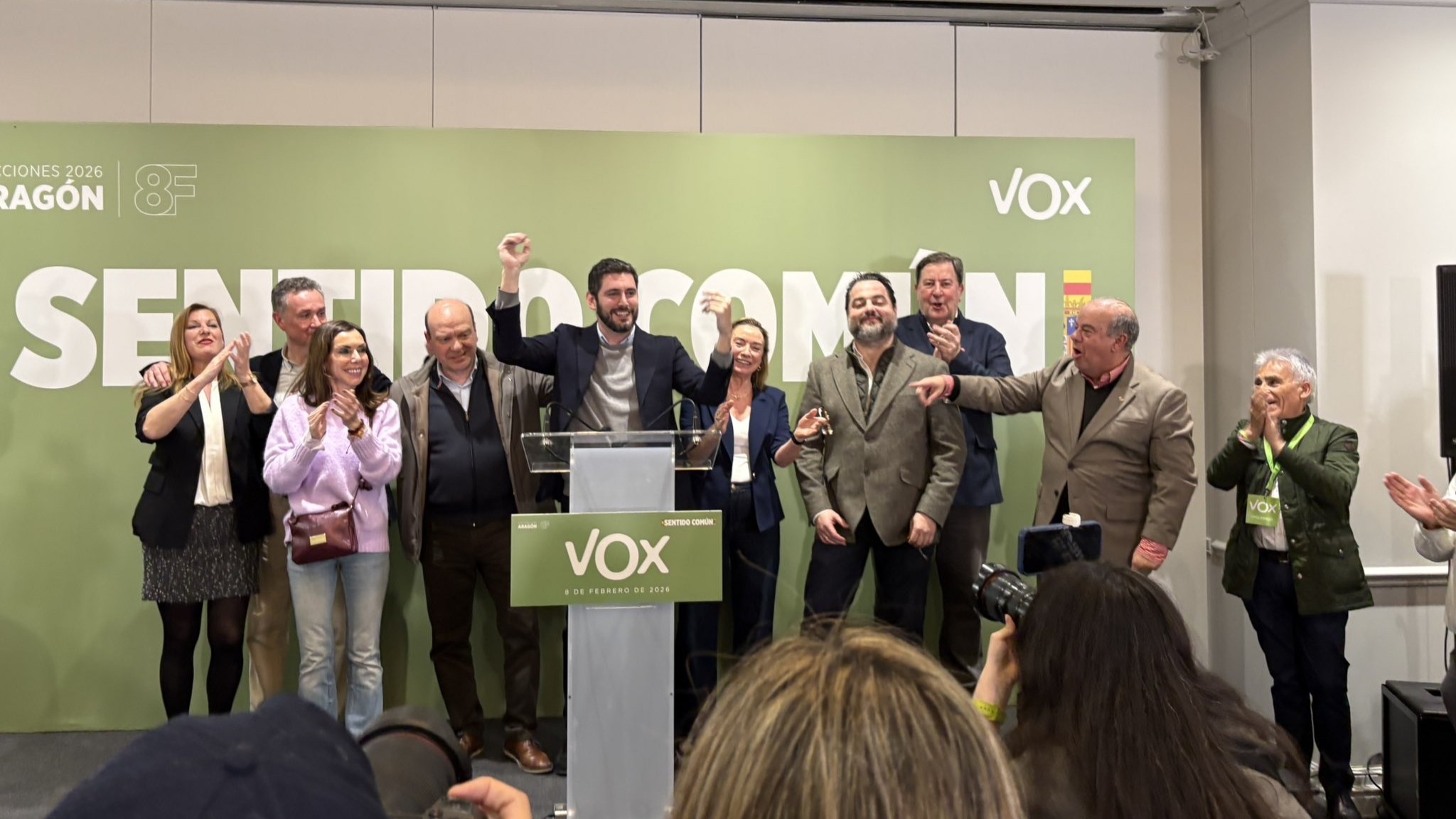
VOX Aragón leaders celebrate the party’s result in the regional election held over the weekend on February 8, 2026
@IgnasiMulleras on X, February 9, 2026
The early regional election in Aragón held over the weekend has delivered a result that is clear in numbers but far more complex in political meaning.
The center People’s Party (PP) emerged once again as the largest force, winning 26 seats, though two fewer than in the previous legislature. VOX was the night’s big winner, doubling its representation to 14 seats. The Socialist Party (PSOE) suffered a heavy blow, falling to 18 seats, its worst result in the region’s history. On the left, Unidas Podemos disappeared entirely from the regional parliament, while the regionalist Chunta Aragonesista (CHA) surprised many by doubling its presence to six seats.
Taken together, the right now holds a comfortable majority: 40 seats for PP and VOX, compared with 25 for the PSOE and the fragmented left. In vote share, the gap is equally telling—more than 52% for the right versus around 37% for the left.
The decision by Aragón’s president, Jorge Azcón, to call early elections was anything but accidental. It rested on two calculations that reflect the broader mood of Spanish politics.
The first was straightforward: to capitalize on the visible decline of the PSOE at the national level under Prime Minister Pedro Sánchez. His government, weakened by controversial alliances with separatist parties, a growing sense of institutional fatigue and surrounded by political scandals, has become a liability for Socialist candidates across the country. Aragón seemed an ideal place to turn that national weariness into electoral damage.
The second reason was more defensive. The PP hoped to stop, or at least slow, the rise of VOX, whose steady growth in polls has begun to worry both major parties. In some regions, VOX is no longer just challenging the PP—it is threatening to overtake the Socialists too. An early election was meant to reaffirm PP’s leadership of the right before that shift became irreversible.
Technically, the PP won. Politically, the result is far less reassuring. Calling early elections only to lose seats rarely feels like success. The party has held on to power, but without expanding its mandate or silencing doubts about its strategy.
Azcón’s PP has followed the national party’s gradual move toward the centre, a shift designed to reassure moderate voters and European partners. In Aragón, that approach delivered stability—but little enthusiasm. It did not prevent losses to VOX, nor did it energize the party’s own base. The PP still governs, but increasingly without a clear sense of direction.
VOX, by contrast, had little difficulty. Doubling its seats and approaching 18% of the vote, the party confirmed its role as the most dynamic force on the Spanish right. Its focus on sovereignty, security, rural Spain and immigration has resonated well beyond its traditional strongholds, even overtaking the PSOE in symbolic areas such as Teruel.
And yet, one question remains: why does VOX still grow more slowly than similar parties elsewhere in Europe? Aragón suggests consolidation rather than explosion—perhaps a sign of Spain’s entrenched party system and a media landscape still resistant to challengers.
For the PSOE, the night was bleak. The fall from 23 to 18 seats under the candidacy of Pilar Alegría, until recently a senior government spokesperson, reinforced the sense that national power now carries a heavy electoral cost. Aragón, often described as a miniature version of Spain’s political map, is sending an uncomfortable message: the Socialist brand is wearing thin.
To the left of the PSOE, the picture is even starker. Unidas Podemos, after years of radical rhetoric, vanished from the regional parliament. CHA (regionalists), meanwhile, benefited from a more grounded, regional message and attracted voters tired of ideological battles fought in Madrid.
Another revealing detail was the rise of SALF (The Party Is Over), the “anti-system” list led by activist Alvise Pérez, which tripled the vote share of the radical left. Its success points to a protest vote that might otherwise drift toward VOX, but for now prefers a different kind of rebellion.
With these results, Azcón has no realistic path to govern without VOX. A coalition is the most likely outcome, though one in which the PP negotiates from a weaker position than before. VOX, having left regional governments in 2024 to preserve its autonomy, now holds the leverage to decide whether to enter government or shape policy from the outside.
Beyond Aragón, the implications are national. The region has long acted as an electoral barometer, and this vote reflects Spain’s wider reality: a centre that still rules but hesitates, a patriotic right that keeps growing, a Socialist Party in decline, and a radical left losing relevance.
Aragón’s election was not an earthquake, but it was a mirror. It showed Spain as it is today: a country where power remains on the right, but leadership is unresolved; where VOX advances almost effortlessly; and where the PSOE continues to pay the price for Pedro Sánchez’s strategy.