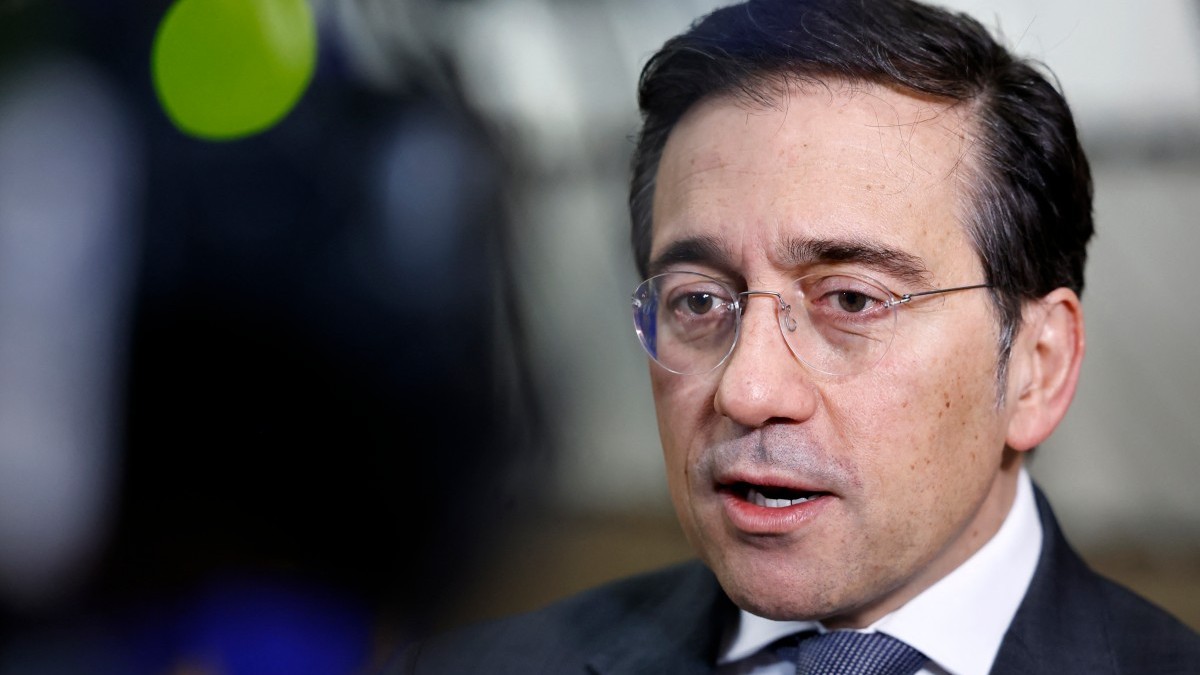
Spain’s Foreign Minister José Manuel Albares talks to journalists upon arrival ahead of a EU Foreign Affairs Council meeting at the EU headquarters in Brussels on January 29, 2026.
SIMON WOHLFAHRT / AFP
Spain’s Foreign Minister, José Manuel Albares, has joined a growing group of European leaders calling for a fundamental change to how the European Union makes decisions in foreign policy.
His remarks come after Hungary and Slovakia blocked a new package of sanctions against Russia and expressed the desire to veto a €90 billion financial package for Ukraine.
At the heart of the debate lies a core principle of EU governance: in key areas, such as foreign policy, all 27 member states must agree unanimously. Albares now suggests that this rule may need to change.
Unlike many national governments, the European Union does not operate as a single state. In sensitive areas—including foreign affairs, taxation, and enlargement—decisions require unanimity among all member states.
This rule was designed to protect national sovereignty and ensure that smaller countries are not overruled by larger ones.
In other areas, however, the EU already uses qualified majority voting (QMV), where decisions pass if supported by at least 55% of member states representing at least 65% of the EU population.
Moving foreign policy decisions to this system would significantly reduce the ability of individual countries to block collective action.
The current controversy centers on two issues. First, the EU’s proposed 20th package of sanctions against Russia, marking four years since the invasion of Ukraine. Second, a €90 billion financial support plan for Kyiv, including €60 billion in military assistance and €30 billion in macroeconomic support for 2026–2027.
Hungary and Slovakia withheld their support for the sanctions package, linking their position to concerns over energy supplies—particularly oil deliveries through the Druzhba pipeline. Hungary has also signaled it may block part of the Ukraine loan mechanism, since one key legal step requires unanimous approval.
Speaking during a visit to Kyiv this Tuesday, Albares argued that while unanimity has its place when “vital national interests” are at stake, it should not be used to prevent the majority of member states from acting.
He suggested that Europe must “take a step forward” in its sovereignty and independence—a shift that, in his view, includes moving foreign policy decisions to qualified majority voting.
His position aligns Spain with the European Commission and several large member states that argue the EU needs faster and more coherent decision-making in a volatile geopolitical environment. Supporters of reform contend that unanimity can paralyze the Union at critical moments. They argue that in a world shaped by major power competition involving the United States, China, and Russia, Europe cannot afford institutional deadlock.
Yet the issue goes far beyond the current conflict. The unanimity rule is embedded in the EU’s founding treaties. Changing it would require treaty reform—which itself demands unanimous agreement by all member states and ratification at national level.
In other words, any move to eliminate the veto would require the consent of the very countries that currently rely on it.
For countries like Hungary, the veto is not merely a procedural tool but a safeguard of national sovereignty within a supranational framework.