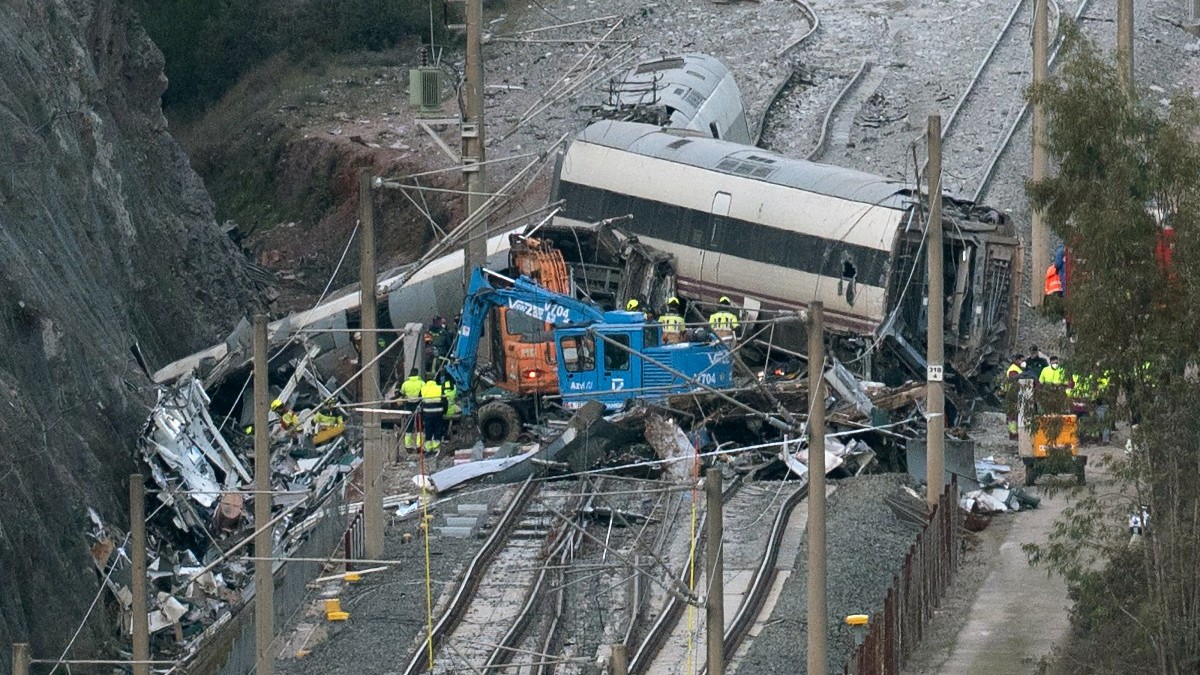
Emergency services and investigators work on the site of a high-speed trains collision that killed at least 42 people, in Adamuz, southern Spain, on January 20, 2026.
JORGE GUERRERO / AFP
More than €111 million in European Union funds, allocated to modernize one of Spain’s most important high-speed rail lines, remain partially unaccounted for. The money, granted by Brussels to renew the Madrid–Seville corridor, was intended to replace obsolete infrastructure identified by the EU itself as a safety and compliance risk.
Today, after a fatal train accident and official admissions that key works were never completed, the central question remains unanswered: where did the money go?
The funding in question—€111,646,340 from the EU’s Regional Development Fund (FEDER)—was approved in January 2024 following a European Commission report warning that the Madrid–Seville high-speed line was “obsolete” and no longer aligned with EU interoperability and Trans-European Transport Network (TEN-T) standards.
The diagnosis was explicit, and so was the remedy: urgent modernization to prevent precisely the kind of failure that later occurred.
According to the official project description submitted to Brussels, the funds were earmarked for the replacement of rails and sleepers, structural upgrades to bridges and tunnels, stabilization of embankments, and improvements to drainage systems. These were not cosmetic upgrades, but core safety interventions on a line carrying millions of passengers every year.
Yet following the deadly derailment near Adamuz on January 18th, which claimed 46 lives, the Spanish government acknowledged that not all the rails had been renewed. That admission alone undermines the integrity of the entire funding process. If a central element of the project was left unfinished, the execution of the EU grant is, at best, incomplete—and at worst, mismanaged.
Spain’s opposition has taken the issue to the European level. Members of the European Parliament from the opposition Partido Popular (PP)—Juan Ignacio Zoido, Borja Giménez and Esther Herranz—have formally asked the European Commission whether it intends to investigate the traceability of the funds and verify how they were actually spent.
Their argument is that the Commission approved the funding on the basis of specific, safety-critical works. If those works were not executed in full, Brussels has a legal and moral obligation to activate its audit and control mechanisms. So far, however, no formal investigation has been announced.
Doubts over the missing funds are no longer confined to one political group. Adelante Andalucía, a party to the left of Spain’s governing Socialists, has also demanded a full independent audit to clarify the destination of “every last euro.” Its leaders have openly questioned whether subcontracting practices and weak oversight allowed public money to be absorbed without delivering the required infrastructure improvements.
The controversy also feeds into a broader European debate. The government of Pedro Sánchez has been surrounded by corruption scandals and institutional tensions for years, yet continues to enjoy a notably cautious approach from Brussels. Critics argue that the EU’s response suggests a troubling double standard: corruption and mismanagement appear to matter less than political alignment.
While Brussels shows relentless vigilance on issues such as climate regulation, digital speech, or fiscal rules, it appears far more reluctant to confront failures involving infrastructure, public safety, and EU money when they implicate politically aligned governments.