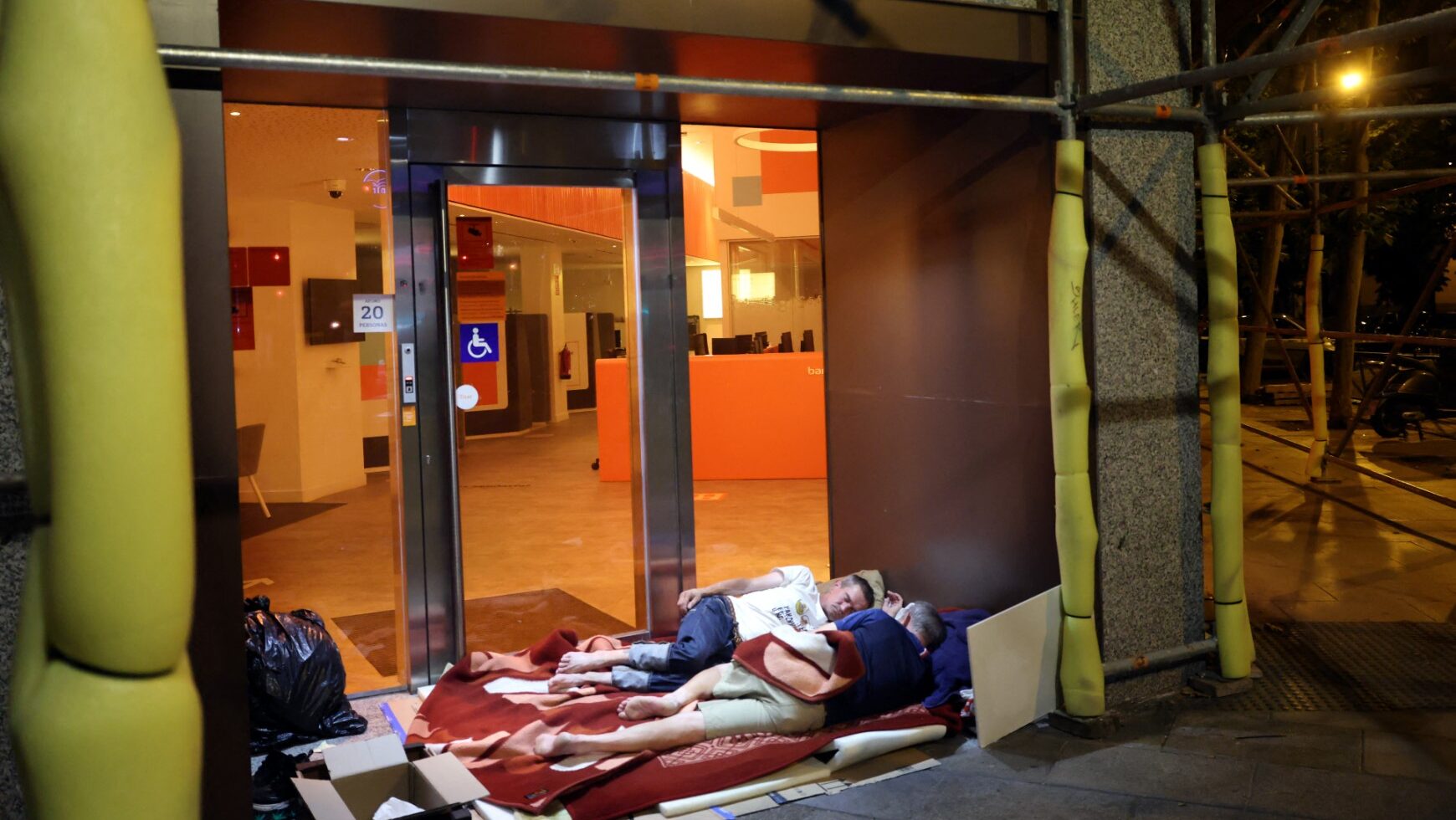
Two homeless people sleep on cardboard in the entrance of a Bankinter bank branch in Madrid, on July 10, 2025.
Thomas COEX / AFP
Spain is going through a multifaceted crisis of demographic, economic, and administrative tensions that is beginning to show visible signs of strain. Accelerated population growth, driven by massive immigration, coincides with a housing market incapable of absorbing new demand and with an extraordinary regularization policy that is already generating controversy in terms of security.
The result is a cocktail affecting housing, employment, and social cohesion, while Brussels announces its intention to tackle the housing crisis across the European Union.
The case of Madrid clearly illustrates the phenomenon. From December 2020 to June 2025, the region’s population has grown from 6.75 million to more than 7.16 million inhabitants: an increase of approximately 403,000 people in less than five years. In the last year alone, growth has been close to 100,000 people.
In that same period, barely 100,000 homes have been completed, around 13,500 of which were started in 2024 and finished in 2025. The imbalance between supply and demand is evident. The average price in the new southeastern developments does not fall below €400,000. To access a property at that price, at least €120,000 in savings is required to cover the down payment and associated costs—an almost insurmountable barrier for many young households.
According to appraisal data, housing prices in the province of Madrid have risen by nearly 20% over twelve months. The financial burden now reaches 43% of the average household’s disposable income in the region and 56% in the capital, well above the 30–35% threshold considered sustainable.
The concept of ‘affordable housing’ is thus called into question. What was supposed to be a safety net for working families has become an inaccessible product for a large segment of the middle class.
Population growth cannot be explained solely by birth rates or internal mobility. Immigration plays a central role in the recent demographic expansion. In recent years, Spain has defended a policy of reception without control or filtering, arguing labor needs and humanitarian commitments.
However, when the arrival of new residents exceeds urban planning and infrastructure capacity, tensions inevitably arise. The issue is not limited to housing but also affects public services, schooling, and healthcare—alongside peaceful and orderly coexistence.
In this context, the extraordinary regularization announced by the Socialist government—which will affect more than half a million people—introduces a new factor of uncertainty.
A recent report by the National Police, dated February 10th, warns of a significant increase in complaints regarding lost or stolen passports by undocumented foreign nationals. According to data comparing January 15-February 6 with the same period the previous year, such complaints have increased by approximately 60%.
In the case of Pakistani nationals, the increase exceeds 800%; among Algerians, more than 350%; and among Moroccans, more than 100%. Immigration units indicate that, in many cases, subsequent checks revealed police records or identities different from those declared.
The new regulation allows applicants to submit a sworn statement declaring that they have no criminal record if their country of origin fails to respond within the specified timeframe. This mechanism, designed to speed up procedures, has been criticized by police unions who warn of the risk of turning regularization into a lax process.
The matter at hand is not minor: until now, the burden of proving the absence of criminal records lay with the applicant, and exceptions were only considered under very specific circumstances. This new procedure amounts to an open door for many offenders who, in addition, will be able to move freely within the Schengen area.