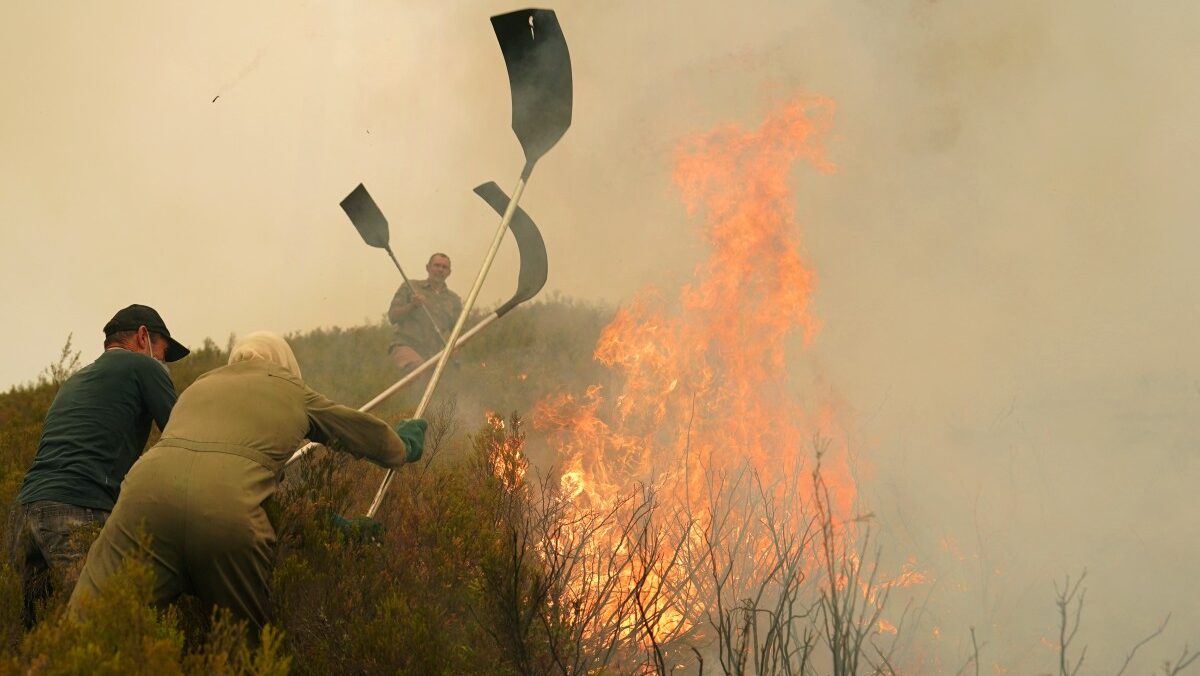
Residents use fire beaters to battle a wildfire in Colinas del Campo de Martin Moro Toledano in Iguena municipality, province of Leon, northwestern Spain on August 21, 2025.
Cesar Manso / AFP
Spain is burning this summer with hundreds of wildfires, tens of thousands of hectares devastated, and several fatalities. At the same time, the government and the opposition have turned the tragedy into a political battlefield. In just 48 hours, Fernando Grande-Marlaska, minister of the interior, and Alfonso Fernández Mañueco, president of the Junta of Castilla y León, have staged two appearances that reflect to what extent PSOE and PP prefer to point fingers at each other rather than acknowledge mistakes or assume shared responsibility.
On Thursday, August 28th, Marlaska went to the Senate to account for his ministry’s actions in managing the wave of fires affecting several communities in western Spain. His appearance, however, was marked by a combative tone against the Partido Popular. He devoted only a few minutes to describing the operation of the National Emergency Response Mechanism—which, according to him, “has worked perfectly”—and instead focused most of his intervention on accusing the PP of “fabricating a distorted version of reality” and of “masking their own management errors” by using the catastrophe for partisan purposes.
The minister insisted that responsibility for firefighting lies with the autonomous communities and stressed that the government had made “all requested resources” available to them, including international reinforcements. However, he did not clearly respond to opposition criticism, which reproached him for delaying the activation of national coordination, even though the Civil Protection Law allows him to declare a national emergency when fires affect several regions, as has happened this summer. He also did not clarify why the interior ministry sent emails requesting resources before officially receiving requests from Castilla y León, Galicia, and Extremadura.
On Friday, it was Mañueco’s turn in the regional parliament of Castilla y León. The regional president defended himself by saying his community had acted “from the very first moment” against the fires and that the firefighting force deployed was “the largest it has ever had.” Still, he acknowledged having faced a “perverse cocktail” of high temperatures, extreme dryness, strong winds, and, in many cases, the intentional action of arsonists. In response to criticism from the PSOE, which demanded his resignation and accused him of cutting resources for prevention and firefighting, Mañueco called for “raising the level of debate” and avoiding “noise, oversimplification, and electoral calculation.”
Meanwhile, the opposition in Castilla y León—from socialists to regionalists and smaller parties—holds him responsible for the scale of the tragedy and calls for a profound change in prevention policies. VOX, for its part, has pointed to the shared responsibility of PP and PSOE and questioned the absence of an effective national model for wildfire management.
While parties trade accusations, the fires have already ravaged more than 140,000 hectares in Castilla y León alone and forced the mobilization of resources from across Spain and several European countries. Political tension increases with every hectare lost, and the prospect of a state pact on wildfires or climate change seems more distant than ever.
With summer still ahead, the fires continue to spread, affected families await answers, and institutions remain entangled in a constant exchange of reproaches. Spain burns, and the political debate blazes at the same pace as the forests.