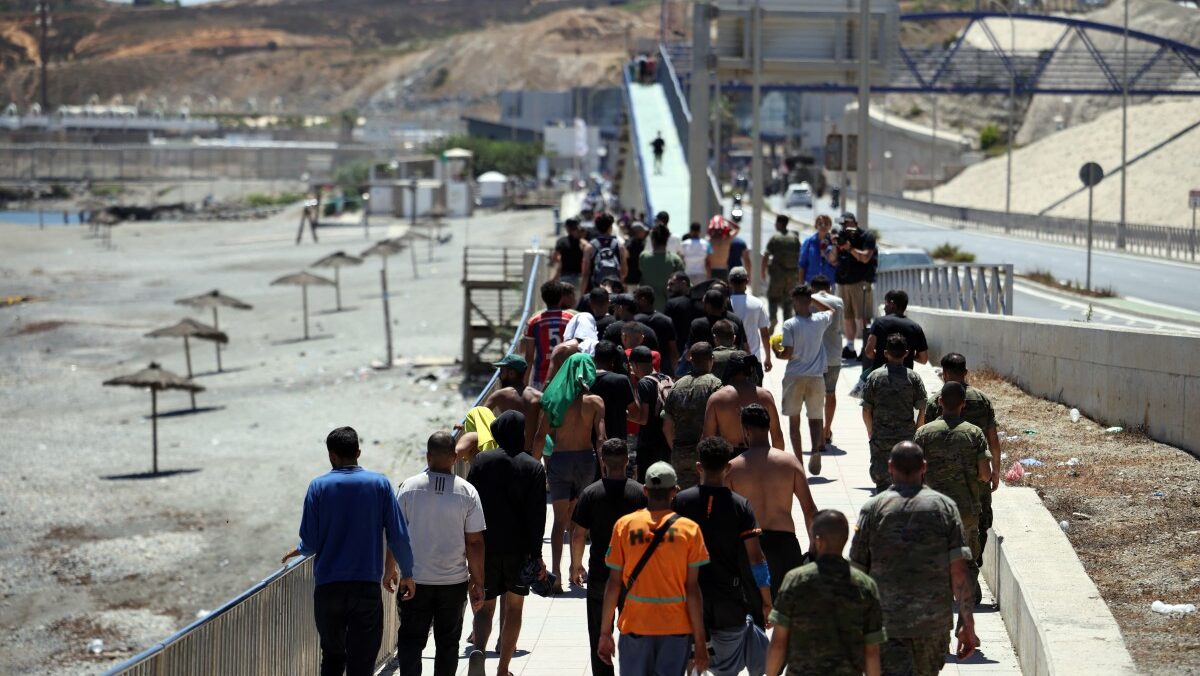
Pedro Sánchez is reportedly preparing to summon three senior ministers for crisis talks as a damaging row over whether his government ignored advance warnings of the mass breach of Spain’s border at Ceuta deepened on Wednesday.
The Spanish prime minister is expected to meet Interior Minister Fernando Grande-Marlaska, Defence Minister Margarita Robles and Foreign Minister José Manuel Albares at La Mareta, the state residence in Lanzarote where he is spending his summer holiday, according to La Razón.
The meeting comes amid growing tensions between the Interior and Defence ministries over what the National Intelligence Centre (CNI) knew before tens of thousands of migrants entered Ceuta, a Spanish territory in North Africa bordering Morocco, last week.
CNI sources told La Razón that the interior ministry was warned “with sufficient time” and that intelligence notes had been prepared. The agency reportedly identified several WhatsApp groups promoting the crossing by July 22—eight days before the influx began—including one named “Crossing to Ceuta or death.”
Grande-Marlaska has repeatedly insisted there was “no report, no warning” of anything resembling the eventual surge. Robles, whose department oversees the CNI, has publicly defended the intelligence service while noting that other information agencies answer to Interior.
The dispute has undercut Grande-Marlaska’s efforts to portray the response as a success after Spain said around 70,000 of approximately 72,000 arrivals had returned to Morocco.
Madrid has meanwhile urged its European allies not to blame Rabat publicly, Euractiv reported. Grande-Marlaska said there did not “necessarily have to be anyone to blame”, despite a Western government source saying Morocco was believed to have at least tacitly approved the surge as a political warning to Spain.
German Chancellor Friedrich Merz has called on Morocco to take back the migrants, but Ursula von der Leyen instead proposed more EU financial support for Rabat while warning against the weaponisation of migration without naming the kingdom.
Spain’s reluctance to confront its neighbour comes as ABC reported that Morocco has spent or committed at least $2.1 million on lobbying and public relations in Washington since January 2025. The campaign has presented Rabat to Republicans as a crucial partner on migration, terrorism, Israel, and regional security.
The Trump administration has blamed the Ceuta crisis on Sánchez’s pro-migration policies rather than on Morocco. Madrid has mounted no comparable lobbying campaign, according to ABC.
Security concerns are also growing. Euronews said Spanish media had reported that at least a dozen people previously arrested, convicted and deported over jihadism-related offences had been identified among the arrivals. The claims have not been officially confirmed.
Police sources separately told La Razón that about 2,000 migrants remained concealed in Ceuta’s neighbourhoods and hills, with officers searching for potentially dangerous individuals before they could reach mainland Spain.
A further political battle has erupted over 826 young migrants stranded in Ceuta, where only 29 beds were reportedly available. Miguel Tellado, secretary-general of the conservative People’s Party, said regions controlled by his party would refuse to receive them and demanded their return to their countries of origin.
Despite reports of online calls for another mass crossing on August 15, Grande-Marlaska said no further reinforcement of Ceuta’s land or sea border was planned beyond previously announced maritime barriers.